
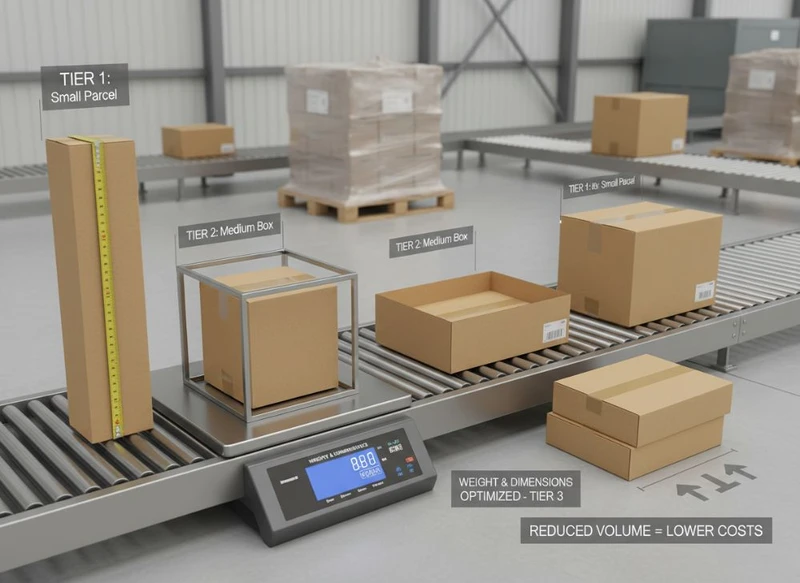
Custom paper box packaging can lower shipping costs when it removes unused space, reduces parcel weight and protects products well enough to avoid preventable replacements or returns. The biggest savings usually come from matching the carton to the product and the freight service’s measurement rules—not simply choosing the thinnest or cheapest board.
For Australian businesses, where delivery distances can make every parcel decision matter, packaging should be assessed as a total cost: box material, packing time, void fill, storage space, freight charges and the cost of damaged goods. These five core levers—right-sized dimensions, appropriate paper stock, close product fit, protective strength and flat-packed supply—are the starting point. The additional design choices below can further improve the outcome.
Optimising Dimensions to Meet Carrier Tiers
A box that is only slightly too large can cost more than expected. Many freight services consider both actual weight and parcel dimensions, so a lightweight but oversized carton may be charged at a higher rate than its contents suggest.
Start by measuring the packed product, not just the product itself. Include every component that must travel in the box, such as:
- Inner trays, tissue or protective wraps
- Instruction cards and promotional inserts
- Accessories, chargers or spare parts
- Tamper seals and closure depth
- Required clearance for fragile or pressure-sensitive items
Then create a practical packing allowance rather than automatically adding a large buffer. The objective is enough room for protection and efficient packing, without transporting air.
Dimension checks before approving a box
Ask your packaging and logistics teams to review:
- External dimensions – These affect freight calculations, pallet patterns and storage planning.
- Internal dimensions – These determine whether the product, inserts and protective elements fit consistently.
- Packed weight – Check the finished parcel, including tape, labels and all dunnage.
- Freight service thresholds – Confirm the current dimensional rules, maximum sizes and relevant rate tiers with the services you use.
- Stacking orientation – A narrow box may reduce material use but create unstable pallet loads or an unsuitable presentation.
A useful approach is to compare two or three proposed carton sizes against the real packed product. The smallest option is not necessarily best if it slows down packing or creates a higher risk of crushing. The right option is the smallest reliable format that works with your fulfilment process.
Choosing Lightweight Yet Durable Paper Stock
Reducing packaging weight can contribute to lower freight costs, but paperboard must still withstand handling, stacking and the journey conditions relevant to your product. Under-specifying the board can lead to bent corners, crushed panels, burst seams or insufficient protection—problems that can cost more than the material saved.
The practical choice depends on the box style, product weight, product shape, pack configuration and intended route. For example, a lightweight folded carton for cosmetics has different needs from a corrugated mailer carrying glassware or multiple units.
| Packaging need | Potential paper packaging approach | What to assess before choosing |
|---|---|---|
| Light, compact retail item | Folding carton or paperboard box | Product fit, closure security and shelf presentation |
| Direct-to-consumer dispatch | Corrugated mailer or shipper | Compression resistance, sealing method and dimensional efficiency |
| Fragile product | Corrugated outer box with fitted internal support | Product movement, drop risk and whether inserts replace loose fill |
| Premium gift presentation | Rigid-style paper box or reinforced gift box | Added weight, protective outer packaging and unboxing requirements |
| Multi-unit order | Purpose-designed larger carton | Load distribution, hand-pack speed and pallet configuration |
Paper stock decisions should be based on a sample of the actual product and packing method. A visually premium board may not be the most efficient dispatch solution, while a lighter material may perform well if the structure, folds and internal fit are designed properly.
When comparing quotes, avoid looking only at board thickness or unit price. Confirm the full box construction, paper type, finish, closure, internal components and whether the stated dimensions are internal or external. Those details affect both performance and freight cost.
The Role of Fit in Minimising Void Fill
Empty space inside a parcel often creates two costs at once: a larger freight footprint and extra void fill. When the product can move freely, staff may need to add paper, cushioning or other packing materials to stabilise it. That increases material handling time, parcel weight and the chance of inconsistent packing.
A better-fitting custom box can hold the product in a predictable position. Depending on the item, this may involve:
- Folded paperboard dividers
- Die-cut inserts
- Paper trays or collars
- Product-specific sleeves
- Compartments for multiple items
- Integrated holders for accessories or documents
For many products, an internal insert can reduce the need for loose packing material. It can also make the packing process simpler because the correct placement is built into the box design.
Fit does not mean an overly tight box
A very tight fit can create different problems. It may scuff printed surfaces, make unpacking frustrating, prevent product variations from fitting or slow down warehouse teams. Fragile items also need controlled clearance for protective elements.
Aim for restrained fit: enough space to protect the product, but not enough for it to shift substantially during normal handling. Test the final pack with the intended closure and any outer transit carton, rather than judging the product box in isolation.
If your products vary in size, consider a small family of standardised custom box sizes rather than one oversized carton intended to suit everything. This can reduce void fill while keeping inventory manageable.
Reducing Damage Rates with Stronger Boxes
A damaged shipment is rarely just a packaging issue. It can create replacement-product costs, extra freight, customer service work, stock write-offs and disruption to the customer experience. A stronger, better-designed paper box may therefore reduce total shipping-related expenditure even when its unit cost is higher.
Strength should be targeted to the points where the pack is most likely to fail:
- Corners and edges that can crush in transit
- Seams and closure flaps that may open
- Panels exposed to stacking pressure
- Internal components that allow products to collide
- Heavy items that can break through a weak base
- Moisture-sensitive products or paper finishes
Match protection to the shipping journey
Consider whether the box is a retail presentation pack, a postal mailer, an inner box placed inside a shipper, or the only layer of transport protection. A gift box may look suitable for dispatch but still need a protective outer carton for longer or more complex journeys.
Before scaling up, inspect physical samples with the actual product inside. Check closure security, product movement, pressure points and the effect of any labels or tape. Where the goods are valuable, fragile or unusually shaped, undertake handling tests that reflect your own packing and distribution conditions. Do not assume that a box suitable for one product or delivery route will suit another.
It is also worth documenting packing instructions. Even a well-designed box can underperform if teams use inconsistent void fill, omit an insert or orient products differently between orders.
Flat-Packed Paper Boxes for Storage Savings
Flat-packed paper boxes can reduce the space required to store empty packaging before use. For businesses with limited warehouse or retail backroom space, this may lower storage pressure and make stock handling easier.
A carton that arrives flat can be assembled when needed, rather than occupying space in its finished form. This is especially useful for folding cartons, mailer-style boxes and some gift packaging formats.
However, flat-packed supply is not automatically the lowest-cost choice. Consider the trade-off between storage efficiency and assembly time.
Questions to ask before selecting a flat-packed format
- How many seconds or minutes does assembly add to each order?
- Can the box be folded quickly and consistently without specialist tools?
- Is the design robust after repeated folding or hurried assembly?
- Does the box need tape, glue or additional labels to remain secure?
- Can fulfilment staff identify the correct size easily?
- Is a pre-assembled option more suitable for premium retail presentation?
For high-volume packing, a self-locking design may reduce handling steps compared with a carton requiring tape or separate fasteners. For lower-volume operations, a more detailed presentation box may still be worthwhile if brand appearance is a priority.
The best decision considers the cost of storage, the labour required to assemble each box and the reliability of the finished pack.
Negotiating Bulk Rates with Packaging Suppliers
Packaging buying decisions should not focus solely on the per-box price. Larger production quantities can sometimes improve unit economics, but ordering too much packaging can tie up cash, consume storage space and leave you with obsolete stock if product dimensions or branding change.
A more useful conversation with a packaging supplier covers the total specification and supply plan. For custom packaging boxes, provide clear information about your product size, expected order volumes, box style, printing requirements, storage constraints and how the box will be used in fulfilment.
Compare packaging quotes on a like-for-like basis
Use a specification sheet so each option can be assessed fairly. Include:
- Box style and final internal and external dimensions
- Paper or board construction
- Printing colours, finish and artwork requirements
- Inserts, dividers or other internal parts
- Flat-packed or assembled format
- Quantity per order and any minimum order requirement
- Sampling, proofing and approval process
- Packing configuration for delivery and storage
- Lead times and commercial terms to confirm before ordering
Ask whether a smaller number of shared box footprints can cover several SKUs. Standardising some dimensions may simplify purchasing and warehouse organisation, while still allowing different printed sleeves, labels or inserts for individual products.
Where product ranges change frequently, it may be sensible to separate the durable structural box from short-run branding elements. For example, a standard box combined with a custom printed sticker can support smaller design updates without discarding a large volume of pre-printed cartons. This approach needs to be assessed against presentation requirements and the labour of applying labels.
Designing Boxes for Automated Fulfilment
Packaging that works well at a packing bench may not suit automated or semi-automated fulfilment. If boxes are erected, filled, labelled, sealed or sorted using equipment, design consistency becomes a shipping-cost issue because jams, rework and hand intervention add time.
Even businesses without full automation can benefit from designing for repeatable handling. Clear folds, reliable locking tabs and consistent box orientation help staff pack accurately at speed.
Features that support efficient fulfilment
Consider whether the box design provides:
- Clearly defined folds and assembly sequence
- A secure closure that does not require unnecessary tape
- A predictable label application area
- Enough flat surface for handling and sorting
- Consistent dimensions across each production batch
- A structure that holds its shape before and after filling
- Easy access for product placement without damaging the pack
Avoid adding decorative structural elements that complicate assembly unless they serve a clear brand, protective or customer-experience purpose. A complicated unboxing design can be appropriate for selected premium products, but it may not be suitable as the standard shipping format for every order.
For gift-led products, consider separating presentation from transit protection. Custom gift packaging can create a stronger receiving experience, while an efficient outer mailer or shipper protects it through delivery. This two-layer approach adds material, so it should be justified by the product value, fragility and brand objective.
Reusable and Returnable Packaging Solutions
Reusable or returnable paper packaging can potentially reduce replacement-packaging demand in specific business models, particularly where products move repeatedly between known locations or customers return goods in the original pack. It is not a universal solution, however.
For a reusable design to work, the box needs to survive more than one handling cycle and remain easy to reseal. The return process must also be convenient enough that people actually use it. Otherwise, additional material and design complexity may not deliver a practical benefit.
When reusable packaging may be worth considering
Reusable or returnable formats may suit:
- Products with a planned return or exchange process
- Subscription or repeat-delivery models
- Business-to-business movements between regular locations
- Higher-value goods where a robust return pack is useful
- Products needing protective packaging for refurbishment or resale
Check the additional box weight, closure design, address-label management, hygiene requirements and reverse-logistics process before adopting this approach. For one-way deliveries of low-value products, a lightweight, recyclable paper box with efficient dimensions may be the more sensible choice.
Also verify the recyclability and material claims for the final specification in Australia. Coatings, laminations, adhesives, magnets, foils and mixed-material inserts can affect how a pack is handled after use. Environmental claims should reflect the actual materials and local collection options rather than assumptions.
A practical checklist before ordering custom boxes
Use this checklist to compare packaging concepts before committing to a production run:
- Measure the complete packed product and map likely box sizes.
- Check external dimensions and packed weight against your current freight arrangements.
- Identify where product movement occurs and whether an insert can remove loose void fill.
- Specify board strength around actual handling risks, not appearance alone.
- Compare flat-packed storage savings with assembly labour.
- Review how easily staff can erect, fill, close, label and stack the box.
- Test samples with the product, accessories and intended protective materials.
- Confirm artwork, dimensions, materials, finishes, quantity and supply terms in writing.
- Keep a record of damage, packing time and freight outcomes after launch, then refine the design if needed.
FAQ
What is the fastest way to reduce shipping costs with custom boxes?
Start with right-sizing. Measure the finished packed product, reduce unnecessary empty space and compare the external box dimensions with the dimensional charging rules of your freight services. This often reveals avoidable volume before changing materials or print finishes.
Should every product have its own custom box size?
Not always. A box for every SKU can increase purchasing complexity and storage needs. Many businesses benefit from a controlled range of box sizes, with inserts or dividers used to adapt the fit for related products. The right balance depends on order volume, product variation and freight sensitivity.
Is lighter paperboard always better for freight?
No. Lighter board can reduce parcel weight, but a box must remain suitable for the product and transport conditions. A box that crushes, opens or fails to protect the item can create higher total costs through damage and replacement shipments.
Can printed packaging still be efficient for e-commerce orders?
Yes. Keep printing purposeful and avoid design features that add size, weight or packing complexity without a clear benefit. A well-fitted, easy-to-assemble printed mailer can support brand presentation while remaining practical for dispatch.
The most cost-effective box is usually the one that fits the product securely, uses only the protection required and works smoothly in your packing operation. Review your current parcel dimensions and damage points first, then develop a clear brief for a suitable custom box specification. XGolden Print’s company information can help you understand its packaging and printing focus before discussing a project.
