
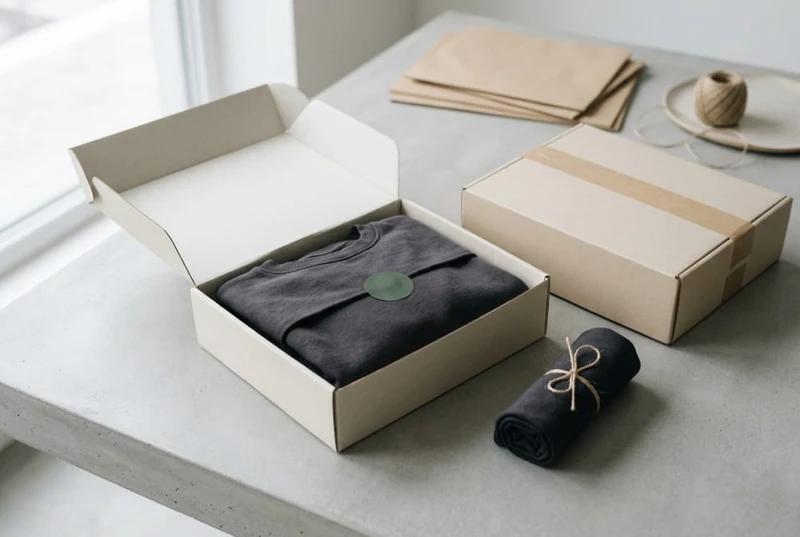
For apparel brands in Australia, packaging is no longer a final operational step. It shapes first impressions in boutiques, protects margins in wholesale channels, improves delivery outcomes for eCommerce, and helps customers decide whether a label feels polished enough to trust again. When clothing travels through retail displays in Sydney, warehouse distribution in Melbourne, or export handling near Brisbane and Fremantle, the right mix of custom boxes, inserts, tissue, sleeves, labels, and stickers influences merchandising, fulfilment speed, return rates, and customer reviews.
The best packaging system is not one box style used everywhere. It is a coordinated framework that changes by channel while keeping sizing clarity, brand cues, and product protection consistent. A folded knit sold through a boutique needs shelf appeal and easy browsing. The same knit shipped from an online store needs crush resistance, clean presentation after transit, and a returns process that feels simple. A coordinated set for gifting needs stronger structure, elevated finishes, and a more intentional opening sequence.
Across the Australia market, especially in fashion hubs such as Sydney, Melbourne, Brisbane, Perth, and Adelaide, apparel labels are also under pressure to balance sustainability claims with practical cost control. That makes packaging decisions more strategic than ever. Brands need solutions that communicate value, support campaign launches, and scale from small runs to larger replenishment programmes without making the range look fragmented.
Direct answer: how custom apparel packaging improves brand experience in Australia
Custom apparel packaging upgrades brand experience because it aligns presentation, handling, and communication across each sales channel. In boutique retail, packaging helps products look curated and easy to shop. In wholesale, it supports bulk handling, carton organisation, SKU accuracy, and retailer confidence. In online orders, it protects garments, adds excitement to unboxing, and reduces confusion during exchanges and returns.
A well-planned packaging setup normally combines outer boxes, internal folding supports or inserts, tissue or sleeves, garment information labels, and stickers used for sizing, security, campaign themes, and stock movement. For example, a private-label fashion brand might use rigid gift boxes for premium capsule releases, folding cartons for coordinated sets, sticker seals for launch drops, and simpler mailer-ready paper boxes for standard online orders. All of these can feel connected when colour palette, logo placement, typography, and finishing choices stay consistent.
Australian fashion businesses also benefit when packaging is developed with local transit conditions in mind. Deliveries moving between metro and regional areas, handling through courier networks, and warehousing in humid or hot conditions all place demands on board strength, coatings, adhesives, and insert stability. Brands that solve these details usually see stronger presentation on arrival, fewer damaged impressions, and better repeat purchase confidence.
Market overview: why packaging matters more in Australia fashion
The Australia fashion market includes boutique labels, marketplace sellers, direct-to-consumer brands, uniform suppliers, resortwear labels, department-store vendors, and private-label importers. Each segment needs packaging that does more than carry product. It must support merchandising, freight efficiency, sustainability goals, and campaign storytelling. In cities such as Melbourne and Sydney, where brand presentation is highly competitive, premium packaging can help a label stand out on shelf and online. In logistics corridors linked to Port Botany, the Port of Melbourne, and the Port of Brisbane, reliable packaging can also reduce handling issues in storage and transit.
Consumer expectations are changing as well. Customers increasingly notice whether apparel arrives neatly folded, protected from dust and creasing, and easy to return if sizing is wrong. Retailers also want packaging that does not waste display space or require excessive unpacking time. This is why many brands now split packaging into channel-specific tiers rather than trying to force one format across every order type.
For businesses comparing options, tailored solutions from a specialist custom box supplier for apparel packaging are often more effective than generic cartons. They make it easier to match garment dimensions, improve folding consistency, and keep branding cohesive from accessories to boxed clothing sets.
What changes between boutique packaging, wholesale packaging, and online order packaging
Boutique packaging focuses on presentation at the point of sale. Garments need to look clean, tactile, and easy to browse. Boxes for boutique retail are often designed for shelf storage or for handing over at checkout, with stronger emphasis on exterior finishes, tactile papers, refined logo placement, and quick-open structures. Inserts are usually lighter because the product is not travelling through parcel systems after merchandising. Sticker use may centre on discreet sizing, collection codes, or colour variants so staff can restock efficiently without cluttering the front presentation.
Wholesale packaging prioritises operational control. Retail buyers, distributors, and multi-store groups need consistent labelling, pack counts, style references, and barcoding. In this context, outer cartons, divider systems, and carton labels matter as much as the individual garment box. Packaging should stack well, protect products during pallet movement, and make store allocation straightforward. A wholesale program often uses simpler finishes but tighter print discipline, ensuring every SKU, size run, and seasonal code is easy to identify.
Online order packaging is built around transit performance and customer experience after delivery. Mailer-compatible apparel boxes, tear-strip openings, reseal options, insert cards, and order-verification stickers can all improve the experience. Because eCommerce orders may be shipped one at a time, packaging must balance cost efficiency with a quality feel. It also has to work for returns, especially in categories such as denim, dresses, and coordinated sets where fit-related exchanges are common.
Australian brands often use one visual language across all three channels but modify structure and specifications by use case. The logo, colour system, and message hierarchy stay consistent, while board thickness, insert type, sticker data, and shipping format vary according to handling requirements.
| Channel | Main goal | Typical box style | Sticker role | Key risk | Best packaging response |
|---|---|---|---|---|---|
| Boutique retail | Visual appeal and easy browsing | Folding carton or premium handover box | Size and collection markers | Visual clutter on shelf | Minimal front branding with clean side labelling |
| Department concession | Brand recognition in mixed retail spaces | Compact branded box with sleeve | Campaign or promotion tag | Blend into surrounding competitors | Distinctive finish and consistent colour coding |
| Wholesale packs | Accuracy and handling efficiency | Transit carton with internal sort packs | SKU, count, and destination details | Mis-picks and store allocation errors | Large readable labels and clear carton mapping |
| Online single orders | Protection and unboxing quality | Mailer-ready apparel box | Seal, order check, return guidance | Creasing or damage in transit | Stronger board and secure internal wrap |
| Online gift orders | Present-ready arrival | Rigid gift box or premium folding box | Gift message or seasonal seal | Gift presentation flattened in shipping | Protective insert and reinforced lid structure |
| Marketplace fulfilment | Fast processing and compliance | Standardised shipper box | Barcode and routing labels | Non-compliant packing flow | Unified print zones and compatible dimensions |
The table shows why one-size-fits-all apparel packaging tends to underperform. A boutique box can be too delicate for courier handling, while a wholesale carton can look too industrial for premium gifting. The solution is channel adaptation without visual drift.
Box and insert ideas for folded garments, accessories, and coordinated sets
Folded garments usually need structure that preserves shape while reducing bulk. Shirts, tees, knitwear, and lightweight dresses work well in folding cartons with tissue wraps, belly bands, or die-cut boards that maintain neat folds. If the apparel is premium or prone to shifting, a shallow insert tray can keep the garment centred and stop corners from collapsing. For heavier items such as denim or sweatshirts, slightly deeper boxes with reinforced side walls help prevent split corners.
Accessories need a different approach because jewellery, belts, scarves, caps, and small leather goods vary greatly in weight and fragility. Scarves can be wrapped around a presentation card and placed in slim boxes. Belts may use elongated boxes with internal channels. Caps often need dome-friendly depth or support inserts to hold shape. Small accessories benefit from partitions that stop movement during transport and reduce scuffing.
Coordinated sets, such as matching sleepwear, activewear sets, and gift-ready loungewear bundles, need packaging that presents multiple pieces as one complete purchase. The most effective options include two-tier inserts, layered tissue, ribbon channels, or branded cards explaining what is included. These details prevent pieces from looking like randomly packed stock and instead create a collected, premium arrangement.
For labels planning multiple product lines, integrating gift packaging for premium apparel collections into the wider range helps create a natural upgrade path. Instead of inventing a separate style language for gifting, brands can use the same colours and print system with sturdier board, better inserts, and upgraded finishing.
| Product type | Preferred box | Insert option | Why it works | Suitable channel | Branding note |
|---|---|---|---|---|---|
| Folded T-shirts | Shallow folding carton | Flat support board | Keeps fold crisp and presentation tidy | Boutique and online | Use size sticker on side panel |
| Knitwear | Medium-depth apparel box | Tissue wrap and fit insert | Reduces shifting and edge collapse | Online and premium retail | Soft-touch finish suits premium feel |
| Shirts | Classic shirt box | Collar support and fold board | Protects formality and retail presentation | Boutique and wholesale | Colour-coded sticker for fit type |
| Scarves | Slim rectangular box | Wrapped card mount | Creates neat reveal and less wrinkling | Gift and boutique | Foil logo works for festive drops |
| Belts | Long narrow box | Die-cut retention channel | Stops movement and buckle damage | Retail and online | Seal sticker adds security |
| Coordinated sets | Deep lid-and-base box | Layered insert or divider tray | Separates pieces and elevates value | Gift, launch, and premium online | Printed insert card explains full set |
This comparison shows that insert design is not decorative only. It directly influences garment stability, opening order, and how premium the set feels when the customer lifts the lid.
Gift-packaging options for premium collections, launches, and seasonal promotions
Gift packaging is most effective when it supports a specific commercial objective. For premium collections, it should reinforce craftsmanship and exclusivity. For launches, it should create recognisable campaign cues that customers can share online. For seasonal promotions, it should feel timely without making unsold stock unusable after the season ends.
Rigid boxes work well for premium collections because they add weight, structure, and perceived value. Magnetic closures, lift-off lids, and premium wraps can support higher price points for formalwear, capsule knitwear, and luxury accessories. Folding gift boxes are more cost-efficient for seasonal programmes, especially if a brand wants flat-packed storage before assembly. Sleeves and wrap bands are practical for launches because they can carry event-specific graphics while leaving the base box unchanged for future use.
Australian apparel brands launching around major retail peaks such as Christmas, Mother’s Day, wedding season, and resort travel periods often benefit from modular gift formats. A standard branded box can be upgraded with seasonal tissue, a campaign sticker, a printed insert, or a limited-edition sleeve. This avoids overcommitting to a highly specific box design that only works for one short promotional window.
Gift add-ons can include message cards, garment-care cards, thank-you notes, ribbon tabs, and premium seals. The key is restraint. Too many decorative elements can slow fulfilment and make the pack feel cluttered rather than elevated.
| Gift format | Best for | Relative cost | Storage efficiency | Perceived value | Notes for Australia market |
|---|---|---|---|---|---|
| Rigid lid-and-base box | Luxury capsules and VIP gifting | High | Low | Very high | Works well for premium launches in Sydney and Melbourne boutiques |
| Magnetic gift box | Premium online gifting | High | Medium | High | Strong for direct-to-consumer presents and influencer sends |
| Folding gift box | Seasonal promotions | Medium | High | Medium to high | Good for scalable Christmas and event campaigns |
| Box with printed sleeve | Launches and collaborations | Medium | High | High | Lets brands update graphics without changing core box stock |
| Tissue and seal upgrade | Entry premium orders | Low | Very high | Medium | Easy for broad online use across Australia |
| Ribbon-tab insert pack | Coordinated sets and gift bundles | Medium | Medium | High | Useful for boxed sleepwear and accessory pairings |
The practical takeaway is that premium gifting does not always require the most expensive box. It requires a format that suits the product, the campaign period, and the fulfilment method.
Sticker uses for sizing, campaign themes, brand seals, and drop management
Stickers are one of the most flexible tools in apparel packaging because they can add information and campaign relevance without changing the entire print run. In retail, size stickers help staff and customers identify garments quickly without unfolding every unit. In wholesale, carton stickers can identify styles, colourways, destination stores, and replenishment dates. In online orders, seal stickers can close tissue, confirm quality control, or indicate gift wrapping.
Campaign themes are another strong use case. Rather than printing a separate box for every launch, brands can use a standard box and add a seasonal or collection-specific sticker. This works especially well for resort drops, Valentine’s gifting, spring launches, and influencer kits. Branded seals can also support tamper awareness and make the opening feel more considered.
For drop management, sticker systems help internal teams track limited editions, pre-orders, and phased releases. Colour-coded or code-based stickers can distinguish first-release stock from restocks, separate online-exclusive units from boutique inventory, or identify premium packaging upgrades. This is useful when brands manage inventory across warehouses in Melbourne or third-party fulfilment centres serving national deliveries.
When selecting labels, many apparel businesses need a reliable sticker solution for sizing and campaign packaging that adheres well, removes cleanly where needed, and stays legible in warm storage and frequent handling.
How packaging affects returns, product reviews, and repeat customer perception
Apparel packaging affects returns in two major ways. First, it influences the condition in which customers receive garments. If the product arrives creased, dusty, misshapen, or with detached labels, customers may assume poor quality even when the garment itself is acceptable. Second, packaging affects how easy it feels to re-pack an item for exchange or return. A box that opens badly, tears during first use, or lacks a reseal option creates friction and can produce more negative customer feedback.
Product reviews are also shaped by presentation. Many reviews mention fit, fabric, and delivery, but customers often add comments such as “beautifully packaged”, “looked premium”, or “arrived messy”. These cues matter because they influence future shoppers who are comparing similar brands at similar price points. Strong packaging can support perceived value even before the garment is tried on.
Repeat customer perception is built through consistency. If one order arrives in a premium box and the next arrives in a generic mailer without explanation, the brand can feel unreliable. This is especially risky for private-label apparel businesses trying to move from transactional purchases to loyal repeat customers. Consistent packaging standards help customers recognise the brand and trust that quality control extends beyond the garment itself.
| Packaging factor | Effect on returns | Effect on reviews | Effect on repeat purchase | High-risk category | Recommended action |
|---|---|---|---|---|---|
| Poor fold support | Higher due to creasing concerns | Negative comments on arrival condition | Weakens trust | Shirts and dresses | Add support board and tissue wrap |
| Weak outer box | Higher due to transit damage | Complaints about crushed delivery | Reduces confidence | Premium online orders | Upgrade board thickness and edge strength |
| Unclear size sticker | Higher due to shipping wrong item | Comments on order error | Encourages switching brands | Fast-moving basics | Use clear, standardised sticker placement |
| No return-friendly structure | More service complaints | Mixed reviews despite good product | Weakens convenience perception | eCommerce apparel | Add reseal guidance or reusable box format |
| Inconsistent branding | Indirect but can increase hesitation | Less memorable unboxing feedback | Lower loyalty | Multi-category brands | Create channel rules and visual standards |
| Useful care inserts | Can reduce misuse-related returns | Supports positive detailed reviews | Improves perceived service | Knitwear and delicates | Include concise branded care card |
The explanation is simple: better packaging cannot fix sizing issues, but it can reduce avoidable dissatisfaction around handling, presentation, and convenience.
Material and finish choices that reflect different fashion positioning
Material and finish choices send immediate signals about where a fashion brand sits in the market. Uncoated natural paper stocks often suggest authenticity, sustainability, and understated style. Smooth coated boards can feel more polished and contemporary. Textured wraps add craftsmanship and tactile depth, especially for occasionwear or premium accessories. Soft-touch lamination can create a luxurious feel, while matte finishes often signal modern minimalism. Gloss can work for youthful, trend-driven labels but may look too commercial for quiet luxury positioning.
For Australia brands, material choice should also consider climate, storage, and logistics. Paper stocks that absorb moisture too easily may not perform well in fluctuating warehouse conditions. Adhesives and specialty finishes should be tested for transport across long distances, especially where parcels may move between coastal humidity and inland heat. Sustainable materials are increasingly important, but the claim needs to be realistic and backed by durable design rather than fragile packs that fail in use.
Different fashion positions usually align with different packaging styles. Contemporary basics often favour clean folding cartons with one-colour print and subtle stickers. Premium resortwear can justify textured paper, elegant inserts, and refined foil or embossing. Streetwear labels may use bold graphics, numbered seals, and drop-specific stickers. Children’s apparel can incorporate friendly colour systems and practical boxes that stack well for gifting.
Mistakes that make private-label apparel packaging look inconsistent
The most common mistake is changing too many things at once. When brands use one logo treatment for clothing boxes, another for accessory packaging, and a third for stickers, the range stops feeling unified. A second problem is inconsistent sizing communication. If one line uses printed side labels, another uses round stickers, and another uses hang tags only, the shopping and warehouse experience becomes confusing.
Another frequent issue is mixing finishes without a rationale. A matte minimalist box can sit awkwardly beside a glossy promotional sleeve and a heavily decorated gift sticker if there is no clear hierarchy. Structural inconsistency is also damaging. Accessories may arrive in oversized boxes, or premium collections may use inserts that do not match the garment fold. This creates waste, weakens perceived quality, and complicates packing operations.
Private-label apparel businesses also run into trouble when they source packaging from multiple vendors without shared specifications. Colour drift, logo placement changes, board variance, and inconsistent adhesive behaviour all become visible to the customer. This is one reason working with a workshop that can control print, box production, sticker output, and quality checks through one coordinated process is valuable. Advanced equipment helps with registration, cutting accuracy, and finish consistency, while experienced teams can inspect material performance before mass production.
How to keep packaging aligned across clothing, accessories, and boxed sets
Alignment starts with a packaging system rather than isolated designs. Brands should define a core visual toolkit made up of approved colours, logo positions, type rules, finish hierarchy, sticker styles, and message tone. Once that toolkit is set, it can be adapted for shirts, accessories, gift boxes, wholesale labels, and online mailer packs without losing recognition.
It also helps to create a structural family. For example, one brand might use similar corner radii, lid proportions, and logo placement across all apparel boxes even if depths vary by product. Accessories can then adopt matching side-panel treatment or internal card styles. Coordinated sets should look like a deliberate extension of the clothing line, not a separate packaging brand.
Manufacturing consistency matters as much as design consistency. Brands that need both small-batch customisation and larger production runs benefit from a packaging partner with flexible manufacturing capability, reliable inspection standards, and the ability to scale without changing the visual outcome. This is especially important in Australia where brands may start with seasonal boutique volumes and then expand into broader wholesale or national online distribution.
Product categories and buying advice for Australia apparel brands
Buying advice should begin with product grouping. Separate your packaging plan into folded garments, structured garments, soft accessories, boxed sets, and premium gift lines. This makes it easier to choose realistic dimensions, inserts, and finish levels. If your best sellers are lightweight basics, invest first in folding discipline, durable apparel boxes, and clear sticker systems. If gift sets drive peak-season revenue, prioritise stronger box formats and premium presentation components.
For wholesale-heavy brands, ask whether the packaging reduces handling time and stock errors. For direct-to-consumer brands, ask whether the packaging photographs well, protects the product, and supports easy returns. For multi-channel brands, review whether the boutique version and the shipped version look recognisably related.
When requesting quotes, specify board type, dimensions, finish, insert style, sticker application, target order quantities, and intended use. This helps suppliers recommend the right balance of cost and performance. It also reduces redesign cycles. Businesses dealing with launch timelines often benefit from a service team that can guide artwork setup, sample refinement, and quality control in one workflow rather than across separate vendors.
Industries, applications, and case-style examples
Apparel packaging is relevant across womenswear, menswear, childrenswear, activewear, resortwear, corporate uniforms, fashion accessories, and private-label retail collections. Applications range from shelf-ready boutique presentation to direct-to-consumer parcel fulfilment, influencer mailers, event gifting, subscription boxes, launch packs, and export-prepared wholesale consignments.
Consider a Melbourne sleepwear brand selling coordinated sets online and through selected boutiques. It may use a base apparel box for standard orders, then add printed tissue and a seasonal sticker for holiday gifting. A Sydney accessories label might use narrow boxes with retention inserts for belts and scarves, paired with colour-coded sizing or style stickers for staff. A Brisbane resortwear brand preparing launch kits for stockists could combine wholesale transit cartons with boutique-ready inner boxes to reduce in-store setup time. In each case, the packaging system supports both operations and brand presentation.
These examples show why apparel packaging should be viewed as part of merchandising and customer retention, not only logistics.
Australia supplier considerations and what to evaluate
When evaluating suppliers for the Australia market, compare more than unit price. Assess technical capability, print control, board and adhesive options, prototyping support, finishing consistency, and responsiveness during sampling. Brands serving premium retail channels may need close colour control and refined structural tolerances. Brands handling rapid launch cycles may value quick sample turnaround and flexible order planning.
Supplier comparison should also include service capability. A professional team that can advise on material selection, artwork adaptation, inserts, stickers, and final inspection reduces risk during rollout. This becomes increasingly important when packaging must stay aligned across apparel, accessories, and boxed gift sets.
| Evaluation factor | Basic supplier | Specialist packaging workshop | Why it matters | Best for | Risk if ignored |
|---|---|---|---|---|---|
| Structural sampling | Limited | Detailed and iterative | Confirms fit, fold, and transit performance | Premium apparel and sets | Poor box-product match |
| Sticker integration | Separate sourcing | Coordinated with box program | Keeps branding and data consistent | Multi-channel brands | Label mismatch and confusion |
| Finish accuracy | Variable | Better control | Protects premium visual identity | Boutique and launch packaging | Inconsistent brand perception |
| Production flexibility | Often quantity rigid | Supports small and larger runs | Useful for seasonal testing and scale-up | Growing labels | Overstock or missed opportunities |
| Inspection process | Basic final check | Material-to-finish oversight | Reduces print and assembly defects | All categories | Higher rework and complaints |
| Service support | Transactional | Advisory and responsive | Improves decision making and rollout timing | Private-label programmes | Slow revisions and avoidable errors |
The explanation here is that apparel packaging succeeds when production, finishing, and service are coordinated. The lowest quote can become expensive if inconsistency causes delays or reorders.
Our company approach for Australia brands
For apparel brands needing consistent custom boxes, gift packaging, and stickers, our approach is built around three strengths. First, on technological capability, our workshop uses advanced production equipment to maintain cleaner print results, accurate cutting, and better repeatability across gift boxes, paper boxes, and label formats. This supports apparel programmes where visual consistency matters from boutique shelves to shipped orders.
Second, on manufacturing capability, we support both small-batch customisation and larger production volumes, which is important for Australia fashion brands testing a new collection, managing a seasonal launch, or scaling a proven line. Careful material selection, controlled production flow, and final inspection help ensure the packaging performs as expected for different product types and channels.
Third, on service capability, our team works closely with clients to refine specifications, align packaging with the intended garment range, and deliver flexible solutions rather than generic stock formats. That means helping brands match box structure, inserts, finishes, and stickers to commercial goals such as gifting, retail presentation, wholesale handling, or eCommerce efficiency.
2026 trends shaping apparel packaging in Australia
Looking toward 2026, apparel packaging in Australia is being shaped by three strong forces: technology, policy, and sustainability. On the technology side, more brands are adopting variable data labels, QR-linked care and return information, and smarter campaign coding that allows one core box format to support multiple launches. This reduces waste and improves stock visibility. Packaging prototypes are also being refined faster through digital proofing and more precise sampling methods.
On the policy side, businesses are paying closer attention to packaging reduction targets, recyclability expectations, and clearer environmental claims. Claims such as recyclable, plastic-reduced, or responsibly sourced need to be credible and matched to actual use conditions. Overstated sustainability messaging can damage trust.
On the sustainability side, brands are moving toward lighter but stronger board choices, fewer mixed-material components, and packaging systems that allow premium presentation without unnecessary excess. The likely direction for 2026 is not plain packaging by default. It is smarter packaging: more modular, more traceable, easier to recycle, and more efficient across channels.
Market charts and demand patterns
The following charts illustrate realistic market direction for apparel packaging demand in Australia, with a focus on channel growth, category demand, trend shifts, and supplier-value comparison. These visuals help brands understand where investment is likely to create the strongest commercial return.
Frequently asked questions
Do apparel brands in Australia need different boxes for retail and online orders?
Usually yes. The visual identity can stay the same, but the structure should change to suit shelf display versus courier transit.
Are stickers enough to create seasonal packaging?
For many campaigns, yes. A seasonal sticker, tissue colour, or printed sleeve can refresh packaging without replacing the full box design.
What is the best packaging for folded garments?
A shallow or medium-depth apparel box with tissue and a support board is a reliable option for many folded garments, especially shirts, knitwear, and tees.
How can private-label brands avoid inconsistency?
Set a visual standard, use defined sticker rules, standardise structural proportions, and work with a supplier that can coordinate boxes and labels together.
What matters most for premium gift packaging?
Structure, material feel, and opening sequence matter more than excessive decoration. Premium should feel intentional, not overloaded.
Final guidance for apparel brands selling through shelves and shipping cartons
For Australia apparel brands, the smartest packaging strategy is a flexible one: consistent in visual identity, different where channel demands require it, and disciplined in materials, inserts, and sticker use. Boutique packaging should support browsing and display. Wholesale packaging should support order accuracy and handling. Online order packaging should protect garments, improve unboxing, and simplify returns.
Boxes, inserts, and stickers all contribute to that result. When chosen well, they improve presentation for folded garments, accessories, and coordinated sets; support premium gift launches; keep campaign management organised; and strengthen repeat customer perception. When chosen poorly, they create inconsistency, confusion, and hidden costs. Brands that treat packaging as part of the product experience, not just a shipping requirement, are better positioned to grow across retail and eCommerce channels in Australia.
