
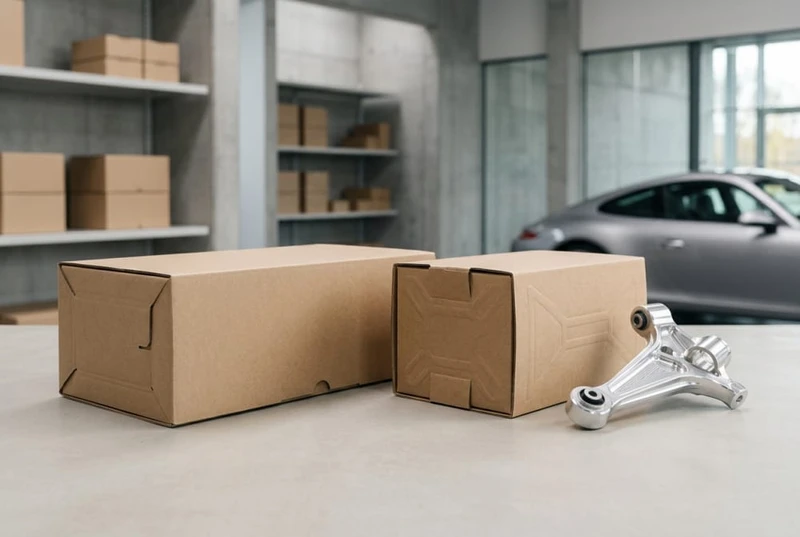
Automotive parts move through a supply chain that is harder on packaging than many buyers expect. Cartons are lifted repeatedly, routed through metro depots in Sydney and Melbourne, stacked for linehaul to Brisbane, Adelaide and Perth, and sometimes held in regional warehouses before final delivery. In that environment, packaging is not just a box. It is a handling system, an identification system, a storage system and a damage-prevention tool. For Australian aftermarket and OEM supply chains, the best packaging reduces movement, keeps multi-part kits complete, limits grease leakage, prevents scratches on coated metal, and helps warehouse staff read and pick the right SKU quickly.
That is why many distributors, importers, parts brands and workshop suppliers now invest in custom box solutions for automotive parts rather than relying on generic cartons. A box designed around the shape, weight and service use of the component creates better fit, stronger stacking performance and more accurate inventory handling. When matched with well-designed part identification stickers, the result is fewer picking errors, fewer transit claims and fewer avoidable returns caused by damage, missing pieces or compatibility confusion.
In Australia, these gains matter because automotive parts often travel long distances between ports, national warehouses, dealer networks, independent workshops and retail shelves. Goods entering through Port Botany, the Port of Melbourne, Fremantle or the Port of Brisbane may pass through several transport stages before the end user opens the package. If the packaging system is weak at any stage, the part can shift, rub, leak, deform or become separated from hardware and instructions. A stronger packaging structure protects margin while also improving customer confidence.
This guide explains how automotive parts packaging should be planned for sensors, filters, repair kits, brake parts and service components; which inserts reduce movement and scuffing; how stickers support storage logic and warehouse accuracy; why retail packs differ from workshop and bulk distribution packs; and how growing brands can standardise packaging across a wider product range without creating catalogue confusion.
Packaging requirements for sensors, filters, repair kits, brake components, and service parts
Different automotive parts fail in different ways, so they should not be packed under a one-style-fits-all approach. Sensors and electronic modules are usually light but vulnerable to impact, dust, static and connector damage. Filters need shape protection and clean presentation, especially when gaskets or seals are packed together. Brake components can be heavy, abrasive and rust-sensitive. Service parts may be small, numerous and easy to lose if internal organisation is poor. Repair kits are especially challenging because several individual pieces must arrive together in the right combination.
For sensors, the most common packaging mistakes are oversized cartons, poor connector protection and labels that do not clearly distinguish similar fitments. In a warehouse with thousands of SKUs, oxygen sensors, ABS sensors and pressure sensors may share similar box sizes. Without sharp product coding on the outer label and a snug insert inside, handling mistakes become more likely. Internal card platforms, folded partitions or pulp-fit nests help suspend the sensor body and stop connector pins from taking impact loads.
Filters call for a cleaner, crush-resistant approach. Air filters need face protection so pleats do not compress during stacking. Oil and fuel filters may need internal separation from accessory items such as O-rings or washers. For Australian supply chains, humidity shifts between coastal ports and inland storage also make board choice important. If the carton loses rigidity, the filter can deform and appear old or mishandled on arrival.
Brake pads, discs, caliper service kits and related components create a different challenge. Weight and edge abrasion matter more than presentation alone. Friction surfaces should be isolated from unnecessary rubbing. Coated discs and machined parts benefit from wraps, pads or sleeves that stop metal-to-metal contact. Greasy service kits, meanwhile, need containment so lubricants do not migrate into the carton or onto adjacent stock in a workshop shelving bay.
Repair kits, from suspension bush sets to water pump service kits, deserve a packaging structure that reflects assembly logic. Users should open the box and immediately identify each item rather than sorting through a mixed cavity. If fasteners, seals and instructions are loose, the perceived quality of the kit drops and the risk of lost parts increases. For brands supplying workshops in busy trade environments, internal sequencing becomes almost as important as outer protection.
| Part type | Main packaging risk | Recommended structure | Label focus | Common distribution channel | Expected result |
|---|---|---|---|---|---|
| Sensors | Connector impact and fitment confusion | Close-fit carton with cavity insert | Part number, connector type, vehicle range | Aftermarket retail and workshop supply | Lower damage and fewer picking errors |
| Air filters | Pleat crushing and carton compression | Rigid carton with face support | Dimensions, engine family, stock code | Retail shelf and national distribution | Better shape retention on arrival |
| Oil filters | Dent damage and accessory loss | Compact carton with accessory sachet area | Thread size, height, compatibility | Workshop and service counter | Cleaner presentation and complete kits |
| Brake pads | Edge wear and mismatched SKUs | Strong board with dividers or sleeves | Axle position, pad shape, batch details | Workshop and wholesale | More accurate fitment control |
| Repair kits | Missing small parts in transit | Partitioned custom box | Kit contents, variant code, instructions | E-commerce and workshop supply | Fewer incomplete deliveries |
| Service components | Mixed storage and misidentification | Standard carton family with insert options | SKU, location code, barcode | Warehouse replenishment | Faster receiving and picking |
The table shows why packaging should begin with part behaviour, not just carton cost. A low-cost generic carton may look efficient at purchase stage, but if it increases damages, slows picking or causes workshop complaints, the total landed cost rises quickly. In practice, the strongest systems classify parts by fragility, weight, contamination risk, surface sensitivity and SKU complexity before selecting a packaging structure.
Insert options that minimise movement, surface damage, and avoidable returns
Internal movement is one of the biggest reasons parts arrive looking used, incomplete or unfit for sale. Even when the outer carton survives transport, a component that shifts repeatedly inside can suffer scratched coatings, damaged tabs, chipped edges or broken plastic housings. Inserts solve this by controlling how the part sits in the pack and how forces are distributed during handling and stacking.
For light electronics and precision components, folded paperboard inserts are often a practical choice because they hold shape, separate fragile areas and are efficient for larger production runs. For heavier or awkward parts, die-cut corrugated cradles can absorb impact while keeping the item centred. Moulded pulp can also work well where a more contoured fit is needed and sustainability targets are part of the packaging brief for 2026 and beyond.
Inserts also reduce returns that are not caused by actual product faults. A scratched sensor body, a disc brake rubbing against hardware, or a seal kit with mixed contents may be returned as “damaged” or “incorrect” even when the core part is technically usable. Better internal restraint lowers that return rate and protects brand credibility with distributors and workshops.
Australian freight conditions make vibration resistance especially relevant. Linehaul routes between capital cities and regional centres can expose cartons to long periods of vibration and repeated transfers. A good insert design does not simply fill empty space; it locates the part so it cannot gain momentum. This is especially valuable for coated, painted or precision-machined surfaces that show visible wear quickly.
| Insert type | Best for | Strength | Limitation | Typical use case | Return reduction effect |
|---|---|---|---|---|---|
| Folded paperboard insert | Sensors and small service parts | Clean presentation and accurate positioning | Less suitable for very heavy items | Retail boxed electronics | Reduces connector and housing damage |
| Die-cut corrugated cradle | Brake parts and medium-weight kits | High shock control and stacking support | Takes more internal box volume | Workshop distribution packs | Reduces impact and scuff claims |
| Moulded pulp insert | Fragile and shaped components | Good contour fit and sustainability profile | Tooling required for custom shapes | OEM and export programmes | Reduces movement in transit |
| Partition grid | Multi-component repair kits | Keeps items separated and countable | May require manual packing | Seal, clip and fastener kits | Reduces missing-piece complaints |
| Paper wrap plus pad | Coated metal parts | Surface protection at low cost | Limited restraint without extra support | Discs, brackets and machined items | Reduces cosmetic return reasons |
| Suspension insert | Precision sensors and modules | Isolates sensitive points from shock | Higher design complexity | Premium electronic parts | Reduces hidden impact damage |
The table highlights that inserts should be selected according to both mechanical risk and business model. A retail-facing carton benefits from a clean opening experience and strong presentation. A workshop carton may prioritise protection, stack strength and speed of pack-out. In either case, internal restraint directly affects customer perception and warranty administration.
Our packaging workshop supports this process with advanced converting machinery and a technical team that can develop inserts around the actual dimensions and vulnerability points of the part. That matters when standard inserts leave connectors exposed or allow hardware bags to move into contact with painted or plated surfaces. By refining the internal layout during sampling, transit issues can often be resolved before large-run production begins.
How stickers support part numbers, compatibility checks, storage systems, and warehouse accuracy
For automotive parts, a sticker is not a decorative extra. It is often the fastest and most important information layer in the packaging system. In busy warehouses across Australia, pickers rarely have time to inspect product details beyond the front-facing label. If part numbers are hard to read, barcodes are inconsistent, or compatibility notes are missing, the risk of stock errors rises immediately.
Well-designed stickers should present the core part number, alternate references where needed, barcode, batch or lot number, key vehicle compatibility details, storage location logic and handling alerts. For example, “left/right”, “front/rear”, “with ABS”, “diesel only” or “contains gasket set” can eliminate a surprising number of human errors. The more similar the products look on shelf, the more important fast visual differentiation becomes.
Sticker systems also help organise inventory across multiple storage environments. Retail shelves may require consumer-friendly naming and cleaner branding. Trade counters need fast fitment references. Bulk warehouse cartons often need larger barcodes, outer case quantity information and pallet-friendly orientation. A good label strategy allows the same product family to carry different information layers without losing master SKU consistency.
For companies scaling across aftermarket and OEM channels, labelling discipline reduces catalogue confusion. When the inner pack, outer carton, shipping label and system SKU all use slightly different naming conventions, errors spread from receiving through to customer service. Standardised stickers help connect physical inventory to ERP data, online listings and workshop ordering processes.
| Sticker element | Purpose | Who uses it most | Typical location | Error prevented | Operational benefit |
|---|---|---|---|---|---|
| Primary part number | Core SKU identification | Warehouse and workshop staff | Front panel | Wrong item picked | Faster scan and confirmation |
| Barcode or QR code | System matching and traceability | Receiving and dispatch teams | Side panel | Manual entry mistakes | Quicker inventory updates |
| Compatibility note | Vehicle/application guidance | Trade counter and technician | Front or top panel | Fitment returns | Better order confidence |
| Location code | Shelf and bin logic | Warehouse picker | Large outer label | Mis-slotting in storage | Higher pick accuracy |
| Batch or lot number | Traceability and QA control | Supplier and warranty team | Secondary label | Unclear product history | Cleaner recall management |
| Handling warning | Special storage or handling | Freight and store staff | Visible outer face | Damage during movement | Improved stock condition |
The table demonstrates that labels carry operational value at every stage, from receiving to fitment. In Australian distribution networks where parts may pass through multiple facilities, consistent sticker use helps preserve data integrity even when the same item is sold through retail, trade and e-commerce channels.
Our service team regularly works with clients to align sticker content, print sequencing and carton placement so packaging supports warehouse flow rather than complicating it. That includes flexible small-batch runs for new product launches and large-scale production for established lines, which is useful for brands expanding range depth across several vehicle platforms.
Retail packaging versus workshop, service, and bulk distribution packaging
Retail packaging and workshop packaging often serve different commercial goals, even when the same part is inside. Retail cartons need stronger shelf visibility, cleaner graphics, easy recognition and often better tamper resistance. Workshop packs focus more on durability, speed of identification and efficient handling in trade environments. Bulk distribution packaging prioritises cube efficiency, pallet stability and outer case labelling for fast replenishment.
For example, a sensor sold through an auto parts retail chain in Melbourne may need a more polished external finish, stronger branding and a clearer consumer-facing compatibility statement. The same sensor supplied in volume to service workshops in Western Sydney may be better served by a more compact carton with a large barcode, bold SKU display and less wasted air space. A master carton for interstate distribution to Perth or Darwin then needs another layer of engineering for stacking strength and internal count control.
The difference matters because over-packaging a workshop item adds cost without adding operational value, while under-packaging a retail SKU can damage brand perception. Packaging should match how the product is bought, stored, displayed and opened. The most efficient systems are tiered: the inner box supports the product and user, while the outer shipper supports freight, warehousing and replenishment.
| Packaging channel | Main priority | Design emphasis | Label style | Board strength need | Typical Australian use |
|---|---|---|---|---|---|
| Retail shelf | Visibility and confidence | Branding and clean presentation | Consumer-friendly fitment guidance | Moderate to high | Auto accessory stores |
| Workshop counter | Speed and accuracy | Compact format and quick opening | Large SKU and barcode | High | Trade parts supply |
| Service kit supply | Completeness and organisation | Internal partitions and contents map | Kit code and count details | High | Maintenance programmes |
| Bulk wholesale case | Pallet efficiency | Outer case stacking performance | Case quantity and bin code | Very high | National DC replenishment |
| E-commerce dispatch | Damage control and returns reduction | Cushioning and tamper awareness | Order and scan labels | High | Direct-to-consumer parts sales |
| OEM service network | Traceability and consistency | Standardised format | Serial, lot and dealer coding | High | Dealer workshops |
This comparison shows why packaging should be specified by channel rather than assumed to be universal. Businesses with mixed route-to-market strategies benefit from a packaging matrix that defines what changes between retail, workshop and wholesale formats while keeping the product family visually consistent.
The line chart illustrates a realistic upward demand trend as Australian automotive supply chains place more emphasis on e-commerce resilience, inventory accuracy and damage prevention. Growth is driven not only by volume but by rising expectations for packaging performance and traceability.
How custom boxes keep multi-part repair kits complete during transit
Multi-component repair kits have one of the highest risks of avoidable dissatisfaction because every lost clip, bolt, seal or bracket creates a perceived product failure. Even if the main part arrives intact, an incomplete kit can stop a workshop job and trigger urgent replacement requests. That costs more than a simple carton claim because it disrupts labour scheduling and customer vehicle handover.
Custom boxes solve this problem by giving each component a defined position. Instead of combining all items loosely in one cavity, the pack can use partitions, folded retainers, accessory chambers or layered trays. This allows both the shipper and the receiver to confirm completeness quickly. It also reduces internal collisions between heavy and light parts.
For example, a brake hardware kit can separate clips, springs, shims and lubricants so metal edges do not cut smaller sachets. A timing service kit can organise belts, seals and instructions in a way that mirrors installation workflow. Suspension repair kits can stop bushes or metal sleeves from moving into contact with coated parts. In each case, the packaging acts as a parts-management tool as much as a transport container.
This is particularly valuable for Australia’s dispersed market. A missing item may be easy to replace in inner Melbourne or Brisbane, but far more disruptive for workshops in regional Queensland, the Northern Territory or remote Western Australia. Complete first-time delivery matters more when resupply lead times are longer.
The bar chart shows that repair kits and brake components usually require the highest packaging control because they combine completeness risk with physical movement risk. Businesses selling complex service kits should therefore treat internal layout as a core design decision, not a finishing detail.
Our manufacturing capability is built around this kind of precision work. With modern box-making and finishing equipment, we can produce both short-run customised kit boxes and larger production volumes with repeatable dimensions, insert placement and label application logic. That consistency helps clients maintain kit integrity across repeat orders and seasonal demand spikes.
Material selection for fragile, heavy, oily, or unusually shaped automotive parts
Material choice should follow product behaviour, freight profile and storage conditions. Lightweight paperboard may suit some sensor boxes, but it is not the right answer for heavy brake hardware or oily mechanical components. Corrugated grades, liner quality, coating choices and inner wraps all influence how the packaging performs in real transport conditions.
Fragile parts need materials that protect from shock without creating dust or abrasion. Heavy parts need stronger corrugated board, reinforced corners or tightly fitted inserts to stop breakthrough and edge crush. Greasy parts may require barrier wraps, leak-resistant liners or separated accessory packs so oil or lubricant does not stain the carton. Oddly shaped parts often need custom die-cuts or engineered void control rather than simply moving to a larger box.
Australian climate and freight exposure should also shape material choice. Goods can pass from humid port environments to dry inland storage, or from summer heat in Brisbane to cooler southern conditions. Board performance, adhesive reliability and label readability should all be considered over the actual route, not just at the packing bench.
| Material option | Best suited part type | Key advantage | Main concern addressed | Typical packaging format | Why it matters |
|---|---|---|---|---|---|
| Solid paperboard | Light sensors and boxed service items | Clean print finish | Retail presentation | Small branded cartons | Supports shelf appeal and labelling clarity |
| Single-wall corrugated | Filters and medium-weight items | Balanced cost and strength | Compression in storage | Trade cartons | Protects shape during warehouse stacking |
| Double-wall corrugated | Brake parts and heavy kits | Higher load resistance | Transit impact and stacking load | Workshop and wholesale packs | Prevents carton failure on long routes |
| Barrier paper or wrap | Greasy or coated parts | Surface and leak protection | Oil migration and scuffing | Inner protective layer | Keeps cartons clean and saleable |
| Moulded pulp | Fragile shaped components | Custom contour support | Movement and point impact | Insert trays | Improves restraint with lower plastic reliance |
| Partitioned corrugated system | Mixed repair kits | Part separation | Missing items and internal collision | Custom kit boxes | Keeps all components countable and protected |
The explanation behind this table is simple: the right material prevents packaging from becoming the weak point in the supply chain. Material choice should be validated against actual part weight, surface sensitivity and route complexity. A board grade that works for local metro distribution may fail under interstate stacking pressure or export handling.
The area chart reflects a growing market shift toward customised, protection-led packaging systems. This trend is expected to continue through 2026 as businesses target fewer returns, better sustainability outcomes and more standardised stock control across expanding product lines.
Catalogue and SKU confusion caused by weak packaging systems
Many packaging problems are actually information problems. If two parts fit different vehicle variants but share similar outer cartons and inconsistent labels, the supply chain is vulnerable to pick errors, incorrect dispatches and workshop frustration. Weak packaging systems make this worse by failing to create clear distinctions between related SKUs.
Catalogue confusion usually appears when a product range grows quickly. A company starts with a manageable number of part numbers, then expands across platforms, engines and model years. Without a packaging standard, each product launch uses slightly different naming, sticker size, colour logic or outer case format. Over time, staff rely on memory instead of system cues, and error rates rise.
In Australia, this can be especially costly when importers service both metro and regional accounts. Returning a mis-picked item from Newcastle or Geelong is inconvenient; correcting an error for a customer in regional WA or Far North Queensland can be expensive and damaging to the supplier relationship. Packaging should therefore be designed to support catalogue discipline at scale.
Strong packaging systems reduce confusion through hierarchy: brand family, product family, SKU, compatibility note, storage code and scan data should all work together. When the outer case and inner pack speak the same language, warehouse accuracy improves and customer service teams spend less time untangling ambiguous orders.
How to standardise packaging across a growing aftermarket or OEM range
Standardisation does not mean making every box identical. It means building a packaging framework that stays consistent while allowing size, insert and channel-specific details to change. For growing aftermarket brands and OEM service programmes, this is one of the most effective ways to control packaging cost, warehouse complexity and product presentation at the same time.
A useful starting point is to group parts into packaging families based on size band, fragility, weight and application complexity. A sensor family may share one visual system and several insert options. Brake service items may use stronger board grades and a different label placement standard. Multi-part kits may have a fixed contents panel format even when inner layouts vary. This preserves consistency without forcing unsuitable structures onto different parts.
Standardisation also improves purchasing and production efficiency. Repeated dielines, label zones and board specifications are easier to source, print and quality-check. New SKU onboarding becomes faster because teams are choosing from approved packaging rules instead of starting every item from scratch. For warehouse staff, standard formats improve slotting and visual recognition. For customers, the brand appears more professional and dependable.
From a 2026 outlook, standardisation will increasingly intersect with policy and sustainability. More buyers are asking for recyclable materials, lower void space, clearer disposal guidance and reduced mixed-material complexity. At the same time, traceability requirements and digital inventory systems are becoming stricter. Packaging standards that combine protection, scan reliability and sustainability readiness will be better positioned for future procurement expectations.
| Standardisation area | What to define | Why it helps | Who benefits | Typical metric improved | Future relevance |
|---|---|---|---|---|---|
| Box family sizes | Approved size ranges | Reduces random carton selection | Packing and procurement teams | Lower material variance | Supports scalable growth |
| Insert rules | When each insert type is used | Matches protection to risk | QA and operations | Lower transit damage | Improves repeatability |
| Label hierarchy | SKU, barcode, fitment, lot placement | Improves scan consistency | Warehouse and customer service | Higher pick accuracy | Supports digital traceability |
| Material standards | Board grades and wraps | Prevents under-specification | Sourcing and production | Fewer carton failures | Helps sustainability reporting |
| Channel variants | Retail, workshop, bulk differences | Avoids over- or under-packaging | Sales and logistics | Better landed cost control | Supports omnichannel supply |
| Artwork logic | Product family visual coding | Reduces SKU confusion | Warehouse and resellers | Fewer order mistakes | Improves brand recognition |
This table shows that standardisation is both an operational and commercial advantage. It lowers error rates today and makes packaging systems easier to manage as product catalogues widen across passenger vehicles, commercial fleets and specialist applications.
The comparison chart suggests why integrated systems outperform basic supply models. When custom box design, internal protection and sticker logic are planned together, businesses usually gain stronger warehouse accuracy, fewer returns and more consistent customer experience.
Australian market conditions, buying advice, and local supply considerations
The Australian market rewards packaging that is robust, simple to identify and efficient to transport. Distances are long, freight costs are meaningful and buyers increasingly expect products to arrive without damage or ambiguity. Businesses supplying workshops around Sydney, Melbourne, Brisbane, Adelaide and Perth may also need to support regional and remote accounts where replacement speed is slower and first-time accuracy matters more.
When evaluating packaging suppliers, buyers should ask practical questions. Can the supplier recommend structures for different part categories rather than offering one standard box? Can they support both small custom runs and larger national programmes? Do they handle stickers and carton production together so data consistency is easier to control? Can they sample quickly enough to validate fit, stacking and transit protection before launch?
It is also useful to assess whether a supplier understands the difference between aftermarket merchandising and workshop handling. A visually attractive retail carton is not automatically suitable for trade replenishment. Likewise, a heavy-duty wholesale carton may be inefficient for shelf display. The best supplier relationships come from matching the packaging design to the actual commercial path of the product.
Our workshop supports Australian buyers with three practical strengths. In technology, we use advanced equipment to maintain accurate cutting, printing and finishing so carton dimensions, insert fit and label placement remain consistent. In manufacturing, we support both low-volume customised work and larger production runs, which helps brands test new lines without losing scalability. In service, we focus on responsive communication, detail control and final inspection so the finished packaging aligns with client requirements rather than forcing clients into a rigid stock format.
Case examples, applications, industries, and frequently asked questions
A brake parts importer supplying dealers and independent workshops in Victoria reduced visible transit scuffing by moving from loose-packed generic cartons to double-wall boxes with sleeves and separators. A national filter distributor improved pick speed after standardising label placement and SKU hierarchy across cartons stored in Brisbane and Melbourne. An e-commerce repair kit seller cut incomplete-order complaints after shifting to partitioned custom boxes that kept every fastener and seal in a defined position. These examples show that packaging decisions affect not only freight claims, but also labour efficiency, customer trust and reorder behaviour.
The industries that benefit most include aftermarket parts distribution, OEM service networks, fleet maintenance supply, agricultural and heavy vehicle aftermarket, motorcycle parts, marine service components and specialist performance parts. Applications range from shelf-ready retail packs to workshop service kits, export cartons, dealer parts counters and palletised national replenishment programmes.
FAQ 1: What type of packaging is best for small electronic sensors?
A close-fit carton with a shaped insert and a clear compatibility label is usually the best starting point. It protects connectors, reduces internal movement and helps warehouse teams distinguish similar SKUs quickly.
FAQ 2: How can packaging reduce automotive parts returns?
Returns often drop when the box holds the part firmly, separates accessories, prevents scratches, contains grease properly and displays fitment information clearly. Many “faulty” or “incorrect” returns are really packaging and labelling failures.
FAQ 3: Why are stickers so important in automotive parts warehousing?
Because warehouse speed depends on fast identification. Stickers connect the physical box to the system record through part numbers, barcodes, lot data, compatibility notes and storage location logic.
FAQ 4: Should retail and workshop packaging be the same?
Usually no. Retail packs need cleaner presentation and stronger shelf communication, while workshop packs often need stronger handling performance, faster scan visibility and less wasted space.
FAQ 5: What trends will matter most in 2026?
Expect more recyclable protective materials, stronger demand for standardised SKU labelling, packaging designed for omnichannel distribution, improved traceability, and tighter alignment with sustainability and procurement requirements.
FAQ 6: How do growing brands avoid packaging chaos across a larger range?
They build a standard packaging framework with approved box families, insert rules, label hierarchy, material specifications and channel-specific variants. That keeps the range organised while still allowing custom protection where needed.
For Australian automotive parts suppliers, effective packaging is not just a procurement line item. It is a practical system for protection, stock control, professional presentation and supply chain accuracy. When custom boxes, inserts and stickers are planned together, parts arrive more organised, stay easier to identify and create fewer avoidable costs across aftermarket and OEM operations.
