
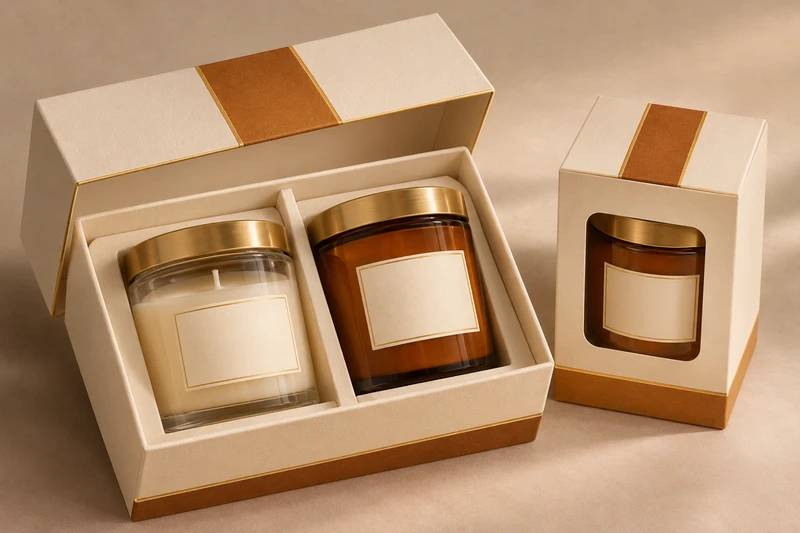
Candle packaging ideas work best when they begin with the jar rather than the artwork. A box for one candle jar needs clear shelf presentation and easy removal. A candle duo needs a layout that keeps the two vessels organised, while a gift box should make the opening sequence feel considered without overlooking the weight and dimensions of the contents.
For candle brands, retailers and e-commerce teams in Australia, the practical brief should account for the complete candle vessel: jar diameter, overall height, lid, label position, base shape and filled weight. These details influence the internal layout, insert design and external box proportions far more than a generic “small” or “large” candle description.
XGolden Print designs and produces custom paper packaging boxes, gift packaging, labels and stickers for candle applications. We can support the packaging brief through structural design, material selection, artwork support, printing, finishing, fitted inserts and sample approval before production.
A different packaging idea for each candle-jar use
The right candle packaging depends on how the customer will encounter the product. A retail shelf box, a two-candle gift set and a corporate gifting presentation may all contain glass candle jars, but they call for different structures and information layouts.
A single jar often benefits from a compact box that makes the product name, fragrance and brand identity easy to find. A duo becomes a set, so the layout needs to show whether the jars are intended to be viewed side by side, stacked or presented as a paired collection. Gift packaging can give more attention to the reveal of the contents, the message inside the lid and the way accessories or cards are arranged.
| Candle-jar use case | Main packaging requirement | Useful box approach | Details to confirm |
|---|---|---|---|
| Single candle on a retail shelf | Clear product identification and a tidy shelf footprint | Custom box sized around one jar | Vessel diameter, total height, lid profile, retail information |
| Candle duo or fragrance pair | Consistent spacing between two jars and clear set presentation | Lid-and-base box with a fitted layout | Weight of both jars, jar spacing, orientation and removal access |
| Seasonal or premium gift set | A more deliberate opening experience and room for coordinated branding | Magnetic closure gift box | Contents list, internal arrangement, message placement and final packed dimensions |
| Corporate, wedding or event candle gift | Presentation that supports an occasion or recipient message | Gift box with printed artwork and planned insert layout | Quantity, recipient variation, event date, delivery destination and packing workflow |
| Online candle order | Product presentation inside a separately planned dispatch system | Retail or gift box used within an outer shipping layer | Outer pack requirements, delivery route and handling assessment |
Before choosing the box style, list every item that will sit inside it. This could include one or two candle jars, a dust cover, care card, matchbox, thank-you note or gift message. Each item changes the usable space and the opening sequence. Leaving these items until after the box has been sized can result in a layout that feels crowded or leaves unused gaps.
It is also useful to distinguish three layers:
- The primary container: the candle jar, lid and any vessel label supplied with the customer product.
- The presentation packaging: the carton, rigid box, gift box or insert that presents the candle for retail or gifting.
- The outer shipping layer: packaging specified separately for transport, storage and delivery handling.
A presentation box is not automatically a complete transport-protection system. Brands selling candle jars online should plan the retail or gift box and the outer shipping layer as connected but separate parts of the packing process.
Single jars on a retail shelf
For a single candle jar, the packaging should make the candle identifiable before the customer opens it. The front panel commonly carries the brand, fragrance name and product range, while side or back panels can carry supporting product information, candle care details or retail information required by the brand.
The important starting point is the actual external size of the filled vessel, not just the nominal jar size. Measure:
- maximum diameter, including any label edge or raised decoration;
- overall height with the lid fitted;
- the diameter and shape of the base;
- any protruding handles, knobs, seals or wax-cover components;
- filled product weight;
- whether the jar must remain upright in the box.
These measurements help determine internal clearances. A box that is too close to the jar can make packing and removal awkward. One that is too loose can make the product look undersized in its own packaging. The aim is a controlled presentation that accommodates normal product variation without making unverified performance assumptions.
For retail shelf presentation, artwork should work from several viewing angles. The front should communicate the product quickly at a glance, while the side panels can help when boxes are displayed tightly together. Brands with multiple fragrance variants may use a shared box structure and coordinated artwork system, changing selected colours, scent names or variant markers while retaining a recognisable product family.
Australian buyers should also provide final Australian English wording, ingredient or candle-care copy where applicable to their product, barcode artwork if needed, and any retailer-specific panel requirements. Packaging artwork support can help prepare files for print, but the brand remains responsible for confirming its product information and required copy.
A simple single-jar box can be appropriate for:
- boutique candles sold individually;
- a fragrance range with several vessel sizes;
- retail launches where shelf consistency matters;
- online orders where the branded box will be placed inside a separate dispatch pack;
- wedding favours or smaller event gifts with personalised artwork.
Where a single jar is intended as a premium gift, the box does not necessarily need to be large. A carefully proportioned rigid structure, considered opening method and suitable internal presentation can create a more gift-ready result than unnecessary empty space.
For projects that need a bespoke structure rather than an off-the-shelf format, our custom box service can support discussion of the vessel dimensions, artwork and intended use before production.
A candle duo in a lid-and-base box
A candle duo is more than two single candles placed in a larger carton. The packaging needs to present the relationship between the products: perhaps two complementary fragrances, a day-and-night pairing, a limited collection or a gift chosen for a particular occasion.
A lid-and-base box provides a straightforward structure for this type of set. The removable lid creates a distinct reveal, while the base can hold an insert planned around the two individual jar profiles. The layout may position vessels side by side, front to back or in another arrangement that suits the proportions of the jars and the way the set is to be viewed.
The LB-324 candle duo lid-and-base box is a relevant example of a lid-and-base style for considering a two-candle presentation. It is useful as a structure reference when developing a duo brief, but the final size, materials, insert arrangement and suitability should be confirmed for the particular jars and filled weights.
For a duo, assess the following early:
Vessel-to-vessel spacing
Two glass vessels need enough planned space that the layout looks intentional. The available gap may be used for a divider, an insert feature, a printed message card or simply a measured margin around each jar. The best choice depends on jar diameter, wall shape and how the customer should remove the products.
Balanced visual weight
A duo can look unbalanced when one jar is taller, wider or visually heavier than the other. If the set combines different vessel sizes, the insert and box proportions should be designed around that difference rather than treating the contents as identical.
Access after the lid is removed
The customer should be able to lift each candle out without struggling with the insert or needing to turn the box upside down. Consider where fingers can reach, whether the jar has a lid that can be gripped, and whether the insert includes a practical removal opening. This should be checked with physical samples, not assumed from a drawing alone.
Set-level artwork
A duo box can describe the collection rather than repeating the full single-candle panel design twice. For example, it may focus on the pairing name, gift occasion or shared fragrance story. Individual jar labels can retain the specific scent information, while the outer box establishes the set as one purchase.
This style suits paired candle gifts, discovery sets, seasonal releases and retail promotions where two jars are sold as a defined combination. It can also be useful for corporate or event gifting when the outer artwork carries an occasion-specific message and the candle jars remain the customer’s products.
Magnetic gift boxes and the opening experience
Magnetic closure boxes are suited to candle gift sets where the opening experience is part of the intended presentation. Instead of simply lifting off a lid, the recipient opens a hinged format that can reveal a printed interior, gift message, pair of candles or a more varied collection of items.
The MC-324 candle gift magnetic box is an example of a candle-gift magnetic style. It can help teams visualise the format when planning a premium candle gift box. As with any catalogue example, its final dimensions, materials, finishes, insert configuration and fit for a particular project need to be agreed separately.
A magnetic gift box can be considered for:
- premium candle and home-fragrance gifts;
- Christmas, seasonal or limited-edition collections;
- corporate thank-you gifts;
- wedding or event gifts;
- candle sets that include a care card, accessories or additional branded pieces.
The opening experience should be designed in sequence. First, consider what is visible when the box is closed: this may be the brand mark, collection name or a restrained gift message. Next, decide what the recipient sees when opening the lid. An inside-lid message can add context, while the insert below presents the products in their intended positions.
Avoid placing essential product information only inside the box if retail staff or customers need to identify the candle before opening it. For retail packaging, fragrance name, variant details and other selected information may need to remain accessible on the exterior. The ideal division of information depends on whether the box will be displayed in-store, sent directly as a gift or packed as part of an event order.
Finishes are also a design decision rather than a default upgrade. A finish may be chosen to support a quiet premium look, improve contrast for a logo or differentiate a seasonal range. Its appearance on the selected material, compatibility with the artwork and appropriateness for the project should be reviewed during sampling.
For broader gift-set planning across several products, see custom gift packaging. Gift packaging can be planned around coordinated branding, multiple contents and the intended opening sequence.
Inserts and spacing around glass vessels
For candle jars, an insert should be specified around the real product shape and the way people will pack and remove it. An insert is not merely a decorative tray: it establishes where each vessel sits, the spacing around it and what is visible when the box opens.
Start with a full product sample wherever possible. A jar can vary from a technical drawing because of its lid, label thickness, base contour, seam, raised logo or applied decoration. If the final vessel is not yet available, identify which measurements are provisional and allow for a review before production approval.
Useful questions for an insert brief include:
- Will the candle sit upright throughout packing and presentation?
- Is the jar round, square, oval or otherwise shaped?
- Does each vessel have the same dimensions?
- Does the set include cards, tools, accessories or secondary products?
- Should the insert fully frame the jar or leave more of the vessel visible?
- Where can fingers access the product for removal?
- Will staff pack the items manually, and in what order?
- Is an unfilled space intentional, such as for a gift note, or should it be removed?
The amount of spacing around a glass vessel should be judged in relation to the presentation and packing process. Tight visual spacing can look refined but may make loading or product removal difficult. Wider spacing can accommodate an additional card or create a clearer separation between fragrances, but it may increase the overall box size. There is no single ideal measurement; it must be developed against the product sample and intended configuration.
XGolden Print can provide fitted inserts as part of the packaging project. Structural design and material selection can be considered together with the box format, but material suitability and the final insert configuration need confirmation for the individual project.
A common mistake is approving the exterior artwork before the internal layout is final. If the insert changes later, the box dimensions, fold positions and artwork panels may also need adjustment. It is more efficient to settle the vessel dimensions and opening layout before finalising artwork.
Sample checks and a separate shipping layer
Sample approval is particularly valuable for candle packaging because a jar can look correct on a flat layout but behave differently when it is placed in a completed box. A sample gives the brand team an opportunity to check product fit, removal access, artwork placement, readability and the overall gift or retail presentation.
For a useful candle-box sample review, assess:
- Fit: Does the actual jar, with lid and label fitted, sit in the intended position?
- Removal: Can a customer or packing team remove each jar comfortably?
- Appearance: Are the fragrance name, gift message and brand elements correctly positioned?
- Set layout: Do paired candles look balanced when the box is opened?
- Packing workflow: Can staff place every item into the box in a clear, repeatable order?
- Outer dimensions: Are the completed pack dimensions suitable for the retailer, storage plan or separate dispatch packaging?
- Artwork accuracy: Is all final Australian English product copy, variant information and customer-supplied data correct?
Sample approval before production is one of the services XGolden Print offers. It gives packaging buyers a defined point to review the agreed structure and artwork before proceeding, rather than relying on digital visuals alone.
For online orders, do not treat the candle gift box as the only packaging decision. The outer shipping layer should be designed and assessed separately for the actual delivery journey, packed weight, handling conditions and destination. The candle jar remains the primary container; the branded box provides retail or gift presentation; and an outer pack is a separate transport requirement. Discussing all three layers early helps avoid a polished gift presentation that does not align with the fulfilment workflow.
When preparing a candle packaging brief for XGolden Print, provide the jar dimensions and filled weight, product quantity per set, photos or samples of the vessel, artwork files or design direction, preferred box style, expected quantity, required delivery date and delivery destination. We can then discuss a suitable custom box or gift packaging approach, including inserts, artwork support and sample approval for the specific candle project.
