
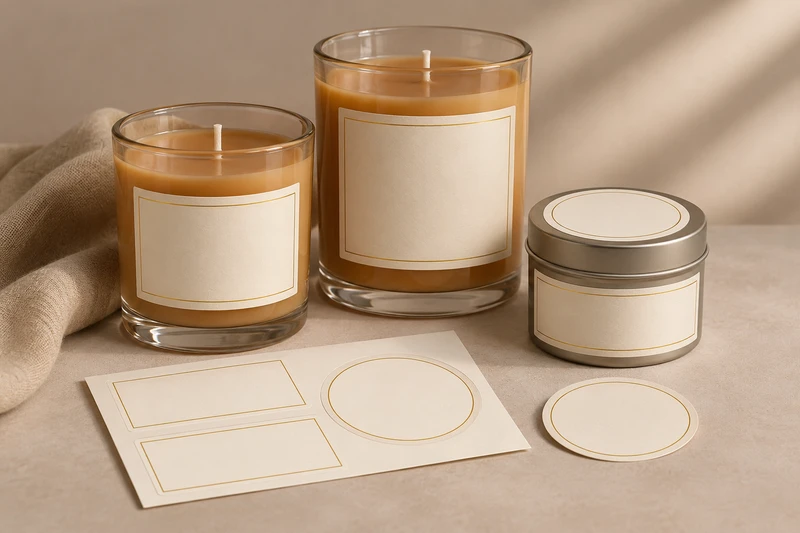
For candle makers, the right candle label size is not a standard dimension—it is the size that fits the usable area of the actual jar or tin without crowding curves, seams, lids or essential product information. Measure the container first, then build the artwork around a defined front panel, lid or base position.
For brands selling candles in Australia through retail, gift sets, online orders or event gifting, label placement affects shelf presentation, product identification and packing workflow. XGolden Print designs and produces custom labels and stickers for jars, bottles, boxes and bags, with dimensions, shapes and roll or sheet formats agreed for the project. The label should be planned as part of the candle’s complete presentation, while the jar or tin remains the primary container.
Start with the usable area on the candle container
The usable label area is the practical surface available after allowing for container features that can interrupt application or readability. It is usually smaller than the total height or circumference of the jar.
Start by measuring the empty candle container that will be used in production, rather than relying only on a supplier description or an approximate image. Record measurements in millimetres and note any variations between fragrance variants, vessel colours or production batches.
For a candle jar, identify:
- Overall jar height and diameter: useful reference dimensions, but not necessarily the label area.
- Straight-sided panel height: the vertical section where a label can sit flat without running onto the shoulder or bottom curve.
- Shoulder and base curves: areas where a flat label may wrinkle, lift or look uneven.
- Seams, mould marks and embossed details: features that may need to remain clear.
- Opening and lid position: important where a lid overlaps the label zone or is removed before use.
- Front-facing direction: decide which side will face forward on shelf, in a gift box or in an e-commerce photograph.
- Base area: measure the flat underside separately if a base label is planned.
For a cylindrical straight-sided jar, measure the height of the flat vertical wall and the circumference around the intended label position. Do not assume a label should wrap all the way around. A gap can make application easier and prevent the ends from meeting unevenly at a seam.
A useful working approach is to create a paper or plain-stock mock-up at the proposed label size. Wrap it around the vessel, mark the front, inspect it from normal viewing distance and check whether the label remains within the stable, flatter section of the container.
Tapered jars need extra care. Their circumference changes from top to bottom, so a rectangular label may not follow the surface evenly. A narrower label, a shorter label height or a shape developed around the taper may be more appropriate. The preferred shape and material should be confirmed on a physical sample rather than assumed from the container’s appearance.
Tins should also be treated as a separate application. Their sidewall, lid profile, seam position and surface finish can differ significantly from glass jars. A label arrangement that works on one jar should not be transferred to a tin without sample confirmation.
Measure the intended finished candle, not only the vessel
The planned candle format can affect what remains visible and accessible. For example, a lid may be stored on top in retail presentation, removed for use, or packed separately inside a gift set. If a dust cover, box sleeve or outer carton carries some branding, the candle label may only need to handle product identification rather than every selling message.
Where candles are presented in a box, the visible front label should still be considered when the customer opens the package. For online orders, it is also worth checking how the label reads in product photography and when the candle is handled during unboxing.
Front-label size on straight and curved jars
A front candle label should be large enough to establish the brand, scent name and variant clearly, but small enough to sit comfortably within the jar’s stable front panel. The best front-label size depends on the vessel geometry and the hierarchy of information—not a copied preset dimension.
On a straight-sided cylindrical jar, a rectangular, square, oval or custom-shaped front label can work when it stays inside the flat vertical area. Leave visual breathing room above and below the label so it does not appear pressed into the shoulder or base curve. Horizontal space should also allow for the jar’s curvature: a very wide label may be technically possible but can become harder to view from an angle.
On a gently curved jar, reduce width before increasing height. A narrower front label usually keeps the most important content nearer the container’s central viewing plane. This helps the logo and scent name remain readable when the jar is seen on a shelf beside other candles.
On a strongly tapered, rounded or faceted vessel, test the proposed artwork as early as possible. Small changes in label width, corner shape and placement height can make a substantial difference to the finished look. Avoid placing fine borders close to the edge, as curvature and application variation can make any unevenness more noticeable.
| Candle container use case | Label priority | Practical sizing and placement approach | Items to confirm |
|---|---|---|---|
| Straight glass jar for retail | Clear front-facing identity | Use the central flat wall for a front label; retain space from shoulder and base curves | Usable panel height, circumference, seam location |
| Rounded or curved glass jar | Readability from the front | Use a narrower label centred on the front-facing area | Curvature, label width, edge appearance on sample |
| Tapered candle jar | Clean application and balanced artwork | Trial a reduced-height or custom-shaped option rather than assuming a rectangle will suit | Top and bottom diameters, label position, sample result |
| Candle tin with lid | Product recognition before opening | Consider lid branding and a separate side or base information label | Lid profile, side seam, intended application method |
| Candle gift set | Coordinated presentation across variants | Keep scent naming and core branding consistent across jars and outer gift packaging | Gift box layout, label hierarchy, variant system |
| Event or corporate candle gifting | Clear personalisation or event messaging | Allow a dedicated area for event details without obscuring the core candle identity | Final artwork, individual names or dates, packing sequence |
When comparing front-label sizes, prioritise the information customers need to recognise first. For many candle ranges, that hierarchy is:
- Brand or collection name
- Scent name
- Candle type, edition or variant
- Supporting descriptor, if required
- Approved product information placed elsewhere or in a secondary area
This hierarchy avoids a front label becoming a dense block of text. If the product needs extensive approved information, plan a back, side or base label rather than forcing every detail onto the shelf-facing panel.
Lid and base labels have different jobs
Lid and base labels can extend the available communication space, but they should not simply duplicate the front label. Each location is viewed at a different stage of the customer journey.
A lid label is useful when customers are likely to view candles from above, such as in a retail display, gift hamper, drawer box or open-top tray. It can carry the brand mark, scent name, a collection colour or a simple visual motif. For candle tins, the lid may be the main display surface when products are stacked or stored flat.
However, measure the lid’s flat area rather than its full diameter. Raised rims, domed surfaces, handles or irregular profiles can reduce the effective label panel. A circular lid does not automatically require a circular label; the best shape depends on artwork and usable surface.
A base label is generally better suited to approved product details, batch or variant identification and other information that does not need to lead the shelf presentation. It should remain readable when the candle is turned over, without conflicting with the container’s base profile or any permanent marks.
A back or side label can bridge the gap between these two roles. It can carry product details while allowing the front label to stay clean and focused. On smaller jars, a single wrap-style label with a distinct front and back panel may be considered, subject to the container shape and sample review.
Think about how labels interact with the outer packaging:
- A rigid box, lid-and-base box or drawer box can carry gift messaging, collection details or coordinated branding.
- The candle label identifies the individual product once the box is opened.
- A fitted insert, where required and agreed for the project, can hold jars in place for presentation and handling inside the box.
- A retail or gift box is not automatically a complete transport-protection system. Transport needs should be assessed separately according to the packaged product, packing method and delivery destination.
For a multi-candle gift set, the label system should help customers distinguish variants quickly. Consistent logo position, scent-name placement and colour treatment can make a range easier to browse without making every label identical.
Arranging scent names and approved product details
A candle label needs to balance visual appeal with clear identification. The most effective layouts establish the scent name quickly, then organise remaining information according to where the customer will see it.
Begin with a simple content plan before final artwork is supplied. Separate content into front-facing, secondary and operational information.
Front-facing content
The front label commonly needs the elements that support immediate recognition:
- Brand name or logo
- Scent name
- Collection, season or edition name
- A concise fragrance descriptor where relevant
- A visual design system that connects variants across the range
Keep the scent name prominent enough to distinguish products at a glance. If a customer must pick between several similar jars in a retail display or gift set, small type and overly decorative lettering can slow product selection.
Secondary approved information
Use a back, side, base or wrap panel for information that must accompany the finished product but does not need to dominate the front. XGolden Print does not interpret labelling rules or determine what information your candle requires. Brands should provide their approved product content and check that it is correct for their intended market and sales channel.
Before submitting artwork, review:
- The final approved wording
- Ingredient, warning, care or other product details required by your own process
- Variant names and scent spellings
- Barcode and internal product codes, where used
- Batch, date or other variable information and how it will be applied
- Minimum type size and contrast needed for your own requirements
- Space for any information that must remain visible after packing
Do not treat another brand’s label dimensions, wording or layout as a requirement for your product. A label’s usable area depends on its container and intended use, while product information should be approved by the responsible brand before printing.
Artwork details that help labels look deliberate
Fine lines, close borders and small reversed-out text can be difficult to judge from an on-screen file alone. Build adequate space between critical content and the label edge, particularly on curved vessels. Consider whether the design needs to read under shop lighting, in an online image and in a customer’s hand.
For an Australian product range, ensure spelling, scent names, units, approved details and any local-language wording are final in the supplied artwork. If the label forms part of a wedding favour, corporate gift or special-event candle, lock in names, dates and event details before sample approval and production.
The LS-322 candle-jar label style
The LS-322 candle-jar label style is a relevant XGolden Print product example for brands planning labels for candle jars. It provides a useful starting point for discussing a candle-jar label brief, but it should not be treated as a fixed size, material specification or guarantee of suitability for every vessel.
The final label dimensions, shape and format should be developed around the actual jar, artwork and application process. A short, wide front label may suit one candle range; another may need a taller front panel, a lid label or separate base information. Tins require their own sample assessment because their surfaces and profiles may differ from jars.
XGolden Print can support the packaging-development process with structural design, material selection, artwork support, printing, finishing, fitted inserts and sample approval before production. For candle labels, that support is most useful when the brief clearly identifies the container, label positions, visual hierarchy and planned packing workflow.
Labels may be supplied in agreed roll or sheet formats. The appropriate format depends on how the label will be applied—by hand, within a packing process or through another agreed application approach. Share this information early, as it can affect the practical label brief.
If labels will be coordinated with candle gift packaging, we can also plan the packaging around multiple products, coordinated branding and the intended opening experience. This is useful for discovery sets, seasonal gifting, corporate presents and event favours where the jar label and outer box need distinct but connected roles.
Checking placement, adhesion and legibility on a sample
A sample check is the practical stage that turns a label size proposal into a usable production brief. It is especially important for curved glass, tapered jars, coated tins and designs with fine typography or close borders.
Before approving a candle label sample, inspect it on the actual production-intent container where possible. Check the label after it has been applied and viewed as the customer would see it—not only as a flat label proof.
Use this checklist:
- Does the label sit within the intended usable panel?
- Is it centred consistently relative to the jar seam, lid or front-facing position?
- Do the top and bottom edges remain clear of curves, shoulders and base transitions?
- Does the label appear even when viewed from the front and slight angles?
- Are the brand name and scent name legible at ordinary viewing distance?
- Does the lid close and open without interfering with the label position?
- Can the base label be read once applied?
- Does the chosen application method suit the agreed roll or sheet format?
- Does the label remain appropriate for the intended container surface and use conditions?
- Do the outer box, insert or gift-set arrangement leave the intended label face visible?
Adhesion and performance should be assessed for the specific jar or tin, label construction, application method and intended conditions. Do not assume that a label suitable for one substrate, storage environment or candle format will perform the same way on another. Heat exposure, oils, handling, outdoor use and other conditions need project-specific confirmation; no performance rating should be inferred without that confirmation.
Common avoidable mistakes include measuring only the vessel’s maximum width, positioning a wide label across a curved panel, placing all content on the front, overlooking tin seams, and approving artwork before the scent list is final. These issues are easier to resolve before production than after labels have been printed.
Prepare a clearer candle-label brief
A concise, accurate brief helps move from an idea to a label that suits the container and sales format. Include:
- Container type: glass jar, ceramic vessel, tin or another format
- Container measurements, photographs and supplier drawing if available
- Usable front, lid, side and base areas
- Proposed label positions and approximate dimensions
- Number of scents, variants or event versions
- Artwork files and approved product information
- Preferred label shape and any required finish direction
- Whether labels are needed in roll or sheet format
- How labels will be applied
- Whether the candle is sold individually, in a gift set, online order or event pack
- Required quantity, delivery date and destination
For broader label options beyond candle jars, explore XGolden Print’s custom stickers and labels. We can help develop the label specification through material selection, artwork support, sampling and production, with final suitability confirmed for the individual project.
To discuss candle label sizes for your jar or tin, send XGolden Print the container dimensions, quantity, artwork, required delivery date and delivery destination, along with details of the intended label placement and application method.
