
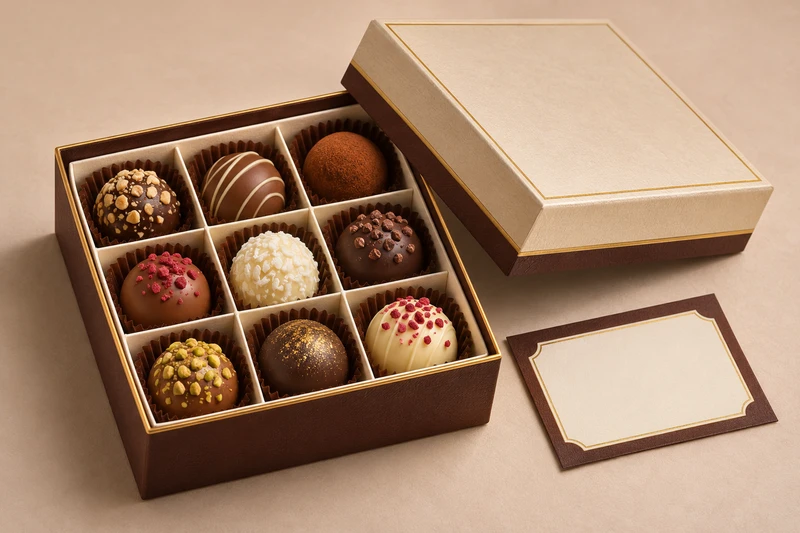
Chocolate truffle boxes need to do more than look gift-ready. For a mixed assortment, the box must hold each chocolate in a clear layout, allow packers to work efficiently and help the recipient identify flavours without spoiling the presentation.
For chocolatiers, retailers and gifting teams in Australia, the best starting point is the actual assortment: the number of truffles, their individual dimensions, coatings or decorations, paper cup requirements and the intended sales occasion. XGolden Print designs and produces custom paper packaging boxes and gift packaging, supporting the structural design, material selection, artwork, printing, finishing, fitted inserts and sample approval for a specific project.
The assortment determines the truffle box
A truffle box should be planned around the chocolates it will contain, rather than selecting a standard box shape first. Mixed-flavour ranges can include round truffles, squares, domes, pralines or pieces with taller decorations. Even when every chocolate has a similar footprint, differences in height and surface finish can affect the insert depth and the clearance needed beneath the lid.
Before developing chocolate truffle boxes, establish whether the assortment is:
- A fixed selection with the same flavours in every box
- A seasonal or limited-edition collection
- A build-your-own gift selection
- A corporate or event gift with a restricted flavour range
- A retail assortment sold in several piece counts
- An online order packed as part of a larger gift hamper
The chosen selection influences the cavity plan. A fixed twelve-piece collection may benefit from a regular grid with every flavour allocated a consistent position. A mixed selection with interchangeable flavours may need a more flexible layout, or a printed guide that can be updated without changing the entire box structure.
For gift packaging, the opening sequence is also part of the product experience. A recipient may lift a lid to reveal a flavour card and a neatly arranged tray, or slide open a drawer box to find the assortment already presented in rows. The format should support the way the chocolates are packed, displayed and gifted, not merely the appearance of the outer box.
Piece count and space around each chocolate
Piece count is the main driver of a truffle box layout. It determines the cavity arrangement, overall footprint, box depth and how much blank space is available for branding or flavour information.
Common arrangements may include rows of four, grids of six, nine or twelve, or larger gift-box formats with multiple layers. However, the final number of chocolates should always be confirmed for the actual project. A nominal piece count alone is not enough: two assortments with twelve truffles can require different cavity sizes if their shapes, paper cups or decorations differ.
When setting out a tray or insert, allow for:
- The maximum chocolate width
Measure the widest point of every truffle, including any decorative finish that may extend beyond the base.
- Chocolate height
The lid should close without contacting toppings, transfer sheets, curls or other surface details. The amount of clearance required depends on the actual confectionery.
- Paper cup dimensions
The cup base and rim may be larger than the chocolate itself. If cups are used, the cavity should be planned around the packed piece, not the unwrapped truffle.
- Finger access
Tight cavities can make chocolates difficult to remove. Consider whether a customer can lift a truffle cleanly without disturbing adjacent pieces.
- Packing tolerance
A layout that is too exact may slow hand-packing or cause pieces to sit unevenly. Build the packing method into the structural brief.
- Weight distribution
A larger assortment may need an insert or tray arrangement that keeps the contents stable and maintains the intended retail presentation.
| Truffle box use case | Layout priority | Packaging considerations | Useful options to discuss |
|---|---|---|---|
| Small retail assortment | Clear piece count and compact display | Product access, visible flavour guide, shelf-facing artwork | Lid-and-base box, simple grid insert, printed flavour card |
| Mixed-flavour gift set | Premium opening experience and flavour navigation | Consistent cavity positions, gifting message, coordinated branding | Rigid box, fitted insert, sleeve or information card |
| Corporate chocolate gift | Branded presentation and repeatable packing | Logo placement, message area, consistent assortment layout | Rigid presentation box, printed insert or branded card |
| Event or wedding favours | Individual presentation and guest identification | Small format, names or event details, efficient packing workflow | Compact box, label or sticker, customised artwork |
| Online chocolate order | Presentation inside a larger shipment | Retail box protection during handling, secondary transport packaging | Structured inner box, suitable outer shipping solution specified separately |
A truffle box is generally retail and gift packaging. It should not be treated as a complete transport-protection system for postal or freight handling. If gift boxes will be sent through an online order, discuss the secondary packaging, packing method and delivery destination separately. The retail box, insert and any outer transport packaging each have different roles.
Cups, dividers and contact-layer requirements
Paper cups, dividers and trays can keep mixed truffles separated, but each component needs to be assessed in relation to the actual product and packing process. The outer chocolate box is not automatically the primary food-contact layer, and food-contact requirements should be confirmed for every component that may touch the chocolates.
Paper cups can help define the assortment visually, contain loose decorative elements and make individual pieces easier to lift. They may also create a consistent appearance where truffle shapes vary slightly. Yet cup size, rim height and stiffness should be checked with the specific chocolates: a cup that appears suitable in a drawing may not sit correctly around a particular truffle.
Dividers are useful when chocolates need distinct positions but a full cavity tray is not required. They can create rows, sections for flavour families or separate areas for different piece sizes. Their practical value depends on whether they remain upright through packing and whether the dividers allow the desired access to each piece.
A fitted insert can provide a more controlled cavity layout. This is particularly relevant where a premium gift set includes a fixed selection and the unboxing arrangement is important. The insert specification should account for the packed chocolate, any cup or wrapper, and the depth needed beneath the lid.
For the packaging brief, identify:
- Whether chocolates will sit in paper cups, wrappers, trays or directly in a specified contact layer
- Which components contact the product and which only separate or support the presentation
- The chocolate dimensions, weight and shape range
- Whether pieces are packed by hand, in rows, or through another agreed workflow
- Whether any flavour positions are fixed
- The required number of layers and the sequence in which they are packed
Do not assume that a paper, board, tray, coating or adhesive is suitable for direct food contact simply because it is used in another packaging project. Food-contact components, material suitability and the final construction need confirmation against the individual project. Equally, packaging should not be relied upon to make preservation or shelf-life claims; the chocolatier should define the product’s own storage and handling requirements.
Two-piece truffle boxes and rigid chocolate presentations
Two-piece boxes are a practical choice for chocolate truffles because the lid can lift away cleanly, giving a full view of the assortment. A lid-and-base construction can suit seasonal gifts, retail collections and corporate presentations where the customer is intended to see the complete layout at once.
The LB-306 truffle lid-and-base box is a relevant style reference when considering a two-piece truffle presentation. Its suitability for a particular assortment will depend on the final dimensions, insert arrangement, piece count and food-contact layers specified for the project.
Rigid chocolate presentations can offer a more substantial feel for higher-value gift sets, selected assortments or branded occasions. The RB-306 fine-chocolate rigid box provides another style reference for a fine-chocolate presentation. It should be treated as a format example rather than evidence of a particular capacity, material or truffle fit.
The choice between a lighter paper box and a rigid presentation box usually comes back to the intended use:
- Retail counter or shelf presentation: prioritise clear branding, flavour information and a box size that works with the store display plan.
- Premium gifting: consider the opening action, insert reveal, message card and the perceived presentation of the assortment.
- Corporate gifts: allow space for a logo, campaign message or recipient-facing card while preserving clear chocolate identification.
- Event gifting: consider whether the packaging needs a name, date, menu reference or colour scheme coordinated with the event.
- E-commerce orders: distinguish the customer-facing chocolate box from the separate protective packaging needed for dispatch.
XGolden Print can support structural design and material selection around these requirements, then provide artwork support, printing, finishing, fitted inserts and sample approval before production. Buyers can also explore broader custom gift packaging options when the truffle box is one part of a larger gift set.
Identifying mixed flavours in a gift set
A mixed truffle box should help the customer understand what they are receiving. This matters for first-time purchasers, gift recipients, retail staff and corporate recipients who may not have a flavour menu at hand.
Flavour identification does not need to overwhelm the presentation. The best approach depends on whether the assortment is fixed, seasonal or changeable.
Useful options include:
- A printed flavour guide placed inside the lid
- A separate card laid over or beneath the tray
- A numbered cavity plan matched to a printed legend
- Printed names or symbols on a tray divider
- A removable insert for seasonal assortments
- An exterior label or sticker identifying the collection, edition or selection
For a fixed assortment, a cavity map can make the experience clearer: for example, the top-left position always corresponds to a certain flavour. For changing or build-your-own collections, a separate card or label can be more practical than printing flavour names permanently inside the box.
Artwork should be checked for the real sales environment. On retail packaging, the front panel may need the collection name, brand identity and a clear product descriptor. For gifts, interior artwork can carry the flavour story or a message without crowding the outside. Where labels or stickers are used on boxes or bags, the placement, dimensions, shape and required roll or sheet format should be agreed for the application method.
Avoid a common mixed-assortment mistake: designing a beautiful box without deciding how the packer, retailer or recipient will distinguish similar-looking truffles. Build that information into the packaging brief from the outset.
Checking fit, packing and storage arrangements
A physical sample is valuable because truffle packaging involves more than flat artwork. It lets the buyer assess whether the chocolates sit at the intended height, whether cups or dividers remain in place, how easily pieces can be removed and whether the closing action is appropriate for the packed assortment.
Before sample approval and production, check the following points with the actual product where possible:
Fit and presentation
- Do all truffle shapes sit correctly in their allocated spaces?
- Are tall decorations clear of the lid?
- Are cups or inserts aligned after the box is handled?
- Can customers remove pieces without damaging nearby chocolates?
- Does the box still look complete when a few chocolates have been removed?
Packing workflow
- Is the layout easy for the packing team to follow?
- Does the flavour guide match the physical positions?
- Are different flavours packed into fixed locations?
- Is there a practical sequence for inserting trays, cards and lids?
- Are there separate versions for different assortments or seasonal artwork?
Storage and distribution
- What storage conditions does the chocolate product require?
- Will the boxes be held in retail storage, included in hampers or sent with online orders?
- Is the customer-facing truffle box placed inside a separate transport package?
- Does the planned packing arrangement protect the presentation through the intended handling stages?
These are project-specific checks, not assumptions that can be resolved by selecting a box style alone. Dimensions, materials, finishes, inserts, quantities, sampling terms, pricing and schedules all need to be confirmed for the individual packaging brief.
Prepare a clearer chocolate truffle box brief
A concise brief helps move from an idea to a workable sample. Include:
- Number of truffles per box and whether the range is fixed or variable
- Dimensions, shape and weight of each chocolate type
- Cup, wrapper, divider or contact-layer requirements
- Preferred layout, including any fixed flavour positions
- Box style preference, such as a lid-and-base box or rigid presentation box
- Artwork files, branding, flavour guide and required printed information
- Retail, gifting, event or e-commerce use
- Quantity, required delivery date and delivery destination
- Any secondary packaging requirements for shipping or hampers
XGolden Print can develop custom chocolate truffle boxes around the actual assortment rather than a generic capacity claim. To discuss your project, share the truffle dimensions, piece count, quantity, artwork, required delivery date and destination through our custom box packaging service.
