
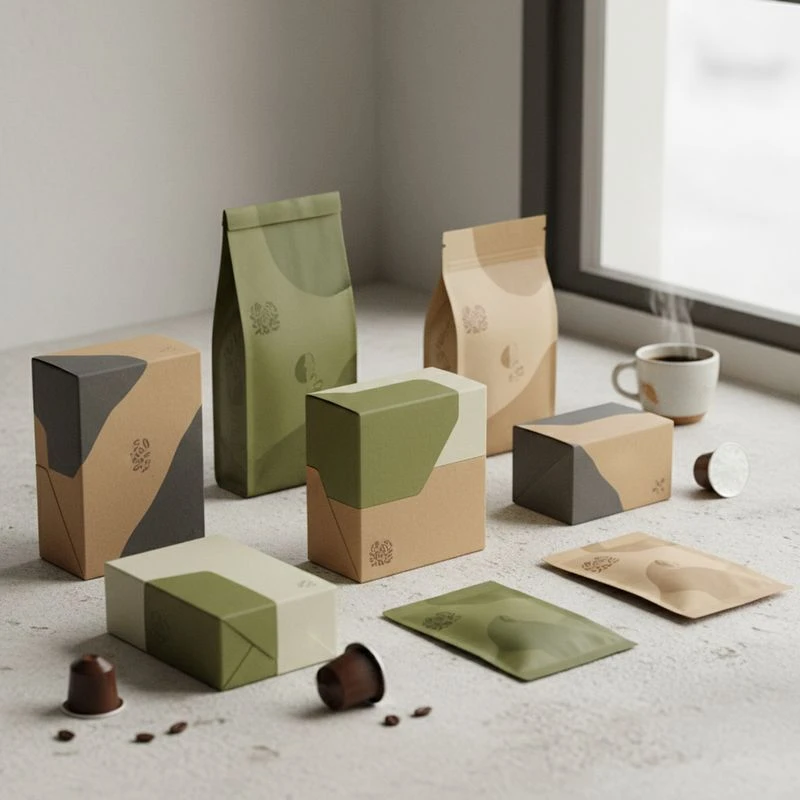
Custom packaging for coffee capsules and pods should protect the product, make the brewing system clear, fit efficiently into retail or e-commerce channels, and support disposal instructions that customers can understand. The best format is usually a compact folding carton or sleeve designed around the capsule count, pod dimensions and shelf presentation required.
Before choosing artwork or finishes, define what the packaging must do: hold a fixed quantity securely, communicate compatibility accurately, withstand handling, and suit the way customers will receive the product. This avoids common problems such as crushed cartons, unclear pack counts and oversized packaging that adds cost without improving the customer experience.
Coffee Capsule Packaging
Coffee capsule packaging is more than an outer box. It is a system that may include the capsule or pod itself, an inner wrap or tray, a retail carton, a multipack format and an outer shipping case. Each layer should have a specific job, rather than duplicating material and cost.
For most consumer packs, the outer carton is responsible for branding, product information, storage protection and shelf-ready presentation. The capsule or pod usually provides the primary barrier, but this must be confirmed for the specific coffee format and product requirements. Do not assume that an attractive retail box alone protects coffee freshness.
Start with the capsule or pod format
Compatibility is one of the first details to settle. Coffee capsules and pods vary in diameter, height, rim shape, material and intended brewing system. A carton designed for one format may not safely hold another, even if the overall dimensions appear similar.
Provide the packaging supplier with:
- The physical dimensions of one filled capsule or pod
- Unit weight and desired pack count
- Whether pods are loose, stacked, nested or held in a tray
- Any individual foil, flow-wrap or other inner packaging
- The direction the product should face when packed
- A sample or technical drawing where possible
- The desired retail orientation: upright, flat or hanging
If the product will be sold in several roast profiles or flavours, retain one core box structure where practical. Different artwork variants on the same dieline can simplify stock management while allowing each SKU to remain distinct.
Select a format that matches how the product is sold
The right format depends on the pack count, merchandising approach and level of protection required.
| Packaging format | Best suited to | Main strengths | Points to check |
|---|---|---|---|
| Folding carton | Standard retail packs and gift packs | Efficient storage, broad print area, familiar shelf format | Internal movement, tuck closure strength and stackability |
| Sleeve around an inner tray | Premium packs or organised capsule layouts | Clean presentation and controlled unboxing | Tray fit, material use and sleeve security |
| Carton with dividers | Larger packs or fragile presentation requirements | Reduces product movement and separates units | Assembly time and whether dividers are necessary |
| Display-ready carton | Retail counter or shelf display | Can combine transport and presentation functions | Retailer requirements, opening method and shelf dimensions |
| Mailer box | Direct-to-consumer and subscription orders | Added protection in transit and room for inserts | Avoiding excess void space and unnecessary secondary material |
A compact folding carton is often a practical starting point for custom coffee pod packaging. It gives ample space for branding and mandatory product information while keeping the pack easy to stack, ship and display. Where capsules can rattle or shift, a closer-fitting structure or internal support may be more useful than simply using thicker board.
Design for the customer’s decision at shelf or online
Coffee packaging needs to answer key buying questions quickly. Customers commonly look for the coffee type, intensity or flavour profile, capsule quantity, brewing-system compatibility and disposal guidance.
The front panel should prioritise the information that helps a shopper identify the right product. Avoid giving every claim, flavour note and brand message the same visual weight. A clear hierarchy is more useful than a crowded panel.
For an online product listing, ensure the pack artwork remains legible in images. Small text, subtle finishes and low-contrast colours may look effective in hand but become difficult to read on a screen. Build a clear product name, pack count and compatibility statement into the main visible panels.
Compact Design
Compact design reduces unnecessary material, makes cartons easier to handle and can improve pallet and storage efficiency. It does not mean making the box as small as physically possible. A carton that is too tight can be difficult to pack, damage product edges or split at the closure.
The goal is controlled fit: enough tolerance for efficient packing and normal manufacturing variation, but not so much empty space that capsules move around.
Measure the real packed product
Base the dieline on actual filled products rather than nominal capsule dimensions. Small differences in rims, seals, foil lids and stacking orientation can change the internal space required.
When specifying dimensions, distinguish between:
- Internal dimensions: the space available for capsules, trays or inner packs
- External dimensions: the finished box size used for retail planograms, shipping cases and storage
- Flat dimensions: the size of the printed board before folding and gluing
Confirm which measurement convention is being used in the quotation and artwork process. Confusion between internal and external measurements is a frequent source of poor fit.
Keep pack counts efficient
Common coffee capsule packs range from small trial quantities to larger household multipacks. Rather than choosing a count based on marketing alone, assess the practical consequences:
- Does the count fit naturally into a stable carton layout?
- Can the product be packed without complex manual handling?
- Will the finished pack fit your chosen shelf, display or delivery configuration?
- Is the pack light enough and compact enough for its sales channel?
- Does the count align with repeat purchasing behaviour?
A 10-pack may be simple to merchandise, while a larger 30- or 60-pack may suit e-commerce or bulk purchasing. Neither is automatically better. The appropriate option depends on product positioning, order value and the customer’s expected use.
Use structure before relying on heavier materials
When a pack feels weak, increasing board weight is not always the best answer. Structural improvements may offer better results, such as:
- Adjusting panel proportions
- Using a more secure tuck or lock closure
- Adding a dust flap where needed
- Changing the packing orientation
- Including a close-fitting insert or tray
- Reducing excess headspace
- Designing a separate transit carton for e-commerce orders
This approach can help retain a compact, practical retail carton without asking the consumer pack to perform every transport-protection function.
Make opening straightforward
An awkward opening experience can undermine an otherwise well-designed product. The carton should open without tearing essential information panels or causing loose capsules to spill.
Consider whether the pack needs:
- A standard tuck opening for regular repeat use
- A perforated opening for a display or dispenser function
- A resealable format for larger packs
- A tamper-evident feature, where appropriate to the product and channel
- An inner arrangement that keeps remaining capsules orderly after opening
Any opening feature should be trialled with the actual capsule count and orientation. Perforations that work on an empty sample may behave differently once the carton is full.
B2B Manufacturing
For a business buyer, custom coffee capsule packaging should be specified as a repeatable manufacturing brief, not simply as a visual concept. A strong brief reduces rework, supports more accurate quotations and helps different teams—product, marketing, procurement and packing operations—work from the same requirements.
Build a practical packaging specification
Your specification can be concise, but it should address the decisions that affect manufacturability and final use.
Include the following:
- Product details: capsule or pod dimensions, pack count, orientation and total filled weight.
- Box style: folding carton, sleeve, tray-and-sleeve, display carton or mailer.
- Finished dimensions: clearly identify internal and external measurements.
- Material preference: board type, finish requirements and any material restrictions.
- Print requirements: number of artwork versions, colours, inside printing, barcode placement and finishes.
- Packing process: whether cartons are hand packed or packed using equipment, and whether they must arrive flat or pre-assembled.
- Distribution needs: retail display, e-commerce shipment, gift presentation or a combination of channels.
- Information panels: product description, ingredients or other required declarations, brewing compatibility, pack count and disposal guidance.
- Approval process: artwork proofing, structural samples and who has final sign-off.
For brands also developing other product formats, a supplier of custom packaging boxes may help standardise carton styles across a wider range. The structural needs of coffee pods should still be assessed separately, as their compact shape and pack density create specific fit considerations.
Choose print and finish for the use case
Print decisions should support readability and brand recognition, not only visual impact. A premium finish can be appropriate for gifting or specialty coffee ranges, but it should not make disposal instructions, compatibility information or legal text difficult to read.
Common options to discuss include:
- Matte, gloss or uncoated finishes
- Spot gloss for selected graphic elements
- Foil accents for a premium visual cue
- Embossing or debossing for tactile branding
- Window features, if product visibility genuinely helps the purchase decision
- Interior printing for unboxing or brand storytelling
Every added process can affect budget, lead planning, artwork setup and recyclability considerations. Ask whether a finish is essential to the product proposition before including it.
Plan variants without creating avoidable complexity
Coffee ranges often have multiple blends, decaffeinated options, single-origin lines or seasonal editions. Keep the structural format consistent where possible and differentiate with a disciplined artwork system.
Useful approaches include:
- One recognisable brand layout across all variants
- A clear colour or pattern system for each roast or flavour profile
- Consistent placement for intensity, compatibility and pack count
- Shared barcode and information zones that are updated carefully per SKU
- A controlled naming system to avoid artwork mix-ups during packing
Avoid relying on colour alone to identify a variant. Include readable text and distinct product names, particularly where similar shades may be difficult to distinguish.
Confirm commercial terms before approving production
Commercial details vary by supplier and order. Confirm them in writing rather than assuming they are standard.
Questions to ask include:
- What is the minimum order quantity for the selected structure and print method?
- Are setup, tooling, proofing or plate costs applicable?
- What proof format will be provided before production?
- What artwork file format and dieline process are required?
- How will finished cartons be packed for delivery and storage?
- What tolerance applies to dimensions, colour and quantities?
- Are cartons supplied flat, glued or assembled?
- What change process applies if artwork or specifications are amended?
XGolden Print has 27 years of experience in custom packaging and printing, with a 15,000 square metre factory, more than 500 employees and production capacity exceeding 10 million units. Those capabilities may be relevant when assessing a packaging partner, but the right choice should still be based on the specific structure, materials, artwork process and order requirements for your coffee range.
Food Safety
Food safety is a design and sourcing consideration for coffee capsule packaging, especially where the packaging touches the product or may transfer substances through direct contact. The outer retail carton is often not the primary food-contact layer, but this must be verified for the full packaging system.
Do not assume that all inks, coatings, adhesives, boards or inserts are suitable for direct food contact. The answer depends on the material, how it is used, the product’s barrier packaging and the conditions of storage and handling.
Identify which layer touches food
Map each component before selecting materials:
- Primary packaging: the capsule, pod, sachet or other layer that directly contains coffee
- Secondary packaging: the carton, sleeve or tray grouping the primary packs
- Tertiary packaging: outer cases and protective materials used for distribution
If a carton, tray or insert directly contacts unwrapped coffee or an unsealed food component, its material suitability becomes especially important. If capsules are individually sealed, the outer carton may have a different risk profile, but it should still be suitable for its intended use and storage environment.
Verify the right requirements for your product
Food-contact packaging and labelling obligations can vary according to product type, materials, market and sales channel. Confirm applicable Australian requirements with appropriately qualified regulatory, food safety and packaging advisers before finalising materials or artwork.
Your review should consider:
- Whether any packaging component contacts food directly
- The suitability of inks, coatings, adhesives and substrates for their intended use
- Migration risk and barrier performance where relevant
- Storage conditions, including heat, moisture and handling
- Product labelling and allergen-related information where applicable
- Batch, date or traceability information needed for your operations
- Claims about freshness, sustainability or product performance
Keep food safety documentation organised by SKU and packaging revision. If you change a board, coating, adhesive, ink system or inner packaging component, reassess whether the change affects the original suitability review.
Avoid unsupported packaging claims
Statements such as “food safe”, “plastic free”, “compostable” or “recyclable” can carry specific meanings and may require evidence. Use claims only when they accurately reflect the complete packaging component and its intended disposal route.
For example, a paperboard carton with foil decoration, plastic window film or a heavy coating may need different recycling guidance from an uncoated carton. Similarly, a claim about a capsule should not be applied broadly to the whole pack unless it is true for every relevant component.
Recycling
Recycling guidance for coffee capsules and pods must be clear, component-specific and realistic. The capsule, lid, carton, inner wrap, tray and shipping materials may each have different disposal pathways. Combining them under one broad environmental statement can confuse customers.
The simplest approach is to design the pack so that components are easy to separate and explain. Where separation is not practical, avoid instructions that imply consumers can recycle a mixed-material item through a standard household system without checking local acceptance.
Design with the whole pack in mind
Start by listing every material used in the consumer-facing package:
- Capsule or pod body
- Lid, seal or filter
- Inner bags, wraps or trays
- Retail carton or sleeve
- Labels and adhesive components
- Decorative finishes, windows and inserts
Then decide whether each item can be reduced, replaced, separated or clearly labelled. A well-designed carton can use one main board material and minimise elements that complicate recovery, but the final recycling outcome depends on local collection systems and the finished material combination.
Give precise disposal instructions
Good disposal guidance identifies the component and tells the customer what they need to do. Generic messages such as “please recycle” are often insufficient.
Clearer instructions may address:
- Whether the carton should be flattened
- Whether the capsule requires emptying or separation
- Whether lids, films or bags should be removed
- Whether a component requires a specialist collection pathway
- Whether local recycling acceptance should be checked
Do not place recycling symbols or claims on artwork until the relevant material specifications and local disposal guidance have been verified. Recycling capabilities can differ between areas and may change over time.
Balance sustainability goals with product protection
Reducing packaging is beneficial only if the revised design still protects the coffee and reaches customers in acceptable condition. A lightweight carton that fails in transit, causes product loss or requires substantial added protective material may not deliver the intended outcome.
Assess changes across the full system:
- Can the carton dimensions be reduced?
- Is an insert genuinely needed?
- Can a decorative component be removed?
- Can the outer shipping pack carry more of the transit-protection role?
- Can multiple material types be simplified?
- Is the disposal message accurate for the final design?
A sustainable packaging decision is usually a series of practical trade-offs, not a single material choice.
FAQ
What information should appear on coffee capsule packaging?
At minimum, prioritise the product name, pack count, brewing-system compatibility, flavour or roast information, required food labelling details and clear disposal guidance. The exact labelling requirements should be checked for the product and Australian market before printing.
Should coffee pods be packed in a tray?
A tray can improve organisation and reduce movement, particularly for premium presentation or larger packs. It is not always necessary. Test whether a well-sized carton can hold capsules securely without an insert before adding extra material.
Can one box design work for retail and e-commerce?
Sometimes, but not always. A retail carton may need an outer mailer or shipping case for e-commerce protection. Treat the retail pack and transit pack as separate functions so the consumer box does not become oversized or over-engineered.
What is the most common mistake in custom capsule packaging?
Designing from artwork first and product dimensions second. Start with the actual capsule format, pack count, packing method and sales channel; then develop graphics around a structure that works.
A practical next step is to prepare a one-page brief with your capsule sample dimensions, intended pack counts, sales channels and artwork requirements. This gives your internal team or packaging supplier a reliable basis for developing custom packaging for coffee capsules and pods.
