
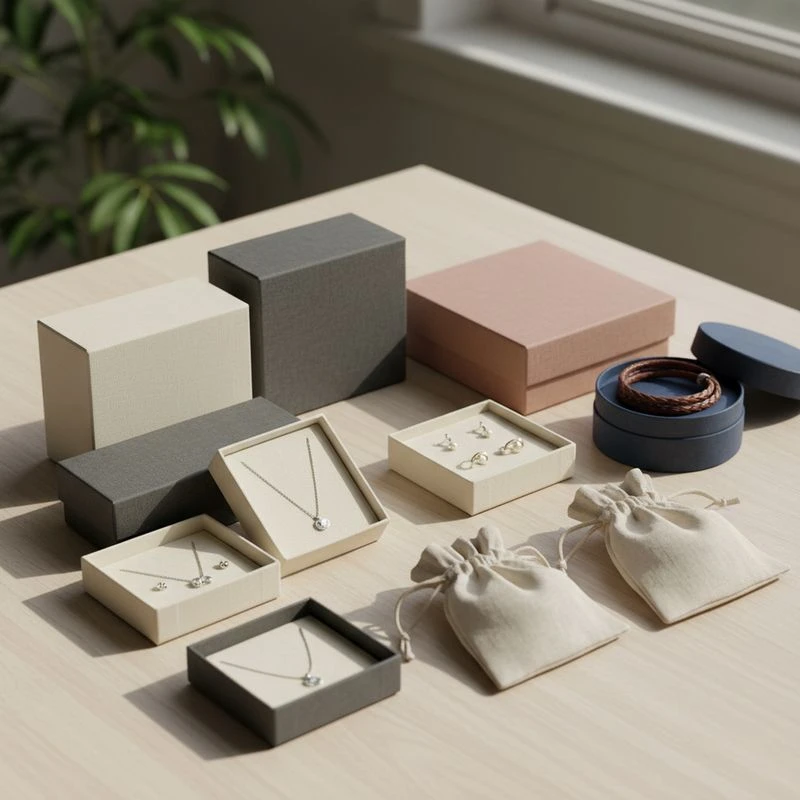
Custom packaging for fashion accessories and jewellery should do three jobs at once: protect delicate products, make the brand feel considered, and suit the way the item is sold—whether online, at a counter or as a gift. The right format depends less on appearance alone than on product dimensions, weight, surface sensitivity, fulfilment method and the customer’s unboxing experience.
For Australian brands and buyers, a practical starting point is to match the packaging level to the product’s perceived value and handling risk. A lightweight hair clip may need a branded card and sleeve; a plated necklace may need a soft pouch, insert and rigid box; a premium gift set may need a layered presentation box with clear product organisation.
Accessory Packaging
Accessory packaging needs to secure the product without hiding its detail or creating unnecessary bulk. Fashion accessories vary widely, from sunglasses and scarves to belts, watches, hair accessories and small leather goods, so a single box style rarely suits an entire range.
Start by grouping products according to three factors:
- Protection needs — Is the item scratch-prone, easily tangled, fragile or subject to crushing?
- Presentation needs — Does the customer need to see the product before buying, or should it be revealed during unboxing?
- Sales channel — Will it sit on a retail shelf, hang from a display, travel through e-commerce fulfilment or be handed over as a gift?
Common packaging formats and where they fit
| Packaging format | Best suited to | Main benefit | Key point to confirm |
|---|---|---|---|
| Folding carton | Scarves, belts, sunglasses, accessory sets | Efficient storage and broad printing area | Board grade and internal fit |
| Rigid box | Jewellery, watches, premium gifts | Strong presentation and perceived value | Size, insert design and outer protection |
| Drawer box | Jewellery sets, special collections | Controlled reveal and reusable feel | Sleeve fit and opening action |
| Pillow box | Small light accessories | Compact gift presentation | Suitability for heavier or delicate products |
| Header card with pouch | Hair accessories, small items, low-weight products | Product visibility and hanging display | Hole position and pouch closure |
| Jewellery card | Earrings, pins, necklaces | Holds product in a visible, compact format | Slot placement and card stiffness |
| Paper or fabric pouch | Rings, pendants, small accessories | Surface protection and soft presentation | Closure type and branding method |
| Mailer box | E-commerce orders and multi-item purchases | Combines transit protection and branding | Internal void space and closure security |
For small accessories, avoid making the outer box substantially larger than the product unless the added space supports a deliberate gifting or display purpose. Oversized packaging can make a compact item feel poorly specified and may increase the need for void fill during packing.
Jewellery packaging requires careful product restraint
Jewellery boxes should prevent movement, tangling and contact between components. This is especially important for items with polished, plated, enamelled or stone-set surfaces. A visually attractive box is not enough if a necklace shifts in transit or earrings fall away from their presentation card.
Useful insert options include:
- Foam inserts with cut-outs for rings, pendants or watches
- Card inserts with slots for earrings and necklaces
- Velvet-look or fabric-covered pads for premium presentation
- Paperboard platforms for lighter jewellery
- Elastic loops, tabs or ribbons to hold a product in position
- Separate compartments for sets containing multiple pieces
Before approving an insert, check the item’s actual finished dimensions, including clasps, charms, folded straps, watch bands and any protective wrapping. Product measurements supplied at an early development stage may not reflect the final assembled item.
Match the pack to the customer journey
The best custom packaging for fashion accessories and jewellery is designed around how customers encounter it.
For retail display, visibility and easy handling may matter most. Consider display windows, hanging cards, product labels and barcodes, while making sure these elements do not obstruct the accessory.
For e-commerce, the priority is usually protection through handling and a tidy opening experience. A mailer box may hold the product box, pouch or tissue securely, while a simple packing layout can reduce the chance of items moving around.
For gift purchases, a reusable rigid box, sleeve or ribbon closure may support a stronger sense of occasion. Make sure any decorative element is practical for staff to assemble at the expected order volume.
For wholesale, packaging often needs to support product identification, stock management and efficient packing. Keep SKU placement, assortment labels and carton packing requirements clear from the outset.
Luxury Look
A luxury look comes from proportion, material choice, finish quality and restraint—not simply from adding more decoration. For jewellery and elevated fashion accessories, packaging should make the product feel intentional while remaining functional and consistent with the brand’s market position.
Choose materials that fit the product and price position
Paperboard cartons work well for many accessory ranges and can be printed, coated, embossed or paired with inserts. Rigid board boxes offer a firmer structure and are commonly used for jewellery, watches and gift-ready products. Pouches add a tactile layer and can help prevent surface contact, but they may need an outer box for better structure or retail presentation.
Material selection should also consider the finish of the item inside:
- Smooth, polished products may benefit from a soft inner layer or pouch.
- Delicate chains need a layout that reduces tangling.
- Heavier accessories need an insert and box base that will not flex excessively.
- Larger fashion pieces may need a folding carton or mailer that keeps their shape.
- Products with care instructions, authentication cards or gift messages need room for these components without overcrowding the box.
If reduced-plastic packaging is an objective, assess the full pack rather than changing only one visible component. For example, consider the box, insert, sealing method, product protection and outer shipping pack together. Confirm material availability, recyclability claims and disposal guidance with the relevant supplier before making environmental statements.
Finishes that support premium presentation
Print finishes can create contrast and draw attention to a logo, pattern or product name. The most suitable option depends on the artwork, box material and the amount of handling the pack will receive.
Common choices include:
- Matte lamination or coating for a subdued, contemporary surface
- Gloss finishes for stronger colour and shine
- Foil stamping for metallic highlights on logos or borders
- Embossing or debossing for subtle, tactile branding
- Spot gloss effects to emphasise selected graphic details
- Textured papers for a distinctive tactile experience
- Coloured edges, ribbons or sleeves for a layered gift-box effect
Use special finishes selectively. A small foil mark or embossed logo can feel more refined than applying several treatments across every panel. Fine details should also be checked at actual production size: thin type, intricate linework and pale colours may not reproduce as expected on every material or finish.
Build a premium unboxing sequence
A luxury unboxing experience does not need to be complicated. It usually follows a clear order:
- The outer pack arrives cleanly and protects the order.
- The branded box or pouch is presented without excess movement.
- The product is held securely and is easy to remove.
- Supporting material—such as a care card or gift note—is easy to find.
- The customer can retain or reuse the packaging if appropriate.
Keep the sequence intuitive. Customers should not need to pull through multiple layers of tape, tissue, inserts and cards just to access a small item. Excessive packaging can frustrate rather than impress.
B2B Printing
For packaging buyers, successful printing begins with a clear specification. Artwork is only one part of the brief. Box structure, material, print method, finishing, insert requirements and packing expectations all influence the final result.
When sourcing custom printed boxes for accessories and jewellery, provide enough information for the packaging to be quoted and developed accurately.
What to include in a packaging brief
A useful B2B printing brief should cover:
- Product type and intended use
- Finished product dimensions and weight
- Required internal clearance around the product
- Box style and opening preference
- Material or finish preferences
- Required branding elements and artwork files
- Colour requirements, including any brand colour references
- Insert type, product restraints or compartments
- Whether the packaging is for retail, e-commerce, gifting or wholesale
- Expected order quantity and repeat ordering needs
- Any labelling, barcode, warning or product-information requirements
- Packing configuration and storage constraints
- Target timing for sampling and production planning
If your product is sold in Australia, verify any packaging, product-information, labelling, material-contact or disposal requirements relevant to your category before artwork is finalised. Requirements can vary by product and sales channel, so they should not be assumed from another product range.
Artwork checks before production
A print-ready file should be reviewed against the packaging dieline before production. The review should confirm that logos, text, barcodes and key graphics are positioned safely away from folds, cut lines and glue areas.
Check these details in particular:
- Bleed and safe-area requirements
- Correct panel orientation
- Legibility of small text
- Barcode placement and scan clearance
- Colour expectations across different substrates
- Alignment of foil, embossing or spot finishes
- Whether artwork runs across folds, seams or box edges
- Visibility of product instructions after the box is assembled
Requesting a physical sample or prototype can be valuable where fit, insert placement or finish is important. A flat artwork proof alone cannot confirm how the assembled package will feel, open or hold the actual product.
Plan for practical procurement
Packaging procurement is easier when specifications are controlled. Keep an approved record of the dieline, artwork version, material, finish, insert and packing method for each SKU. This reduces confusion when a range is reordered or extended.
It can also help to distinguish between:
- Core packaging used across a continuing product range
- Seasonal packaging for limited releases or gifting periods
- Campaign packaging with short-term artwork or promotional elements
- Ship-ready packaging designed for direct fulfilment
- Retail-ready packaging designed for shelf or hanging display
For a growing range, choose structures that can accommodate modest product variation where possible. However, do not force very different products into one box if it creates poor fit or inadequate protection.
Display
Packaging is part of product merchandising. For fashion accessories and jewellery sold in person, it should help customers identify the product, understand what is included and inspect it without damaging the pack.
Retail display considerations
Packaging designed for display may need one or more of the following:
- A hang hole or header card
- A stable base for counter or shelf placement
- A window that reveals the product
- Clear product naming and variant information
- Space for barcode or inventory labels
- Tamper-evident features where appropriate
- Easy-opening construction for staff
- Consistent dimensions for organised shelving
Windows can be useful for colour-driven products such as hair accessories, scarves or small leather goods. For premium jewellery, however, a closed box with a high-quality image or a display sample may better support a gift-focused position. A window is not automatically the more premium choice.
Balance visibility with protection
Visible packaging creates a trade-off: the more product a customer can touch or remove, the more likely it is to become marked, tangled or misplaced. Use cards, trays, tabs and clear protective components where they genuinely improve handling.
For earrings, check that posts and backs remain secure. For necklaces, test whether the chain stays positioned when the pack is held vertically. For sunglasses, confirm that the arms do not press against the carton walls. For belts, make sure the buckle does not distort the box or damage adjacent products.
Display packaging should also work for staff. If a pack is difficult to refill, label or keep upright, it can create avoidable problems at the point of sale.
Brand Identity
Packaging gives fashion and jewellery brands a repeatable physical expression. It can communicate minimalism, playfulness, craftsmanship, occasion gifting or everyday practicality before the customer sees the product itself.
The most effective brand identity systems are consistent rather than identical. A jewellery box, mailing carton, pouch, care card and sticker can use different formats while sharing recognisable colours, typography, logo treatment and tone.
Create a packaging system, not a one-off box
Think in layers:
- Primary packaging: the box, card or pouch that holds the item
- Secondary packaging: the mailer or outer carton used for transport
- Supporting pieces: tissue, inserts, care cards, thank-you cards and seals
- Operational labels: product codes, barcodes, handling marks and variant identifiers
Decide which elements should be permanent and which can change by collection. For example, a core logo and box structure may remain consistent, while sleeves, stickers or insert cards change for seasonal colours or gifting campaigns.
Align packaging with product positioning
A low-cost, everyday accessory may benefit from clean, easy-to-recycle packaging with bold product information. A premium jewellery line may call for more tactile materials, controlled reveal and a secure insert. Neither approach is inherently better; the packaging should make sense for the customer, product and sales channel.
Ask these questions during selection:
- Does the packaging match the product’s quality and intended price position?
- Will customers understand what the item is and how to use or care for it?
- Does it protect the product through storage, handling and delivery?
- Is it manageable for staff to pack, label and replenish?
- Can the design be applied consistently across future product sizes?
- Are all claims and required details verified before printing?
Common mistakes to avoid
- Choosing a box based on appearance before measuring the product
- Using inserts that look premium but do not restrain the item
- Overcomplicating the unboxing sequence
- Leaving no space for product information or barcode labels
- Applying small text or fine artwork without checking reproduction
- Treating a retail box as automatically suitable for postal handling
- Adding sustainability wording without verifying the relevant materials and claims
- Approving packaging without testing the actual finished product inside it
A practical selection checklist
Before placing an order for custom packaging for fashion accessories and jewellery, confirm:
- Product dimensions, weight and surface sensitivity
- Box style, internal clearance and insert layout
- Product orientation when packed and displayed
- Retail, gift, wholesale and e-commerce requirements
- Material, finish and branding hierarchy
- Artwork, dieline and print specification
- Product information, barcodes and any required labels
- Outer-pack protection for delivery or warehouse handling
- Sample approval process
- Storage space, assembly needs and repeat-order consistency
XGolden Print provides custom packaging boxes and printing solutions, with experience across packaging development and production. A clear specification, artwork pack and product sample give any packaging supplier a stronger basis for developing a suitable solution.
FAQ
What packaging is best for jewellery?
Rigid boxes with fitted inserts are a common choice for premium jewellery because they provide structure and presentation. For lighter or lower-cost pieces, jewellery cards, pouches or folding cartons may be more suitable. The best option depends on the item’s weight, shape, finish and sales channel.
Should jewellery packaging include an insert?
Usually, yes. An insert can hold a ring, pendant, bracelet, watch or earrings in place and reduce movement. The insert must be designed for the specific product rather than selected only for its appearance.
Can one packaging style work for retail and online orders?
Sometimes, but it depends on the product and shipping setup. A retail box may need an additional mailer or protective outer pack for e-commerce. Test the complete packing configuration rather than relying on the inner box alone.
Which print finish looks most luxurious?
There is no single answer. Matte surfaces, subtle embossing, foil details and textured materials can all create a premium impression. Choose a finish that supports the brand identity and remains practical for the expected handling level.
How can accessory packaging be made more sustainable?
Start by reducing unnecessary layers, choosing an appropriate pack size and considering materials across the whole packaging system. Verify material composition, recycling guidance and any environmental claims with your supplier before including them on packaging or marketing material.
A considered packaging brief is the best next step: measure the product, define the sales channel, select the desired presentation level and test the proposed pack with the finished item before committing to a full run.
