
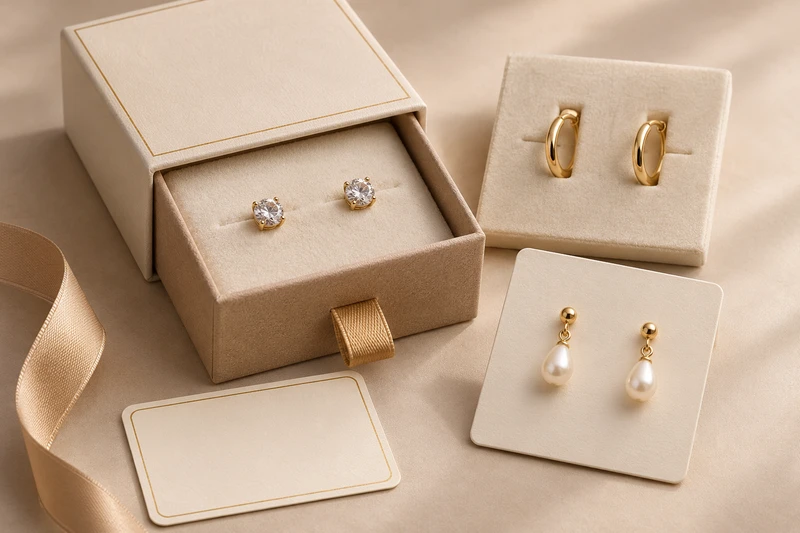
Earring packaging should hold a matched pair in a clear, balanced display while allowing customers to remove and replace the jewellery without struggling with the fittings. The most useful earring packaging ideas start with the shape of the pair: studs need accurate hole spacing and room behind the card, while hoops and drops need more vertical clearance and a layout that prevents the pair from tangling visually.
For jewellery brands, retailers, online sellers and event-gifting teams in Australia, the packaging brief should account for the actual earrings rather than a generic card size. Measure the full pair with backs, hooks, clasps or posts attached, then decide whether the presentation calls for a display card, an insert within a gift box, or both.
XGolden Print designs and produces custom paper packaging boxes and gift packaging for jewellery applications. We can support structural design, material selection, artwork, printing, finishing, fitted inserts and sample approval before production, helping buyers turn the dimensions and handling needs of an earring range into a clear packaging specification.
One earring layout does not suit every shape
A packaging layout that suits small studs can look crowded or impractical for large hoops. Likewise, a card made for long drop earrings may leave a petite pair of studs looking lost. The display position, mounting method and available depth should be selected around the earring type and the intended sales setting.
For a range containing several earring styles, there are two common approaches:
- Use a separate card or insert layout for each category. This gives each pair suitable spacing and presentation, particularly where studs, hoops and drops differ substantially in scale.
- Create a flexible layout for a coordinated collection. A shared box size may work across a collection, with different fitted inserts or cards inside. This can retain a consistent outer presentation while accommodating product variations.
The retail context matters. A card intended for a counter display needs the earrings to read clearly from the front, with the logo and product information positioned around—not behind—the jewellery. For a gift set, the opening moment may take priority: the pair can sit inside an insert, revealed when the lid or drawer is opened.
The table below compares practical considerations for common earring formats.
| Earring type | Layout priority | Key clearance to check | Suitable presentation options |
|---|---|---|---|
| Studs | Even pair spacing and a compact front view | Posts, backs and the space behind the card | Display card, fitted insert, small drawer box |
| Hoops | Width and depth around the curved form | Hoop diameter, closure point and profile depth | Wider card layout, recessed insert, drawer box |
| Drops and dangles | Vertical balance and separation between each earring | Total hanging length, hooks and moving components | Tall card, shaped insert, gift box with considered depth |
| Mixed earring set | A layout that distinguishes each pair | Different fitting types and overall set arrangement | Multi-position insert in a gift box or drawer box |
Do not choose dimensions from a front-facing product photo alone. A hoop can project beyond the card, and a drop earring may need additional room once its hook and moving elements are included. The packaging should also allow staff to load the pair consistently during fulfilment or gift-set assembly.
Stud spacing and room for the backs
Stud earring packaging depends on two dimensions that are often overlooked: the distance between the mounting holes and the depth behind the presentation surface. The holes should match the post positions of the actual pair so the earrings sit level and do not overlap.
Place the studs far enough apart for each design to be visible as an individual earring, but not so far apart that the paired relationship is weakened. The best visual spacing depends on the stud size, its silhouette and any surrounding artwork. Large statement studs generally require more separation than a small gemstone-style pair.
The rear of the card or insert needs equal attention. Earring backs add depth, and their shape can affect how the card sits in a box. If the packaging is too shallow, the backs may press against the box or prevent the lid from closing as intended. If the card is packed in a deeper gift box, consider whether it needs a fitted recess or support underneath to avoid shifting during normal handling.
For stud earring cards, include these details in the brief:
- the centre-to-centre measurement between the earring posts;
- the widest and deepest points of each stud;
- the type and dimensions of the earring backs;
- whether the earrings are mounted before or after the card is placed in the box;
- the front-facing logo, collection name, care wording or product identifier required;
- whether the card must be displayed on its own, or only inside outer packaging.
Artwork should work with the jewellery, not compete with it. Leave sufficient quiet space around the mounting positions for detailed designs, reflective surfaces or coloured stones to remain visible. Text positioned too close to the posts can become obscured once the earrings are mounted.
Giving hoops and drops enough depth
Hoops and drop earrings need a layout that allows for their three-dimensional form and, in many cases, their length. Their packaging should not force a curved hoop flat or leave a dangle sitting awkwardly over a logo or product information.
For hoops, check the outer diameter as well as the profile depth. A round hoop might fit within a card’s width but extend beyond the available internal box depth once its clasp or hinge is included. The layout should also keep each hoop visually separate, preventing the pair from crossing over one another in the display.
Drop earrings need a clear vertical zone. Their lowest point should not sit against the base edge of the card, where it can appear cramped or make removal difficult. Allow room for hooks, ear wires and any suspended pieces that may move after the pair is mounted.
Useful layout decisions for hoops and drops include:
- positioning holes high enough for the earring to hang within the intended display area;
- selecting a taller card or insert where the earring length requires it;
- allowing width between the pair so components do not overlap;
- checking the box’s internal depth with the mounted pair, not just the loose jewellery;
- keeping decorative foil, embossing or printed details away from areas hidden by the earrings.
Where a brand sells several hoop diameters or drop lengths, it may be preferable to group compatible sizes into a shared format rather than force every product into one card. A consistent outer box and coordinated artwork can still create a unified range, even if insert dimensions change between product families.
Display cards and inserts inside a box
Display cards and fitted inserts serve different roles, and many earring packaging concepts use both. A display card is primarily the mounting and presentation surface for the pair. An insert holds that card or the earrings in a defined position inside a box.
A card-only format can suit compact retail presentation, especially where the jewellery needs to be seen before purchase. However, a card by itself is not necessarily a complete solution for gifting, premium presentation or online orders. An outer box can add a more considered opening experience, protect the retail-facing card from scuffing in routine handling, and provide a separate surface for branding or collection information.
A fitted insert can be planned around:
- one matched pair of earrings;
- a pair plus a message card or care card supplied by the seller;
- a coordinated jewellery set;
- a gift-box layout with separate spaces for several products.
For event gifting, such as wedding favours or corporate gift packs, the insert should make the quantity and loading process realistic for the assembly team. A visually intricate layout may not be the most practical choice if each pair needs multiple manual adjustments. Define who will load the jewellery, whether the earrings arrive already mounted, and whether the finished boxes need to be opened again for checking.
The box, card and insert also have different functional boundaries. The jewellery itself is the customer’s product. The card and insert are presentation and positioning components, while the outer box provides retail or gift presentation. For online orders, a separate outer transit pack may still be required for the journey to the delivery destination. Retail packaging should not be represented as a complete transport protection system without assessing the full packing configuration.
Material and finish choices should follow the use case. A smooth printed surface may suit detailed artwork; a textured paper can change the visual character of a gift box; and a rigid construction can support a more substantial unboxing format. The suitability of particular materials, finishes and insert constructions should be confirmed for the individual project.
An earring drawer-box style from XGolden
A drawer box can be a useful format when the aim is to reveal earrings through a controlled opening action rather than present them on an exposed card. The sliding tray can hold a card or fitted insert, with the outer sleeve providing a separate branded surface.
The DB-307 earring drawer-box style is a relevant format to consider when preparing an earring gift-box brief. Its drawer-box structure makes it a useful reference for buyers assessing a pull-out presentation for a matched pair. The final internal layout, dimensions, materials, insert design and suitability for a specific stud, hoop or drop style should be confirmed against the project.
A drawer box can be especially relevant for:
- gift purchases where the opening sequence is part of the presentation;
- jewellery collections requiring a coordinated outer format;
- retailers that want the earring pair contained inside a box rather than on an open display card;
- online orders that will be placed into separate outer packaging for dispatch;
- event or corporate gifting where a box can carry coordinated artwork for the occasion.
A lid-and-base box or magnetic closure box may also suit certain gift packaging concepts, depending on the intended opening experience, product arrangement and overall box size. The correct format is not simply the one that looks most elaborate. It should suit the mounted jewellery, the packing workflow and the intended retail or gifting use.
For a wider review of formats, buyers can explore custom jewellery box options as a starting point for discussing structure and presentation.
Loading and removal checks with the real pair
Before approving earring packaging, test the proposed layout with the real pair, including all posts, hooks, backs, clasps and decorative components. A sample can reveal practical issues that a flat artwork file or loose product measurement cannot show.
The key checks are straightforward:
- Mounting: Can the earrings be attached to the card or insert without bending, forcing or repeated adjustment?
- Alignment: Do the pair sit at the same height and face the intended direction?
- Clearance: Is there enough room around the earrings, behind the backs and beneath long drops?
- Box closure: Does the mounted product fit inside the finished internal space without interference?
- Removal: Can a customer take out the pair without tearing the card, dislodging the insert or catching the fittings?
- Reloading: If customers may return the earrings to the packaging, is that action reasonably intuitive?
- Pack-out: Can staff assemble the format efficiently and check that each pair is complete before the box is closed?
Common mistakes include choosing hole positions before seeing the actual posts, using one insert depth for products with very different backs, and leaving no allowance for a hoop’s curved profile. Another is treating the outer box dimensions as the usable space without accounting for the card, insert and any additional printed pieces.
For Australian buyers planning a retail launch, online range or event gift, provide the intended delivery destination as part of the enquiry. It helps keep the packaging discussion connected to the complete packing plan, while avoiding assumptions about the outer dispatch packaging required after the retail box is packed.
XGolden Print has 27 years of experience in custom paper packaging, supported by a 15,000 square metre factory, 500+ employees and 10M+ production capacity. For earring packaging, the practical value is in applying the available design, artwork, printing, finishing, insert and sample-approval services to the dimensions and presentation needs of the actual jewellery—not relying on a one-size-fits-all layout.
To discuss an earring packaging project with XGolden Print, share the real pair’s dimensions, earring type, required quantity, artwork, preferred box or card format, required delivery date and destination. For multi-product gifting concepts, see our custom gift packaging options and include the full set layout in the brief.
