
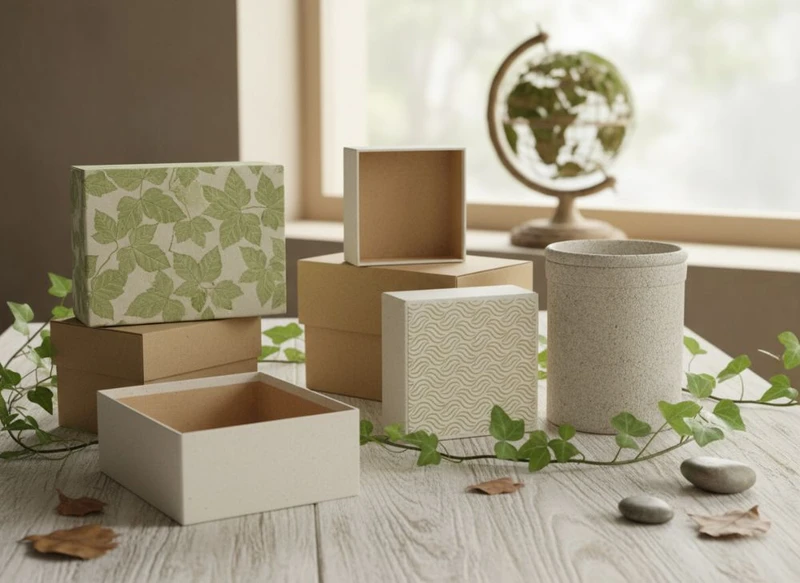
Eco-friendly paper box packaging is not simply a brown box or a recycled-content claim. A more sustainable pack uses only the material it needs, suits the product and supply chain, and has an end-of-life pathway customers can realistically follow.
For Australian brands, the strongest choices usually begin with a right-sized paperboard or kraft box, uncomplicated construction, restrained printing and clear disposal information. Verify material composition, coatings, adhesives, recycled content and relevant environmental claims with your packaging supplier before approving production.
The Business Case for Biodegradable Custom Packaging
Sustainable packaging decisions can support brand positioning, reduce avoidable material use and make disposal instructions easier for customers to understand. However, “biodegradable” should not be used as a catch-all description for every paper-based box.
Paper and cardboard are often suitable for recycling or may break down under appropriate conditions, but their actual end-of-life outcome depends on what else is attached to them. Plastic laminations, metallic finishes, heavy adhesive use, foam inserts and mixed-material components can complicate recycling or composting.
A practical business case focuses on the full packaging system:
- Material efficiency: Use a box size and board grade that protects the product without excessive void space or weight.
- Product protection: A damaged product and replacement shipment can create more waste than a slightly stronger, well-designed carton.
- Customer expectations: Many shoppers look for packaging that is simple to separate, reuse or place in common recycling streams.
- Brand clarity: Straightforward materials and honest on-pack instructions can be more credible than broad environmental language.
- Procurement consistency: Setting material and artwork requirements early helps teams compare suppliers on like-for-like specifications.
Rather than promising that a pack is “green”, define what is being improved. For example, you may specify recycled fibre content, remove a plastic window, reduce box dimensions or select an uncoated board that is easier to process at end of life. Each claim should match the final, supplied packaging—not just the base paper before printing and finishing.
Best Alternatives to Plastic: Cardboard and Kraft Paper
Cardboard and kraft paper are versatile alternatives for retail, e-commerce, food-adjacent secondary packaging and gift boxes. The best option depends on presentation needs, product weight, moisture exposure, print design and required structural strength.
| Material option | Best suited to | Key advantages | Points to check |
|---|---|---|---|
| Recycled paperboard | Folding cartons, product boxes and lighter gift packaging | Can incorporate recovered fibre; smooth formats can print well | Recycled content level, strength, surface finish and suitability for the product |
| Virgin-fibre paperboard | Premium cartons, complex folds and applications needing reliable stiffness | Consistent appearance and structural performance | Fibre sourcing information and whether virgin material is necessary for the application |
| Kraft paper or kraft board | Natural-look packs, mailer boxes, sleeves and protective wraps | Distinctive natural appearance; commonly used with simple one- or two-colour designs | Colour variation, print reproduction, board strength and available recycled content |
| Corrugated cardboard | E-commerce mailers, shipping cartons and heavier products | Good cushioning and stack strength for transport | Flute grade, right-sizing, tape choice and whether any coatings affect recyclability |
For many products, corrugated cardboard is the practical outer-packaging choice because it combines protection and a paper-based format. Folding cartons and kraft sleeves can then provide the retail presentation closer to the product.
Do not select a material based on appearance alone. A thin kraft box may look environmentally conscious but may not protect a fragile item. Conversely, a heavily embellished premium carton may undermine an otherwise simple material choice. Request samples and assess the assembled box with the real product, inserts and closure method.
If you are comparing formats, review available custom packaging boxes by their construction, board type, print coverage and finishing options—not just their external dimensions.
Navigating Eco-Friendly Certification Labels
Certification marks and environmental labels can help buyers assess paper sourcing and material claims, but only when they apply to the actual product and are used correctly. A logo on a supplier’s general brochure does not automatically mean every box specification is covered.
Before including a certification mark or environmental statement on packaging, ask for written confirmation of:
- What the claim covers: Is it the paper fibre, the finished board, the printing process or a specific production chain?
- Which exact material is covered: The certification should relate to the board grade and stock you are ordering.
- Whether logo use is permitted: Many schemes have artwork rules, approval processes and licence requirements.
- Whether the claim remains accurate after conversion: Coatings, laminates and added components can change the pack’s end-of-life characteristics.
- Whether it is appropriate for Australia: Check current Australian requirements, local recycling guidance and the substantiation expected for environmental marketing claims.
Avoid vague statements such as “100% eco-friendly”, “planet safe” or “zero impact”. These are difficult to substantiate and leave customers unsure what action to take. Specific claims are more useful, such as identifying recycled content where verified, or explaining which components should be separated before disposal.
A simple approach is to create a claim register for every packaging SKU. Record the board specification, any recycled or certified content documentation, coatings, ink system, disposal wording and artwork approval. This makes it easier for product, legal, marketing and procurement teams to review changes before reprints.
Reducing Waste with Minimalist Box Design
Minimalist box design means removing unnecessary material and complexity while keeping the packaging fit for purpose. It is often one of the most effective ways to improve a paper packaging specification because it addresses waste at the design stage.
Start with the physical product. Measure its true packed dimensions, including any protective wrap or accessory. Then design the box around the protection needed during handling, display and delivery.
Practical ways to simplify a box
- Choose a close-fitting carton instead of a much larger standard size.
- Replace multiple layers with one well-designed structural insert where possible.
- Use integrated paperboard dividers rather than separate plastic trays when product protection allows.
- Consider a tuck closure or tab lock in place of magnets, ribbons or extra hardware.
- Print directly on the box instead of adding a separate information card where suitable.
- Limit special finishes to the areas where they genuinely improve usability or brand recognition.
- Use a single material family where possible, so components are easier to separate.
Minimalism does not mean every package must be plain. It means design choices should earn their place. A gift box may need a stronger board, a protective insert and an elevated unboxing experience. The question is whether each component is essential to product safety, reuse, presentation or customer information.
Common mistakes include making a box so thin that it crushes in transit, eliminating instructions customers need, or using an oversized insert simply to create a premium reveal. Test the final pack with the product and anticipated handling conditions before confirming a material reduction.
Choosing Water-Based or Soy-Based Inks
Ink choice is one part of an eco-friendly paper box packaging specification, but it does not determine sustainability on its own. The substrate, print coverage, coatings, adhesives and finishing all matter.
Water-based inks are commonly considered for certain paper and board applications because they use water as a primary carrier. Soy-based inks use soy oil in their formulation, although formulations can differ and may include other ingredients. Neither label is a universal guarantee of recyclability, compostability or lower impact.
When discussing ink options with a printer, ask:
- Is the proposed ink compatible with the selected paperboard or kraft stock?
- Will the design require a protective coating, and what material is that coating?
- How does large-area solid colour affect the board’s look and performance?
- Are there restrictions for the intended product category?
- Can the supplier provide documentation for the proposed ink and finish system?
- Does the final printed box remain compatible with the intended recycling pathway?
For simple kraft packaging, a limited palette can reduce visual clutter and let the stock itself become part of the design. For high-end retail cartons, use colour strategically rather than assuming a full-coverage print is necessary. White space, line art and carefully selected brand colours can create a considered result with less decorative complexity.
Be cautious with descriptions such as “non-toxic” or “chemical-free”. Packaging materials are manufactured products, and broad claims need evidence. Use only claims your business can substantiate for the finished item.
How to Communicate Your Sustainability Efforts to Customers
Customers should not have to guess whether a box belongs in recycling, whether an insert should be removed or what a sustainability statement means. Clear, modest communication is more valuable than a long list of broad claims.
Use packaging copy to answer three questions:
- What is this packaging made from?
- What should the customer do with each component?
- What has the brand changed or reduced?
For example, a simple disposal panel could identify the box, paper insert and any non-paper component separately. Only provide instructions that have been checked for the materials and likely local disposal options. If acceptance varies between areas or depends on facilities, say so rather than giving an absolute instruction.
Make claims precise and useful
Better wording tends to be specific:
- “Box made with recycled paper content” — only if the percentage or claim is documented.
- “Please remove the non-paper component before disposal” — when a component needs separation.
- “Designed without a plastic display window” — when this accurately describes a meaningful design choice.
- “Reusable gift box” — only when the construction is robust enough for realistic reuse.
Avoid implying that customers can solve all environmental impacts through disposal alone. Responsible packaging also involves material selection, product protection, production planning and reducing unnecessary components.
Printed labels can support this communication without adding a separate leaflet. Consider custom printed stickers for variable batch information, disposal prompts or product-specific instructions where direct box printing is not practical. Keep labels compatible with the intended end-of-life plan and avoid applying them unnecessarily across large areas.
Design Inspirations for Green Gift Packaging
Gift packaging can feel premium without relying on layers of mixed materials. The most successful sustainable-looking concepts pair a tactile paper stock with thoughtful structure and a clear hierarchy of information.
Kraft sleeve over a reusable box
A durable, uncoated box can be paired with a lightweight printed kraft sleeve. The sleeve carries seasonal messaging or campaign artwork, while the core box can be retained and reused. This approach may reduce the need to redesign the full box for every promotion.
One-colour botanical or line-art print
A restrained ink palette on natural kraft stock can create an intentional, contemporary finish. Fine line work, simple patterns and a considered logo placement often provide enough visual interest without extensive decorative treatments.
Paperboard insert with a product-shaped cut-out
For suitable products, a folded or die-cut paperboard insert can hold the item in place without foam. Confirm that the board has adequate strength and that the product will not move or scuff during transport.
Uncoated board with embossed detail
Embossing or debossing can add tactile interest to a logo or pattern without introducing foil. It still requires tooling and should be assessed for cost, production suitability and readability, but it can be a lower-complexity alternative to some multi-material embellishments.
Modular gift sets
A standard outer box with adjustable paperboard dividers can accommodate several product combinations. This may reduce the number of box sizes held in inventory, provided the dividers protect each variation properly.
Explore structural options for custom gift packaging with the product dimensions and desired unboxing sequence in mind. Ask to review the complete format, including closure, insert, external print and any protective wrap, rather than approving a box shell in isolation.
Recycled vs. Virgin Pulp: What You Need to Know
Recycled and virgin pulp are both used in paper packaging. Neither is automatically the right answer for every application. The appropriate choice depends on the packaging function, desired appearance, required strength and the information available about fibre sourcing.
Recycled pulp is made from recovered paper fibres that have been processed for reuse. It can help keep fibre in circulation and is often suitable for cartons, corrugated packaging and protective paper components. Its appearance may vary, particularly in natural or uncoated grades, and repeated recycling can shorten fibre length.
Virgin pulp uses new wood fibre. It may offer more consistent brightness, strength or forming characteristics for particular packaging designs. In some applications, especially where demanding structural performance or a refined print surface is needed, virgin fibre may be the practical specification.
The decision is not always either-or. Some boards use a mix of recycled and virgin fibres to balance performance and material recovery. Ask for the exact composition of the selected board rather than relying on a general description such as “recyclable cardboard”.
Selection checklist for paper fibre
When specifying recycled or virgin-fibre packaging, confirm:
- recycled content, if any, and how it is calculated;
- whether the stated content applies to the finished board grade;
- fibre sourcing information where available;
- board thickness, stiffness and strength for the product;
- colour consistency and print expectations;
- compatibility with any coating, adhesive or embellishment;
- whether the final pack can be separated into materials at end of life.
Be especially careful where a premium white finish is required. Achieving a particular visual result may involve a different board construction from a natural kraft carton, so compare both appearance and material information before making a claim.
A Practical Specification Process for Sustainable Paper Boxes
A clear brief reduces the chance of choosing a material that looks sustainable but performs poorly. Before seeking quotations or samples, prepare the following:
- Product dimensions, weight and fragility.
- Sales channel: shelf display, direct-to-customer delivery, gift set or internal packaging.
- Required protection against compression, scuffing or moisture.
- Preferred paperboard or corrugated format.
- Minimum recycled-content or fibre-sourcing requirements, where applicable.
- Print colours, ink preference, coatings and finishes.
- Inserts, labels, closures and whether each component can be removed.
- Exact environmental claims and disposal messaging to be verified.
- A final sample review using the real product.
XGolden Print produces custom packaging boxes and printing solutions, with 27 years of experience in the sector. When discussing a project, provide the complete specification and ask for the material details relevant to your claims rather than treating a general packaging category as proof of sustainability.
The best next step is to shortlist two or three box constructions, then compare them using the same product, print design and end-of-life criteria. This will help your team select paper packaging that protects the product, represents the brand well and makes sustainability communication more credible.
