
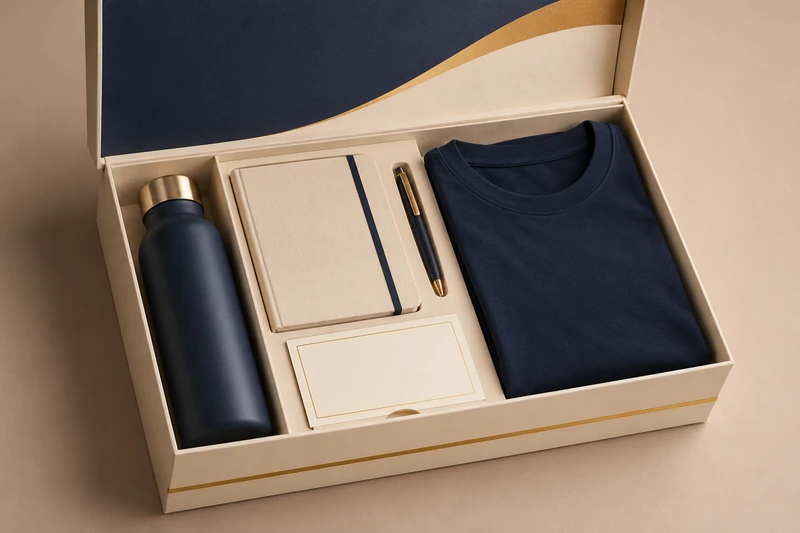
Employee welcome boxes are empty branded packages designed to present customer-supplied onboarding gifts in a clear, organised way. The best box format depends on the actual contents, how each item is accessed and whether the kit is handed over in an office or sent to an individual destination.
For HR teams, branded-gift buyers and workplace teams in Australia, the first decision is not the box style. It is the content plan. A welcome kit containing a notebook, pen and card needs a different layout from one that includes a drink bottle, folded apparel or several small desk accessories. XGolden Print helps buyers develop custom paper packaging boxes and gift packaging through structural design, material selection, artwork support, printing, finishing, fitted inserts and sample approval before production.
The box is a presentation package for the gifts supplied by your organisation or packing partner. It should not be treated as a complete transport-protection system unless outer shipping packaging and handling requirements have been separately planned.
Define the gifts before choosing a welcome box
Start an employee welcome box brief with a final list of every item going into the kit. Include its packed dimensions, weight, shape and any part that protrudes, flexes or needs to remain upright. “One welcome pack” is not enough detail for a packaging layout: a notebook and pen can sit flat, while a bottle, mug or folded hoodie changes the required internal volume and weight distribution.
Ask these questions before selecting a structure:
- Which gifts are included in every employee welcome box?
- Which items change by department, location, role or campaign?
- Are the contents already in their own primary packaging, such as a bottle carton or pouch?
- Does any item need a separate compartment to prevent movement or surface contact?
- Should the recipient see all items at once, or reveal them in layers?
- Will the box hold a welcome card, instructions, event programme or company information?
- Who supplies the gifts, places them in the box and completes the final pack check?
Measure products in the condition in which they will be packed. For apparel, specify whether it is folded, rolled or bagged. For drinkware, measure the finished item and any protective sleeve or retail carton that will travel with it. For a notebook set, account for pen clips, cable ends, clips and other details that can affect how the lid closes.
Employee welcome boxes can be planned around multiple customer products and a coordinated opening experience. However, a larger kit should be specified as its own packaging project. A small stationery box reference does not establish the dimensions, weight capacity or insert arrangement for a kit containing clothing, drinkware or other larger gifts.
A useful brief distinguishes three packaging layers:
- Primary containers and contact layers are the packaging directly around a product, such as a bottle, pouch or protective wrapping supplied for the item itself.
- The employee welcome box is the branded presentation box holding the selected gifts and printed materials.
- Outer transport packaging protects the packed welcome box while it is handled in transit. This needs separate consideration for remote distribution.
Keeping these layers separate avoids a common mistake: expecting a gift box intended for a polished handover to perform as the only protection for a remote shipment.
Separating stationery, drinkware and apparel
Mixed welcome kits need deliberate spacing. Items of very different sizes and weights should not simply be stacked in an oversized box, as movement can affect both the unboxing presentation and the condition in which gifts arrive at the recipient.
Stationery is usually the easiest starting point. Notebooks, pens, cards, desktop organisers and small accessories can be arranged in shallow sections, with a fitted insert or individual recesses where appropriate. A drawer box may suit a kit designed to be opened from one end, while a lid-and-base box can create a more traditional lift-off reveal.
Drinkware deserves separate planning. The dimensions of the actual supplied item, its existing packaging and its intended position in the box all need confirmation. Do not assume a stationery-kit structure will fit a bottle, tumbler, mug or flask. If the welcome kit includes drinkware, specify the item separately and ask for a structure designed around its dimensions, weight and required internal support.
Apparel also needs its own space rather than being forced around hard items. A folded T-shirt, cap, hoodie or tote may need a larger footprint, a deeper box or a layered layout. Consider whether the garment is packed loose, in a bag or with a card on top, as each choice affects the opening sequence.
| Welcome-kit content | Main packaging requirement | Practical layout option | Important check |
|---|---|---|---|
| Notebook, pen and welcome card | Flat organisation and easy access | Shallow insert, drawer format or layered card | Confirm pen clips and card thickness |
| Small desk accessories | Defined positions for several components | Compartments or fitted insert | Allow for each item’s final packed dimensions |
| Drinkware with office items | Separation from smaller pieces and stable support | Purpose-designed larger box with dedicated area | Specify the exact drinkware and any existing carton |
| Folded apparel and printed materials | Sufficient footprint and controlled presentation | Larger lid-and-base box or layered arrangement | Confirm folded size, bagging and depth |
| Mixed remote welcome kit | Presentation plus separate transit planning | Inner gift box within suitable outer transport packaging | Agree who provides and packs the outer protection |
For employee welcome boxes with several hard goods, fitted inserts can guide placement and make missing items easier to spot during packing. The appropriate insert design, material and fit should be confirmed against the individual kit rather than selected from a generic template.
If the box will also be displayed as a retail-style corporate gift, consider what the recipient sees before opening it. The outer artwork may carry the employer brand, campaign name or event identity, while the internal card provides a more personal welcome. Any information intended to be read before opening should be positioned where it remains visible when the box is stacked or handed over.
Office handover and remote delivery are different uses
An office handover prioritises presentation, speed of distribution and a consistent first impression. The box may be placed on a desk, given during orientation or presented at a staff event. In this setting, the opening method, reveal sequence and ease of carrying can be more important than the requirements of parcel handling.
Remote delivery changes the brief. An employee welcome box may still be the branded inner package, but it should be planned alongside an outer shipping solution, protective packing method and packing workflow. The outer package, not the gift box alone, is responsible for the transit stage. Confirm who supplies that outer packaging, who packs it and which destination details must be managed by your team or fulfilment partner.
For remote onboarding, it helps to decide whether every kit is identical or whether items vary by recipient. A single standard kit simplifies packing. Multiple variants require clearer controls, such as a distinct box label, a printed packing list or a check against the employee allocation list.
Before approving employee welcome boxes for remote distribution, document:
- the packed dimensions and approximate packed weight of the complete kit;
- the required orientation of fragile or upright contents;
- whether the gift box needs to arrive unmarked;
- the outer transport packaging supplied by the responsible party;
- which team inserts cards, gifts and any recipient-specific materials;
- the required delivery date and delivery destination for the project.
XGolden Print produces custom paper packaging boxes, but material suitability, finishes, inserts, quantities, sample terms, pricing and production schedules should be confirmed for the individual project. The same applies to any handling expectations once a completed kit leaves the packing location.
Small office-gift box styles as structure references
A compact desk-oriented gift can provide a useful starting point for discussing employee welcome box presentation, provided the contents remain within the scope of the chosen structure.
The DB-329 stationery-kit drawer box is a structure reference for smaller stationery-based office gifts. A drawer format can suit items that are removed in a controlled sequence, such as a notebook, pen, card or small desk component. It is a relevant reference when your welcome kit is compact and largely paper-based or made up of small office items.
The LB-327 desk-accessory box is a lid-and-base reference for smaller desk accessories. A lift-off lid can support a straightforward presentation for components arranged on an insert or within a shallow layout.
Neither reference demonstrates a complete existing employee welcome kit, nor should either be used to assume fit for drinkware, clothing or a larger multi-item onboarding pack. If your proposed kit includes a mug, bottle, apparel, large electronics accessories or bulky gifts, provide the full contents list and measurements so that a larger box can be specified separately.
The structural choice should follow the intended opening experience:
- Drawer boxes can create a staged reveal and keep smaller parts contained while the tray is opened.
- Magnetic closure boxes may suit a premium gift presentation where a hinged opening is part of the experience.
- Lid-and-base boxes offer a familiar lift-off format for flat or layered kit layouts.
- Rigid boxes can be considered where the required presentation calls for a more substantial paper packaging structure.
These are format options, not automatic recommendations. The final choice depends on the customer-supplied gifts, the desired dimensions, handling needs, artwork and budget parameters. Explore custom box options when the welcome kit needs a structure developed around a defined content list.
Personalised cards and checks for kit variants
A welcome card can make an onboarding kit feel considered without changing the physical box structure. It can carry a general greeting, team message, event information or instructions for using included company items. If kits need recipient names, role-specific messages or location-specific content, identify those variants at the start rather than after the box artwork is approved.
For Australian workplaces, make sure all recipient-facing copy, spelling and contact details are final before production artwork is signed off. Check that the visible box artwork and enclosed materials work together: an employee should not receive a box marked for one programme with a card for another.
A practical variant-control plan may include:
- a version code for each kit configuration;
- a content list assigned to each code;
- artwork files matched to the right card, sticker or box version;
- a clearly defined person or team responsible for packing checks;
- a final count of completed kits by variant.
Labels and stickers can also help identify boxes, bags or packing stages where appropriate. XGolden Print can produce custom labels and stickers for boxes and bags in agreed dimensions, shapes and roll or sheet formats. The brief should state the surface being labelled, where the label sits, whether it is applied by hand or during packing, and whether the label is for general kit identification or a temporary packing control.
Do not assume that a printed label replaces a personalisation workflow. If names or individual allocations are involved, decide who creates the variable information, who applies it and who checks it against the recipient list. That responsibility should be agreed before production and packing begin.
Approving the layout and agreed packing responsibilities
A sample is most useful when it represents the intended welcome-box layout, not just the external artwork. Before approving production, place the actual customer-supplied gifts, or accurate samples of them, into the proposed structure. Check the fit, product access, lid or drawer operation, insert alignment and appearance once the box is closed.
Use the review to identify issues such as:
- a lid that cannot close comfortably over the final contents;
- an insert that does not account for a gift’s actual shape;
- printed items hidden beneath heavier products;
- too much empty space around smaller components;
- a card that bends or shifts during packing;
- a box designed for office presentation but unsuitable as the only layer for remote transport.
XGolden Print can support the packaging process with structural design, material selection, artwork support, printing, finishing, fitted inserts and sample approval before production. The project brief should also state what XGolden Print is producing and what remains with your organisation, gifting agency, warehouse or packing partner. In particular, do not assume that supply of the empty packaging includes gift sourcing, kit assembly, personalisation or outer transport packing unless those responsibilities have been separately agreed.
For a clearer proposal, prepare:
- A list of every supplied gift and its packed dimensions.
- Photographs or physical samples where available.
- The number of kit variants and expected quantity for each.
- Required box artwork, card artwork and any label information.
- Whether kits are handed over in an office, used for an event or sent remotely.
- The intended delivery date and destination.
- A clear allocation of responsibilities for filling, checking and shipping completed kits.
XGolden Print has 27 years of experience in custom paper packaging, with a 15,000 square metre factory, 500+ employees and 10M+ production capacity. For an employee welcome box project, the most useful next step is to discuss the actual kit contents and presentation requirements rather than choosing a box by name alone. View gift packaging options and share your product dimensions, quantity, artwork, required delivery date and destination with XGolden Print.
