
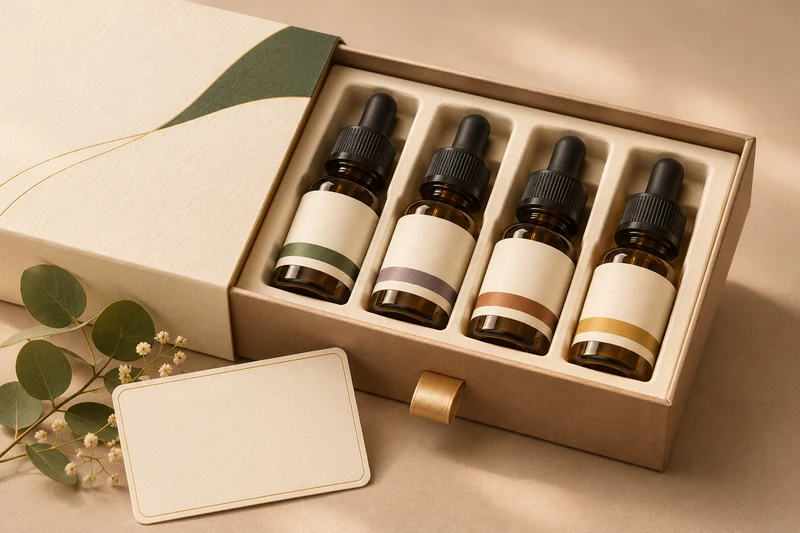
Essential oil boxes for multi-bottle collections need to do more than group several products together. They need to present each bottle clearly, allow safe and simple removal, accommodate the full closure height, and give the brand enough space for names, instructions and gifting artwork.
For brand owners, retailers and e-commerce teams in Australia, a well-planned essential oil gift box can support retail presentation, seasonal gifting, corporate gifts and event packs. XGolden Print designs and produces custom paper packaging, gift packaging, labels and stickers for customer products, including bottle-based beauty and fragrance collections. We do not supply the oils or primary glass bottles; the packaging brief should begin with the actual filled containers and the way the set will be sold.
When individual oils become a gift collection
A single essential oil bottle may need only a label and an outer carton. A collection changes the packaging task. The outer box has to turn separate products into one considered set while making it easy for the recipient to identify, select and return each bottle.
Multi-bottle essential oil gift boxes can suit:
- Discovery collections with several scent or blend variants
- Curated starter sets for retail shelves
- Seasonal, promotional or limited-edition gift packs
- Corporate gifting with coordinated branding
- Wedding, event or wellness-themed favours where the brand supplies the contents
- Online orders where a set is packed and presented as one saleable item
The box should be planned around the complete customer experience, not only the bottles’ footprint. Consider what the recipient sees first, whether a gift message or instruction card is included, how each oil is named, and whether the bottles can be removed without pulling on droppers or caps.
For a retail collection, the external panels may need a clear set name, scent or blend range, bottle count, brand artwork and any information the brand wishes to present at shelf level. For an online gift, an unboxing sequence may be more important: a branded lid, a reveal card and evenly positioned bottles can make the collection feel intentional rather than simply bundled.
Essential oil boxes are outer presentation packaging. The bottle, closure and any direct contact components remain the brand’s primary packaging system. A gift box can organise and present those containers, but it should not be treated as the complete transport-protection solution. Brands should separately consider the outer shipper, packing method and handling conditions for their delivery destination.
Bottle count and closure height shape the box
The number of bottles is the first sizing input, but it is not enough on its own. Each bottle’s diameter, total height and closure profile determine the usable internal layout of an essential oil gift box.
A dropper bottle can be taller than a screw-cap bottle of the same nominal volume. The rubber bulb, collar, tamper feature or pipette assembly may create additional height or a shape that needs clearance. If the insert is specified only from an empty glass bottle, the final filled product can sit too high, press against the box, or be difficult to remove.
Provide measurements for the real saleable bottle, including:
- Maximum bottle diameter or width at its widest point
- Overall filled height, measured from base to the highest point of the closure
- Closure type, such as dropper, screw cap or another format used by the brand
- Label thickness and seam position, if labels are applied before packing
- Bottle weight when filled, especially for larger collections
- Quantity of variants and whether every bottle uses the same container
- Additional items, including cards, samples, accessories or gift messages
Bottle count also influences the visual rhythm of the set. Three bottles may suit a single row, a triangular layout or separate compartments depending on the container shape. A six-bottle set may suit two rows, while a larger collection may need a layout that keeps names facing the opening direction.
| Essential oil set use case | Packaging requirement | Useful box and insert considerations |
|---|---|---|
| Three-bottle discovery set | Compact presentation and quick product recognition | A fitted insert with each bottle in an individual position; artwork that identifies the range |
| Four- or six-bottle retail set | Consistent shelf-facing layout | Even rows, aligned labels, a box front with set information and room for an insert card |
| Dropper-bottle gift set | Clearance for taller closures and easy lifting | Measured headroom, individual cavities and a removal method checked with filled bottles |
| Corporate or event gift pack | Coordinated branding and a considered opening sequence | Branded outer box, card space and a layout that presents the set as one gift |
| Online multi-bottle order | Presentation packaging plus a separate transit plan | A fitted internal layout for the gift box, then suitable outer shipping packaging confirmed by the brand |
Avoid assuming a standard bottle count will fit a standard box. Even bottles that appear similar can vary in diameter, shoulder shape and dropper height. The most reliable approach is to brief from physical samples or accurate technical dimensions, then review the proposed construction with the actual bottles.
Material selection should follow the box structure, bottle weight, intended finish and use conditions. XGolden Print can support material selection as part of a custom packaging brief, but the final material and construction should be confirmed for the individual project rather than assumed from a product photograph or a previous set.
Separate positions and readable oil names
Individual bottle positions make a multi-bottle essential oil set easier to use. A fitted insert can keep each product in a defined location, separate glass containers from one another and maintain the intended display when the box is opened.
The insert design should account for access as well as fit. A very tight cavity may hold a bottle firmly but make it awkward for a customer to lift out. Conversely, a loose position can make the set look untidy when handled. Consider whether a finger notch, open side, lift point or another access detail is needed. The appropriate option depends on the bottle shape, insert material and overall box style.
Label orientation deserves the same level of planning. If customers need to compare blends or select a product quickly, the bottle labels should face the opening direction. This matters particularly when the set contains visually similar bottles or names that differ only slightly.
Before artwork is finalised, establish:
- Which panel of each bottle label should face up or forward
- Whether bottle names must be readable while products remain in the insert
- The intended order of variants from left to right or top to bottom
- Whether individual cavities need printed names, numbers or scent categories
- How refill, batch or brand-specific information will be handled by the product owner
- Whether the same set will be supplied in multiple language or retailer versions
Labels and stickers can be specified for bottles, jars, boxes and bags, with custom dimensions, shapes and agreed roll or sheet formats. For essential oil bottles, the label brief should identify the container diameter, usable label area, placement position and application method. A label that looks balanced on a flat artwork file may wrap differently on a narrow cylindrical bottle, particularly where a seam must be kept away from key text.
For Australia-facing retail packaging, prepare artwork that is clear for the intended customer and sales channel. This might include product names on both the bottle labels and the outer box, rather than relying on a card that can become separated from the set. The brand remains responsible for the content and suitability of all product information, directions and claims.
A drawer-box style for dropper-bottle sets
A drawer box can create a deliberate reveal for a dropper-bottle collection. The outer sleeve frames the branding, while the tray slides out to show bottles held in their individual positions. This structure can suit a gift set where opening presentation matters alongside storage and product selection.
XGolden Print’s DB-13 essential oil bottles drawer box is an existing drawer-box style example relevant to dropper-bottle sets. It can be a useful visual starting point for discussing a sliding tray and multi-bottle layout. However, its exact bottle count, dimensions and fitted insert arrangement should not be assumed for a new collection. Your bottle dimensions, closure height, card requirements and preferred opening experience need a new brief and sample review.
A drawer-box approach may be worth considering when the collection needs:
- A distinct sleeve-and-tray opening action
- A tray that presents all bottles at once
- Space for a card above, below or alongside the bottles
- Separate branded panels for the sleeve and inner tray
- A premium gift format for retail, campaigns or corporate presentation
The choice between a drawer box, magnetic closure box, rigid box or lid-and-base box should follow the product use. A drawer box is not automatically the right answer for every set. For example, a lid-and-base format may suit a straightforward gift reveal, while a magnetic closure format may suit a collection that is opened and retained as a keepsake box. The best structure depends on bottle quantity, insert depth, artwork needs, opening sequence and the brand’s packing workflow.
A useful practical question is who will pack the set. If the brand or fulfilment team needs to place bottles into inserts repeatedly, the layout should be understandable and efficient to load. If cards, ribbons or additional products are included, confirm the order in which they are packed and whether they affect the box’s ability to close cleanly.
Explore custom gift packaging when comparing structures for a multi-product collection. The decision should be based on the actual essential oil set rather than a generic “premium box” description.
Cards and product instructions supplied by the brand
Instruction cards, blend guides and gift messages can make an essential oil set more useful, provided they are planned as part of the internal layout. A card that is added late can cover bottle names, interfere with the drawer action or force a larger box than necessary.
The brand can supply card content for uses such as:
- A welcome note or gift message
- Product names and a collection overview
- Variant descriptions supplied by the brand
- Directions, care information or other brand-approved instructions
- A story behind a limited-edition or event collection
- Corporate co-branding or a recipient-specific message
Keep health, therapeutic and safety statements within the brand’s own approved product content. XGolden Print’s role is packaging design and production support, not creating or validating claims about the oils.
The physical format should be defined early. Is the card a flat insert, folded leaflet, small booklet or a single message card? Does it sit on top of the bottles, in a recess, inside the lid or within the sleeve? The answer affects the internal depth and opening experience.
If a card is placed directly over bottles, the recipient may see the brand message first and the products second. If it sits beneath the insert, the bottle collection becomes the immediate focal point. Neither is universally better; it is a choice about the intended reveal.
Artwork support is particularly helpful where outer-box graphics, insert printing, bottle labels and cards need to appear as one coordinated range. Provide final logos, colour references, copy, variant names, dieline requirements where available, and clear instructions on which artwork belongs on which component. Artwork should also distinguish any similar variants clearly enough for packing teams and customers to identify them.
Checking a complete filled-bottle sample
A complete sample review is the most important check before production of multi-bottle essential oil boxes. The relevant sample is not an empty box alone. It should represent the full set: filled bottles, final closures, labels, insert, cards and any other included components.
Check the sample in the same sequence a customer or packing team will use it:
- Place every filled bottle into its intended cavity.
- Confirm that bottle labels face the agreed direction.
- Check that droppers, caps and other closures have sufficient clearance.
- Remove each bottle individually without excessive force or contact with adjacent bottles.
- Add the card, leaflet or promotional item in its final location.
- Close the box and inspect whether the structure sits as intended.
- Open the pack again to review the reveal, bottle alignment and access.
- Pack the completed gift box into the brand’s proposed outer shipping arrangement for a separate transit assessment.
Common mistakes become visible at this stage. A card may be too thick for the remaining depth. A bottle label may rotate when inserted. A dropper bulb may sit close to the lid. An insert may look balanced with one bottle type but not with a slightly taller variant. These are packaging-design issues best addressed before the production specification is agreed.
XGolden Print offers structural design, material selection, artwork support, printing, finishing, fitted inserts and sample approval before production. With 27 years of experience, a 15,000 square metre factory, 500+ employees and 10M+ production capacity, we can support custom paper packaging projects from brief development through to production. Material suitability, finishing options, insert construction, sample terms, quantities, pricing and production schedules should be confirmed against your specific essential oil collection.
Prepare a clearer essential oil box brief
A specific brief helps move the discussion from a general gift-box idea to a package designed around your products. Include the following information when requesting essential oil boxes:
- Number of bottles per set and full product range
- Filled bottle samples or accurate maximum dimensions and weight
- Bottle and closure photographs from side and top views
- Required label position and whether labels are already applied
- Preferred box style, such as drawer, rigid, magnetic closure or lid-and-base
- Insert requirement and preferred bottle arrangement
- Cards, leaflets, accessories or gift-message requirements
- Artwork files, branding references and print/finish preferences
- Intended use: retail shelf, online order, corporate gifting, event gifting or another channel
- Packing workflow, including who will assemble the set
- Required quantity, delivery date and delivery destination
For a multi-bottle collection that needs a structure beyond a standard format, see custom boxes as a starting point for a tailored packaging discussion.
Bring the actual bottle dimensions, quantity, artwork, required delivery date and destination to XGolden Print, along with any card or insert requirements. We can then help develop an essential oil gift box brief around the complete set rather than an assumed bottle layout.
