
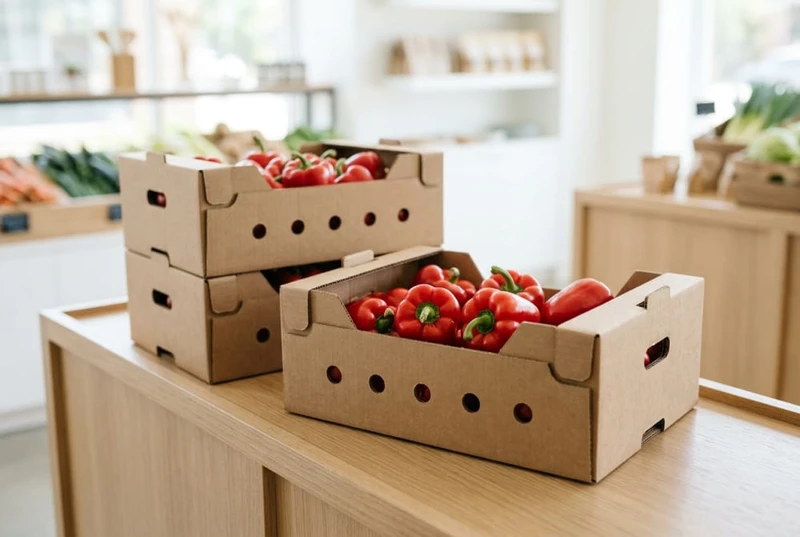
Custom produce packaging plays a practical role in the Australian fresh food chain. It is not only about putting fruit or vegetables into a box. The right structure affects airflow, stacking strength, shelf presentation, label visibility, picking speed, truck fill, cold-chain stability, and product loss. From Bowen mangoes moving south, to apples from Tasmania, citrus from the Riverland, leafy greens packed near Werribee, and mixed vegetable cartons entering Sydney Markets or the Melbourne Wholesale Market, packaging decisions shape what arrives in saleable condition.
For growers, packhouses, wholesalers, and retailers, the best packaging balances three priorities at once: protect the crop, move efficiently, and help it sell. In Australia, that balance is influenced by long transport distances, hot seasonal conditions, export-adjacent handling expectations, supermarket replenishment pressures, and the growing demand for traceability and cleaner shelf-ready presentation. A well-designed carton with the right vent pattern, compression strength, base size, print layout, and sticker system can reduce bruising, speed replenishment, and create more consistent outcomes across multiple produce lines.
This guide explains how produce boxes, stickers, and display-ready formats support different crop categories and selling environments. It also looks at common packing mistakes, standardisation strategies, and how specialised packaging can be adapted for wholesale depots, independent greengrocers, major retail distribution, and regional transport routes across Australia.
Packaging considerations for fruit, vegetables, mixed produce, and farm-packed goods
Different produce categories behave differently under load, temperature change, vibration, and shelf time. Soft fruit such as peaches, nectarines, figs, plums, and ripe tomatoes require more internal restraint and less empty headspace than harder products like potatoes, pumpkins, onions, and oranges. Leafy vegetables need packaging that protects from crushing while allowing adequate ventilation. Mixed produce packs, often used for farm gates, meal-box distribution, independent stores, and short-order wholesale supply, need versatility and clear variety identification.
Fruit packaging often prioritises bruise prevention, airflow, clean presentation, and ease of grading. Stone fruit, apples, pears, avocados, and mangoes benefit from cartons designed around tray count, layer pattern, and pressure control. Vegetables vary more sharply. Root crops tolerate weight but can scuff if cartons collapse or slide. Capsicums and eggplants mark easily. Cucumbers and zucchini need stable placement to avoid pressure bruises along edges. Lettuce and herbs are vulnerable to compression and dehydration, making vent placement and moisture management more important than simple box strength.
Farm-packed goods introduce another layer of complexity because produce is often packed closer to harvest and may move through fewer handling stages before sale. In these settings, packaging needs to support rapid assembly, reliable palletising, and strong identity at point of sale. Many growers also combine direct-to-retail and wholesale distribution, which means the same pack may need to function in a shed, on a truck, in a cool room, and on a store floor.
Custom sizing becomes especially valuable when one operation handles multiple lines with different density and fragility profiles. A workshop with advanced converting equipment can produce cartons and paper-based packs with ventilation, print coverage, and board grade matched to each crop instead of forcing everything into one generic footprint. This improves consistency across fruit, vegetables, mixed packs, and seasonal promotional runs.
| Produce category | Main risk | Recommended box feature | Ventilation level | Typical packing style | Merchandising need |
|---|---|---|---|---|---|
| Apples and pears | Compression marking | Strong corners and tray-compatible depth | Medium | Layer packed | Variety identification |
| Mangoes and avocados | Bruising during transit | Controlled headspace and stable stacking | Medium to high | Single or double layer | Premium visual presentation |
| Leafy greens | Crushing and moisture loss | Side vents and lighter pack weight | High | Loose or bagged inner packs | Freshness cues |
| Tomatoes and capsicums | Pressure bruising | Smooth internal surfaces and shallow profile | Medium | Tray or loose packed | Colour visibility |
| Potatoes and onions | Stack collapse from heavy loads | Higher compression strength | Low to medium | Bulk packed | Clear origin labelling |
| Mixed farm boxes | Cross-damage between items | Dividers or proportioned compartments | Medium | Mixed assortment | Easy item recognition |
The table shows why produce packaging should not be standardised only by cost per unit. In practice, the wrong depth, vent spacing, or board grade can turn a low-cost carton into a high-loss packaging choice once shrink, repacking time, and shelf waste are considered.
Ventilation, stackability, and box sizing decisions that affect real-world performance
Ventilation is one of the most misunderstood packaging variables in produce handling. More vent area is not automatically better. Vents need to match the cooling method, produce respiration rate, and compression profile of the carton. If vents are too large or badly positioned, sidewalls weaken and cartons may bulge or collapse when stacked in cool rooms or trailers. If vents are too limited, residual field heat and moisture build-up can shorten shelf life, especially in warm weather moving through Queensland, New South Wales, South Australia, or Western Australia.
Stackability depends on more than board thickness. Real-world performance is shaped by corner design, flute direction, pallet pattern, moisture exposure, and whether loads are cross-stacked or column-stacked. A box that performs well in a short metro route may fail on a longer trip from Mildura to Brisbane or from regional packing sheds to Perth distribution centres. Compression strength must be designed around the total pallet height, truck vibration, cool-room dwell time, and retailer handling routines.
Box sizing also affects pallet efficiency and produce protection. Oversized cartons create internal movement, encouraging scuffing and bruising. Undersized cartons force overfill, causing lid pressure, sidewall strain, and poor presentation. The best size is one that supports the actual pack count, keeps produce from shifting, and aligns with standard pallet modules used in Australian transport and warehouse systems.
Our manufacturing approach for custom paper boxes is built around dimensional accuracy, board selection, and repeatable die-cutting, which helps customers maintain consistent pallet outcomes over multiple runs. This matters when growers need the same footprint across several seasons, or when wholesalers want packaging that works predictably in racking, loading docks, and retail back rooms.
| Design factor | If underspecified | If overspecified | Operational effect | Best-use scenario | Commercial impact |
|---|---|---|---|---|---|
| Side ventilation | Poor cooling | Weakened walls | Affects freshness and stack strength | Leafy greens, herbs | Lower shrink when balanced |
| Top opening size | Harder product access | Reduced protection | Affects replenishment speed | Retail-ready trays | Faster shelf fill |
| Carton depth | Overfill pressure | Excess product movement | Affects bruise rate | Stone fruit, tomatoes | Less waste in transit |
| Board grade | Carton collapse | Unnecessary cost | Affects load safety | Heavy root veg | Better cost control |
| Footprint standardisation | Poor pallet use | Limited crop flexibility | Affects truck fill | Mixed product programmes | Freight efficiency |
| Handhold design | Unsafe lifting | Wall weakening | Affects handling injuries and drops | Wholesale and store use | Lower handling damage |
This comparison highlights a practical point: packaging performance is rarely about a single feature. Ventilation, stackability, and dimensions must be balanced together, with transport route and handling style built into the specification from the beginning.
The growth trend reflects wider uptake of fit-for-purpose produce cartons in Australia, especially where freight costs, labour pressure, and retailer presentation standards make packaging efficiency more visible in financial results.
How handling needs change between wholesale markets, retail stores, and transport routes
Produce boxes are handled differently in wholesale, retail, and transport settings, so the same crop may need a different packaging structure depending on the route to market. At wholesale markets such as Sydney Markets at Flemington, the Melbourne Wholesale Market in Epping, the Brisbane Produce Market, or Adelaide Produce Market, speed matters. Boxes are unloaded, shifted, inspected, stacked, restacked, and often sold in a short window. Handholds, quick visual product recognition, and reliable stack strength are crucial. A carton that slows unloading or tears during repeated lifting can quickly become a cost problem.
Retail stores need another set of features. Supermarkets and independent greengrocers often want packaging that moves from back room to shelf with minimal repacking. That means clean openings, tidy print, label legibility, and dimensions that fit shelf modules or produce tables. Display-ready formats reduce labour, but only if the structure still protects produce through transport and store handling. Packaging that looks attractive but collapses after one stock rotation is not fit for purpose.
Transport routes across Australia introduce some of the toughest conditions. Long hauls, temperature variation, vibration, delayed unloading, and mixed-load trucking all increase the importance of load stability. Boxes for produce travelling from regional farms into capitals or from one state to another must account for the realities of linehaul freight, regional depots, and pallet transfer points. Sea-adjacent distribution near Port Botany, the Port of Melbourne, Fremantle, or the Port of Brisbane can add further handling stages that stress weak or poorly sized cartons.
Service flexibility is often the difference between packaging that works in theory and packaging that works in practice. A packaging supplier that supports both short-run customisation and larger repeat orders allows growers and wholesalers to adjust formats for local markets, contract retail supply, and seasonal promotions without disrupting the entire operation.
| Channel | Main handling pattern | Key packaging priority | Preferred box style | Label need | Risk if ignored |
|---|---|---|---|---|---|
| Wholesale markets | Frequent manual lifting | Strength and quick identification | Stackable carton with handholds | Large variety and origin marks | Tearing and mis-sorting |
| Independent greengrocers | Back-room to floor transfer | Easy opening and visual appeal | Display-ready tray | Price and origin support | Extra repacking labour |
| Major retail chains | Distribution centre handling | Consistency and shelf efficiency | Standard footprint shipper | Traceable coding | Non-compliance and delays |
| Regional transport | Long vibration exposure | Compression strength | Reinforced carton | Route and batch tracking | Bruising and collapse |
| Farm gate or direct sales | Shorter movement cycle | Branding and convenience | Compact carry box | Producer identity | Weak presentation |
| Hospitality supply | Fast unpack and storage | Clear counts and handling ease | Shallow produce box | Product description | Picking errors |
The table makes clear that “one box for everything” rarely works well. Packaging should match where the product is sold, how often it is touched, and how quickly staff must move it from truck to cool room to display.
The bar chart shows why wholesale and retail remain the core demand centres for custom produce boxes in Australia, while direct and specialised channels continue to grow as branding and traceability expectations rise.
Sticker uses for origin, variety, traceability, and merchandising support
Stickers are often treated as a minor add-on, but in produce packaging they serve operational and commercial roles at the same time. A well-designed sticker system can identify grower origin, varietal information, pack date, grade, batch code, farm region, retailer-specific SKUs, and promotional messaging. In Australian supply chains, where produce may move across long distances and through multiple handlers, clear sticker application supports traceability and reduces sorting mistakes.
Origin labelling is particularly valuable in a market where consumers increasingly notice local provenance. Labels referencing Tasmania, the Goulburn Valley, Stanthorpe, the Riverina, Bundaberg, or the Adelaide Hills can reinforce trust and help independent retailers explain the story behind the produce. Variety labels matter too. Apples, tomatoes, citrus, grapes, and avocados often sell better when the exact variety is visible rather than hidden behind a generic product name.
Traceability is equally important. Batch-coded stickers support recalls, stock rotation, and quality tracking. When combined with carton print, stickers can distinguish between production dates, grades, customer allocations, or different retail programmes using the same base box. This is especially helpful for packhouses managing several growers or crop windows in one facility.
There is also a merchandising function. Clean, well-positioned stickers can improve shelf communication without requiring a full redesign of the carton. For businesses seeking this flexibility, custom sticker production offers a practical way to adapt one packaging structure across several markets or seasonal campaigns while keeping costs controlled. Purpose-built produce identification stickers are useful for traceability, branding, and in-store clarity when box artwork alone is not enough.
From a technology perspective, precise printing and finishing matter. Consistent colour, strong adhesive selection, and clear legibility in cool-room conditions make labels more reliable across the supply chain. Advanced machinery supports repeatable output for both small-batch seasonal runs and larger ongoing programmes, helping packers standardise information without sacrificing flexibility.
| Sticker type | Main purpose | Best placement | Most useful for | Operational benefit | Selling benefit |
|---|---|---|---|---|---|
| Origin sticker | Identify growing region | Front panel | Retail and farm-direct sales | Reduces confusion | Builds provenance value |
| Variety sticker | Name cultivar | Top or front edge | Apples, grapes, tomatoes | Improves sorting | Supports premium pricing |
| Batch code sticker | Traceability | Side panel | Wholesale and major retail | Faster recall response | Improves trust |
| Promotional sticker | Seasonal messaging | Display face | Retail-ready cartons | Flexible campaign change | Boosts visibility |
| Price support sticker | Assist shelf communication | Front lip | Independent stores | Simplifies ticketing | Encourages impulse purchase |
| Handling instruction sticker | Care guidance | Side or top | Fragile fruit lines | Less rough handling | Protects quality reputation |
This table shows that stickers do more than decorate a box. They connect logistics, compliance, and merchandising in a low-cost format that is easy to adapt across crops and customers.
Display-ready packaging ideas that help produce sell more cleanly at shelf level
Display-ready packaging works best when it reduces labour and improves product appearance at the same time. In produce, that usually means cartons or trays that can move from delivery to shelf with minimal cutting, decanting, or rearranging. The design should expose colour and freshness, keep the produce stable during display, and maintain a neat front edge after repeated customer handling.
Common formats include tear-front shippers for tomatoes and citrus, shallow trays for capsicums and stone fruit, carry-display hybrids for berries or smaller specialty produce, and reinforced open-top boxes for potatoes, onions, or pumpkins in high-turn environments. The right format depends on the shelf fixture, stock rotation speed, and whether staff replenish in full boxes or partial top-ups.
Display-ready structures also support hygiene and tidiness. Instead of tipping produce into bins, retailers can place a neat carton directly onto the shelf or produce table. This reduces product handling and can lower surface marking. It also helps preserve batch identity when several varieties are displayed side by side. For independent stores, attractive printed trays can create a premium look without expensive display equipment.
For businesses wanting this approach, custom produce packaging boxes can be tailored to retail shelf depth, case count, opening style, and brand presentation. This is especially useful for mixed-format supply, where one producer serves both wholesale and shelf-ready retail accounts with related but distinct packaging versions.
Service capability matters here as much as structural design. Retail-ready packaging often changes by season, promotion window, or customer specification. A supplier able to handle both pilot runs and scale production gives growers and distributors more room to test new retail formats without overcommitting stock or tooling too early.
The area chart reflects a steady trend toward packaging that serves transport and shelf presentation together. This shift is particularly visible in metro retail, convenience formats, and premium independent fresh food stores.
Where custom sizing reduces bruising, wasted space, and transport inefficiency
Custom sizing creates value whenever standard cartons leave too much void space, force overpacking, or fail to align with pallet and vehicle dimensions. In produce logistics, these sizing errors often cause damage that is blamed on transport or staff handling when the real problem starts with poor fit. A carton that is 20 to 30 millimetres too deep may not sound serious on paper, but over a long route it can allow fruit to bounce, roll, or settle unevenly. Likewise, a carton that is too shallow can create lid pressure and contact bruises.
Transport inefficiency is another hidden cost. If box footprints do not optimise pallet layers, operators lose truck space or need awkward pallet patterns that reduce load stability. This matters on high-volume routes feeding Sydney, Melbourne, Brisbane, Perth, and Adelaide. It also matters for regional operators combining produce from several farms into one outbound load. Better sizing can improve cube efficiency, reduce dunnage, and lower the number of damaged cartons on arrival.
Custom dimensions are especially helpful for mixed produce boxes, gift-style farm hampers, specialty varieties, and produce sold in smaller display units. Instead of using oversized generic cartons, packers can specify a format that matches actual content volume and handling requirements. That means less product movement, less wasted paperboard, and cleaner presentation at delivery.
From a manufacturing standpoint, flexible production capability is important because custom sizing only works commercially if it can be delivered consistently at both modest and large order volumes. Efficient converting lines and disciplined quality checks help maintain dimensional accuracy so that each run stacks and performs the same way as the last.
Transport and stocking mistakes that often damage produce before sale
Many produce losses happen before the shopper ever sees the product. Common transport and stocking mistakes include overstacking weak cartons, mixing incompatible weights on the same pallet, blocking vents with stretch wrap, storing produce in warm receiving areas for too long, and cutting open retail-ready cartons in ways that damage the structural front edge. Even a well-designed box cannot compensate for repeated mishandling.
Another frequent issue is using the wrong box for the route. Cartons suitable for short suburban delivery are sometimes pushed into interstate or overnight transport where they face longer dwell times and more vibration. Likewise, some stores place heavy produce on top of softer items in back rooms, or stack open display trays too high after the original pallet has been broken down. These habits cause bruising, compression marks, and unattractive shelf presentation.
Moisture exposure is also a major factor. Wet cool-room floors, condensation, and direct contact with ice or misting systems can reduce paperboard strength if the packaging was not specified for those conditions. Staff training should cover not only product handling but also how to preserve carton integrity after arrival. That includes lifting from handholds, keeping vents unobstructed, rotating stock correctly, and avoiding overfill during shelf top-up.
The most effective prevention combines correct packaging with route-specific handling rules. Growers and distributors that review damage patterns by crop, customer, and destination usually uncover repeatable issues that can be solved through better box sizing, clearer labels, or stronger shelf-ready formats.
| Mistake | Where it happens | Immediate effect | Longer-term impact | Packaging fix | Process fix |
|---|---|---|---|---|---|
| Overstacking soft fruit | Cool room and truck | Compression bruising | Short shelf life | Higher strength shallow tray | Limit pallet height |
| Blocking vents with wrap | Dispatch | Reduced cooling | Faster deterioration | Redesigned vent pattern | Wrap training |
| Loose fill in oversized box | Packing shed | Scuffing | More rejects at store | Custom dimensions | Pack-count control |
| Rough lifting by sidewalls | Wholesale floor | Torn carton | Product drops | Better handholds | Handling instruction |
| Using wet-unsafe cartons | Cold storage | Wall softening | Stack collapse risk | Appropriate board selection | Storage discipline |
| Poor shelf replenishment | Retail store | Messy display | Lower sales conversion | Display-ready tray | Clear opening guide |
The repeated pattern is simple: many losses are avoidable when packaging specification and handling practice are developed together rather than treated as separate decisions.
How growers and packers can standardize packaging across different crop categories
Standardisation does not mean using one identical carton for every product. It means building a rational packaging system with shared footprints, compatible pallet patterns, predictable print zones, and coordinated sticker logic across multiple crop categories. This approach helps growers and packers reduce procurement complexity while still allowing crop-specific adjustments in depth, board grade, vent design, and display format.
A practical model is to define a small family of standard base sizes for fruit, vegetables, mixed packs, and display-ready formats. From there, each crop can be assigned the most appropriate height, opening style, and ventilation pattern. This gives operations a cleaner inventory structure while keeping protection performance aligned to the actual produce. Standard print locations and label panels also simplify warehouse scanning, stock control, and customer-specific coding.
For packhouses managing several growers, standardisation improves line changeovers and reduces packing errors. For wholesalers, it improves stacking and store allocation. For retailers, it supports cleaner shelf execution and easier back-room organisation. The key is to design the packaging family around the handling reality of the business rather than around a purely generic box catalogue.
By 2026, three trends are expected to shape standardisation in Australia even more strongly. First, sustainability targets will push more businesses toward right-sized, material-efficient paper-based formats. Second, retailer and supply-chain policy requirements are likely to increase expectations for traceability and clearer pack identification. Third, technology will continue to improve short-run customisation, enabling growers to standardise structure while varying print, sticker data, and customer-specific branding more easily. These trends favour suppliers with strong technical capability, precise manufacturing, and responsive service for both custom development and repeat production.
The comparison chart illustrates why many Australian produce businesses are moving away from generic stock cartons. Formats that combine structural fit, traceability support, and shelf readiness perform better across the full supply chain.
Australian market realities and buying advice
In Australia, produce packaging buyers should start with route conditions rather than unit price alone. A carton for local delivery around Sydney or Melbourne may not suit a longer run from regional Queensland, the Riverland, or Tasmania. Buyers should assess crop fragility, expected pallet height, cooling method, moisture exposure, and whether the box is sold through wholesale, chain retail, independents, or mixed channels.
Ask suppliers about vent configuration, compression performance, print consistency, dimensional tolerance, and minimum order flexibility. For seasonal produce, it is often useful to trial one or two variants before locking in a season-long run. For multi-crop operations, request a coordinated packaging family rather than buying unrelated boxes one by one. This usually improves procurement efficiency and handling consistency over time.
Also review the role of stickers and variable identification. Where varieties, grades, or customer destinations change frequently, combining a standard carton with adaptable sticker systems can be more efficient than printing every variation as a separate box. This is particularly useful for producers supplying both wholesale markets and retail-ready programmes.
Industries, applications, and local supplier considerations
Fresh produce packaging is relevant across farming, packhouses, wholesale market trading, supermarket supply, convenience retail, hospitality distribution, meal-kit assembly, and direct-to-consumer farm programmes. Applications range from orchard fruit and vine crops to leafy vegetables, root crops, citrus, tropical fruit, and seasonal mixed produce boxes.
When evaluating local suppliers, Australian buyers should look for three broad strengths. The first is technological capability: precise die-cutting, dependable printing, and the ability to produce both boxes and stickers to coordinated specifications. The second is manufacturing capability: efficient production for small custom runs as well as large-volume repeat orders, supported by quality control from material selection through final inspection. The third is service capability: responsiveness on design refinements, flexibility on order size, and clear communication on delivery timing, especially during harvest peaks.
These capabilities matter because produce programmes are rarely static. Seasonal shifts, retailer promotions, weather impacts, and changing crop volumes all require packaging suppliers that can respond quickly without sacrificing consistency.
Case examples from Australian supply chains
A citrus grower supplying both Adelaide Produce Market and suburban retail stores may use one standard footprint with two top styles: a stronger closed carton for wholesale transport and a tear-front version for shelf-ready store replenishment. A mango packer in North Queensland may reduce bruising by moving from a generic deep carton to a shallower, count-specific box with better restraint and cleaner vent placement. A mixed vegetable supplier servicing hospitality accounts around Melbourne may improve picking accuracy by adding colour-coded stickers for product type and batch date while keeping the same outer box dimensions.
Another common case is the independent greengrocer channel. Retailers often prefer produce to arrive in trays or boxes that can sit neatly on shelf or bench without a messy decanting step. Suppliers who adapt box height, opening line, and display face printing for this channel often see better presentation and less back-room handling damage. These are not abstract design changes; they are operational decisions that improve saleable yield.
About our packaging capability for Australia
We support Australian businesses with custom paper boxes, stickers, and packaging solutions designed for practical supply-chain use. Our workshop uses advanced production equipment to deliver consistent structure, print quality, and finishing, which is important when carton dimensions, vent placement, and label clarity affect freshness and handling. Across manufacturing, we manage both small-batch custom work and larger-scale production with attention to material selection and inspection at each stage. On the service side, we focus on flexible response, efficient order handling, and packaging development that can be adapted to different crops, channels, and merchandising goals without unnecessary complexity.
Frequently asked questions
| Question | Short answer | Why it matters | Best practice | Common mistake | Useful outcome |
|---|---|---|---|---|---|
| Should all produce use ventilated boxes? | No, ventilation should match crop and route | Too much or too little both cause problems | Set vents by respiration and strength needs | Using one vent pattern for all crops | Better freshness and stacking |
| Are stock cartons cheaper overall? | Not always | Damage and wasted space add hidden cost | Compare delivered performance, not unit cost only | Ignoring freight and shrink | Lower total packaging cost |
| When are stickers most useful? | When origin, variety, or batch changes often | They improve traceability and merchandising | Use consistent label zones | Applying inconsistent formats | Cleaner operations |
| Can one supplier handle boxes and labels together? | Yes, if they have integrated capability | It simplifies coordination | Align artwork and data requirements early | Managing separate specs manually | Fewer supply issues |
| What helps shelf-ready produce sell better? | Easy-open trays with tidy front presentation | Shoppers respond to clean, accessible displays | Design around actual shelf dimensions | Using transport cartons as ad hoc displays | Better shelf appeal |
| What is the biggest packaging error for growers? | Choosing by price without route testing | Performance failures show up after dispatch | Trial under real transport conditions | Approving packaging from desk review only | More reliable season outcomes |
The FAQ table underlines a central principle: produce packaging works best when it is treated as part of handling strategy, transport planning, and merchandising execution, not as an afterthought once the crop is harvested.
For Australian growers, packers, wholesalers, and retailers, custom produce packaging is ultimately a performance decision. The right box structure, sticker system, and display format can support ventilation, protect fragile crops, improve pallet efficiency, simplify traceability, and present produce more effectively at shelf level. As sustainability expectations, data requirements, and retail standards continue to rise through 2026, businesses that standardise packaging intelligently across crop categories will be better placed to reduce waste, improve handling, and sell fresh produce in cleaner, more efficient ways.
