
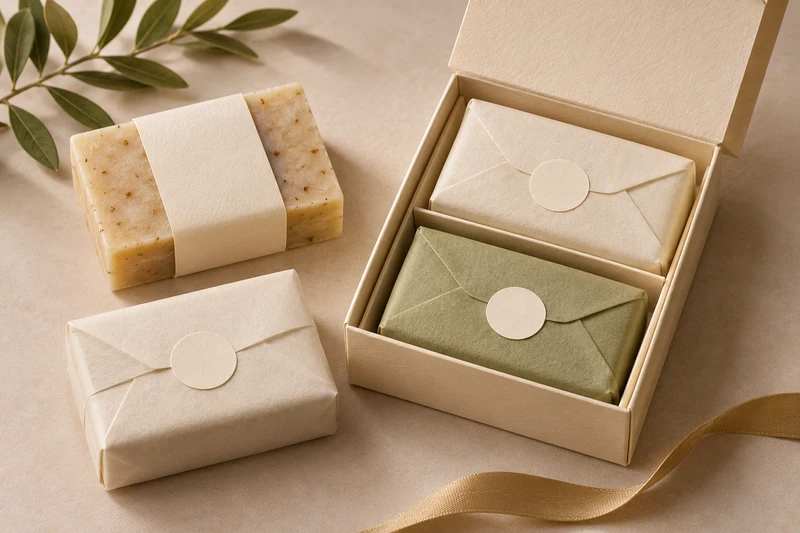
For handmade soap, the right packaging depends less on the bar alone than on how it will be sold. A single bar displayed on a retail shelf may need its colour, texture and scent name to be easy to see. A set intended as a present needs a more coordinated unboxing experience, secure positioning and room for several variants. Online orders may need a retail pack that works within a separate transport-protection system.
For soap makers, retailers and product teams in Australia, the most useful soap packaging ideas start with the sales use: individual retail bars, market-ready wrapped bars, subscription inclusions, corporate gifts or event favours. Sleeves, wraps, labels and gift boxes each answer a different brief. XGolden Print designs and produces custom paper packaging boxes, gift packaging, labels and stickers, with structural design, artwork support, material selection, finishing, inserts and sample approval available for the relevant project.
The sales use decides how much of the soap to cover
A handmade soap bar does not always need to be fully enclosed. The amount of coverage should follow the selling environment, the information required and the desired presentation.
A partially visible bar can support a tactile, handcrafted retail look. It lets customers see details such as marbling, botanicals or an embossed surface, while the paper component carries the brand, scent name and product information. A fully wrapped bar gives more printable area and a more enclosed appearance, which can be useful where the product will be handled often before purchase or packed alongside other items.
Gift packaging works differently again. Rather than treating each bar as an isolated unit, it can bring a collection together: for example, several scent variants, a seasonal selection or a soap-and-accessories presentation. The outer gift box becomes the principal branded object, while individual wraps or labels can identify each bar inside.
| Sales use for handmade soap | Main packaging requirement | Suitable approach | Details to plan |
|---|---|---|---|
| Individual boutique retail bar | Product visibility and clear scent identification | Paper sleeve or wrap with a label | Bar dimensions, front-facing panel, barcode area, label placement |
| Market stall or pop-up display | Quick sorting and easy handling | Wrap with a prominent scent label | Variant names, pack workflow, batch or product information space |
| Online order inclusion | A presentable retail pack within an outer dispatch pack | Sleeve, wrap or small box | Pack weight, movement within the order, separate transport protection |
| Multi-bar gift set | Coordinated presentation and orderly layout | Lid-and-base, drawer or magnetic closure gift box | Number of bars, internal layout, access, insert requirements |
| Event favour or corporate gift | Branding and efficient assembly | Compact box, wrap or coordinated label system | Personalised artwork, quantity, recipient experience and packing sequence |
The decision is not simply “minimal packaging versus premium packaging”. It is a choice about what the customer needs to recognise first and how the product will be picked up, displayed and given.
Before selecting a format, define:
- whether one bar is sold alone or with other products;
- the finished bar’s length, width, height and weight;
- how much of the bar should remain visible;
- which panel needs the scent name, ingredient information, barcode or brand mark;
- whether shop staff need to identify variants quickly from the side or top;
- whether the soap will be placed in a separate outer carton, satchel or other dispatch packaging for online orders; and
- the intended gift occasion, if presentation is the priority.
Retail and gift packaging should not be assumed to be a complete transport protection system. If soap bars are sent through an online fulfilment process, the retail sleeve, wrap or gift box needs to be considered alongside the outer packaging and packing method used for the journey.
Sleeves that leave part of a bar visible
A soap sleeve is a paper band that passes around part of the bar while leaving the front, sides or top exposed. It is often a practical option for handmade soap because it can display the product itself while creating a defined print area.
For a retail bar, a sleeve can put the essential message on the front: brand, scent or variant, bar type and a visual cue such as colour coding. The rear panel can carry additional information where needed. The visible soap remains part of the shelf presentation, so the sleeve artwork should work with the natural variation of the bars rather than rely on every bar looking identical.
What to measure for a soap sleeve
A sleeve needs the actual finished bar dimensions, not only the nominal mould size. Handmade bars can vary slightly once cut, cured or finished. Measure a representative range and identify the dimensions that the sleeve must accommodate.
Include in the brief:
- finished bar length, width and height;
- the direction the bar will sit in the sleeve;
- the preferred exposed faces;
- the desired overlap or joining arrangement;
- the approximate bar weight;
- whether the bar has an uneven, bevelled or textured edge; and
- how the sleeve will be applied during packing.
If a sleeve fits too closely, it may be difficult for staff to apply consistently. If it is too loose, it can rotate or obscure the intended front panel. Structural design and sample approval are valuable at this stage because a flat artwork file cannot confirm how the paper band will sit on the physical bar.
Sleeve artwork for shelf-facing identification
The front of a sleeve should let a customer distinguish one scent from another at a glance. For a range with several varieties, set a hierarchy before designing:
- Brand identifier
- Scent or product variant
- Product descriptor
- Supporting details and decorative artwork
This hierarchy is especially useful when soaps are displayed in trays, stacks or wall shelving where only one face may be visible. Consider what appears on the narrow side panels as well as the front. A short scent name or colour strip on the edge can help staff and customers sort the range without repeatedly lifting every bar.
For Australian retail projects, prepare artwork in the language and form needed for the intended sales channels, and reserve appropriate space for the product information your business must provide. XGolden Print can provide artwork support, but content responsibility and any product-specific requirements remain with the soap brand.
Wraps and soap labels for individual bars
A full paper wrap gives an individual handmade soap bar more coverage than a sleeve and more surface area for graphics, storytelling and product identification. It can suit bars sold as a complete branded unit, assortments where each soap needs its own presentation, or ranges with substantial on-pack information.
A wrap is not automatically the right choice for every handmade bar. Its success depends on the fold layout, the shape of the soap and the packing workflow. Straight-sided rectangular bars are generally simpler to wrap consistently than unusually shaped or heavily textured pieces. Where the bar has a pronounced surface pattern that is important to the purchase decision, a sleeve may preserve more visibility.
Labels and stickers can support either format. A label may identify a scent variant, close a wrap, add a batch-specific detail or apply a branded seal to a box. The label should be designed around the surface it will be applied to: bare paper, a coated box, a bag, jar or another agreed surface. Its size, shape and roll or sheet format should be selected for the actual application method, whether placed by hand during a small packing run or incorporated into a more repeatable workflow.
The LS-323 soap wrap labels provide a relevant style reference for a soap-wrap label approach. It is useful when considering how a label can contribute to an individually presented bar. However, it does not establish a dedicated soap-box construction and does not confirm direct soap-contact suitability for a particular project.
Avoid confusing the label with the contact layer
A paper wrap or label is an outer presentation and identification component unless the agreed construction specifies otherwise. Do not assume that a paper, adhesive, coating or finish is suitable for direct contact with soap simply because it is used on outer packaging.
This distinction matters when the bar touches its wrap, sits against an insert or is placed inside a gift box. The soap brand should identify:
- whether there is a separate primary wrap or liner;
- which packaging components touch the bar;
- whether an internal divider, tissue or other layer is required;
- whether any fragrance, colour, surface residue or moisture-related characteristic could affect the packaging; and
- which suitability checks are needed for the chosen material and construction.
Material suitability, finishes and contact-layer arrangements must be confirmed for the individual project. This is a practical design step, not a cosmetic afterthought.
For labels used on boxes, bags or other sales packaging, XGolden Print can specify custom dimensions, shapes and agreed roll or sheet formats. See the custom label and sticker options when preparing a brief that needs a particular placement, shape or application workflow.
Gift boxes for a coordinated soap collection
Gift boxes are suited to handmade soap collections where the opening experience matters as much as the individual bars. They can bring together several soaps, a limited-edition scent set, a corporate gift or a wedding and special-event favour collection.
A box should be planned from the contents outward. Start with the number of bars and any accompanying products, then determine the internal layout, access and exterior presentation. A three-bar set may need each bar held in a row; a mixed gift could need separate positions for items of differing dimensions. The box should not be selected only from an exterior photograph or a desired style name.
XGolden Print offers rigid boxes, magnetic closure boxes, drawer boxes and lid-and-base boxes as packaging formats. Each can support a different gift brief when its dimensions, internal arrangement and opening sequence are developed around the customer’s products.
Matching the box format to the gift experience
A lid-and-base box can suit a formal reveal, where lifting the lid introduces a carefully arranged soap collection. A drawer box can make the set feel more sequential, with the contents sliding into view. A magnetic closure box can support a more substantial presentation format when the opening and reclosing action is part of the intended experience. A rigid box may suit a gift set requiring a structured outer form.
The correct choice depends on the contents, not on an assumption that one format is universally more premium. Ask:
- How many soap bars will be included?
- Will each bar be individually wrapped, sleeved or exposed within the box?
- Is there another customer product in the set, such as a candle or a jarred item?
- Should the recipient see all contents at once or discover them in layers?
- Does the box need a finger notch, ribbon pull or another access feature?
- Will the set be assembled by hand, and in what order?
- Is an insert needed to separate the bars or hold multiple products in position?
Fitted inserts can be planned to organise the contents and maintain the intended layout during retail handling. Their material, finish and fit should be confirmed against the actual products, including the final wrapped dimensions rather than the bare soap dimensions alone.
For a new multi-product brief, our custom box service can support structural design, material selection, artwork, printing, finishing, fitted inserts and sample approval. For a set built specifically around an occasion or coordinated range, explore gift packaging development.
Gift boxes are not automatically mailing cartons
A soap gift box may look complete on a counter or when handed to a recipient, but it is not necessarily designed to manage all transport conditions by itself. For online orders, specify the outer dispatch packaging separately and plan how the gift box will sit within it.
Give the packing team a clear sequence: individual bar preparation, placement in the insert or box, closing method, any additional presentation components, and placement into the outer shipping pack. This helps avoid a gift box that is attractive in isolation but awkward to assemble or inconsistent in fulfilment.
Scent identification and contact-layer checks
Scent is often the main way a customer differentiates one handmade soap from another, so it needs a consistent naming and visual system across sleeves, wraps, labels and gift boxes.
Place the scent name where it can be read in the way the product is displayed. A bar presented upright in a retail tray may need the scent on the front or top edge. A gift box stored flat may need the set name on the lid and individual scent names on internal wraps. For online orders, the customer should be able to identify the variant without unwrapping every item after opening the delivery.
Use a controlled naming system for variants. If one bar says “Lemon Myrtle”, another says “Lavender Fields” and a third uses only a colour, staff and shoppers may struggle to scan the range. Keep the product name in a consistent position and make decorative illustrations secondary to the core identifier.
At the same time, avoid making packaging claims that have not been approved by the soap brand. Packaging copy should not imply cosmetic, therapeutic, regulatory or product-performance outcomes unless the brand has determined that the wording is appropriate for its own product.
Contact-layer decisions need equally careful treatment. If bars are packed directly against an insert, wrapped in paper or secured with a sticker, document exactly what touches what. The project brief should distinguish:
- primary or contact layer: the material directly against the soap, if any;
- retail presentation pack: the sleeve, wrap, label or gift box seen by the shopper;
- outer transport pack: the separate packaging used for dispatch and handling in transit.
That separation allows the brand, packaging designer and production team to discuss the right component rather than treating “soap packaging” as one material decision.
Trial packing and shop presentation
A sample is most valuable when it is used in the real packing and display process. Trial pack the actual finished bar, not a substitute object of similar dimensions. Check how the sleeve or wrap aligns, whether labels apply cleanly, how each variant is recognised, and whether the final presentation remains orderly when products are handled.
For gift sets, trial the full sequence:
- Prepare the individual bar packaging.
- Place each bar in the intended insert or box layout.
- Close the box as a customer or packing team member would.
- Check the front, side and top presentation in the intended retail position.
- Place the gift box into the proposed outer dispatch packaging if it will be sold online.
- Record adjustments needed to dimensions, artwork panels, insert spacing or packing steps.
Common problems are usually practical rather than dramatic: scent names hidden by folds, a sleeve that turns on a tapered bar, a label placed over a key artwork panel, an insert designed for bare bars rather than wrapped bars, or a box that requires too many manual adjustments to pack neatly.
A useful brief for XGolden Print should include product dimensions and weight, number of variants, reference images or artwork, required quantity, intended retail or gift use, desired packaging format, packing sequence, required delivery date and delivery destination. If the project involves a multi-item collection, list every item and its finished packed dimensions.
XGolden Print brings 27 years of experience to custom paper packaging projects, supported by a 15,000 square metre factory, 500+ employees and 10M+ production capacity. For handmade soap, the practical value is in turning a defined retail, gift or label brief into an agreed packaging structure, artwork and sample before production. Discuss your soap packaging project with XGolden Print via our gift packaging service, and provide the bar dimensions, quantity, artwork, required date and delivery destination.
