
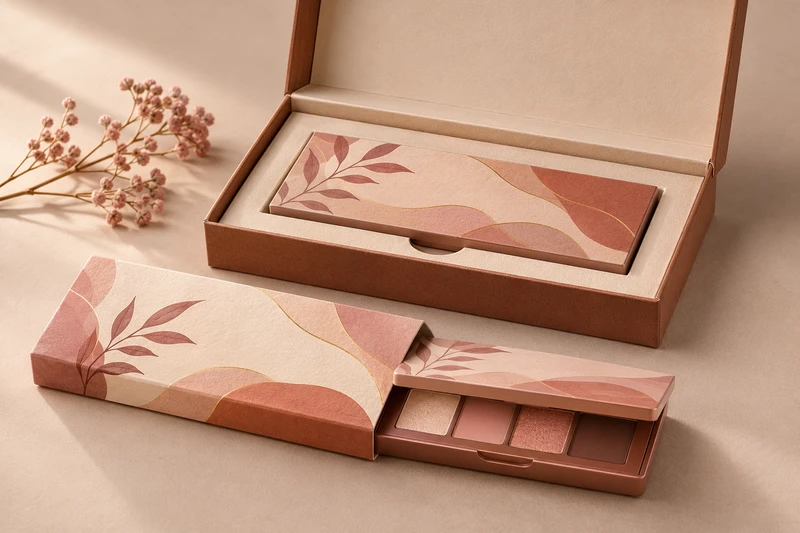
Makeup palette boxes are outer presentation packs made to hold a finished cosmetic palette for retail display, gifting or fulfilment. They are not the empty refillable palette, pan holder or cosmetic compact component itself. A well-planned box gives the finished palette a clear shelf presence, supports shade identification and allows customers to remove the product without catching corners or damaging the palette’s lid edges.
For packaging buyers in Australia, the most useful starting point is the actual closed palette: its length, width, height, corner shape, opening direction, weight and any existing wrap or carton. XGolden Print designs and produces custom paper packaging for beauty products, including boxes, gift packaging, labels and stickers. We can support the structural design, material selection, artwork, printing, finishing, fitted inserts and sample approval needed for a makeup palette packaging brief.
Outer boxes and palette components are different products
A makeup palette box is secondary packaging around a completed product. It may be used to present an eyeshadow, face, blush, contour, highlighter or mixed-colour palette that already has its own primary compact, case or closure.
The palette component, by contrast, is the product housing that holds cosmetic pans or refillable inserts. It may include a hinge, clasp, mirror, wells or magnetic features. That is a different product category from a paperboard outer box.
This distinction matters when preparing a packaging enquiry. A supplier designing makeup palette boxes needs information about the finished external palette, rather than the dimensions of empty pans or internal makeup wells. Provide the closed palette measurements and any features that affect the outside profile, such as:
- A raised logo, clasp or magnetic catch
- Rounded, square or sharply angled corners
- A hinged edge that sits higher than the rest of the palette
- A sleeve, protective wrap or tamper seal already used around the compact
- A protruding pull tab, ribbon, applicator or accessory
- Variations between shade collections or palette editions
An outer carton can make a compact easier to merchandise and gift, but it should not be presented as a complete transport-protection system by itself. If palettes will move through online order fulfilment, distribution or event packing, assess the outer shipping configuration separately. The level of transit protection needed should be tested with the complete packed product and its intended delivery journey.
What a finished palette needs from its packaging
The best makeup palette boxes balance presentation with practical handling. A palette often has a broad, flat profile, so small errors in internal dimensions can make the pack look loose, difficult to open or awkward to remove.
Clearance around the lid edges and corners
The inside of the box needs enough clearance for the finished compact to slide in and out without scraping lid edges, corners or decoration. At the same time, excessive space can allow the palette to shift inside the carton and reduce the sense of a considered fit.
Do not base the box size only on the nominal dimensions from a product drawing. Measure the actual finished palette, including coatings, closure hardware, labels, wraps and any slight variation across production samples. If the palette has square corners, it is particularly important to check the inner corner geometry of the proposed box.
Clearance is a design decision rather than a fixed rule. It depends on the palette material, its finish, the carton structure, whether an insert is used and how the product will be packed. Confirm the final fit through a physical sample before production.
Product removal access
A tight-fitting palette can look premium but still frustrate customers if there is no sensible way to lift it out. Buyers should consider removal access from the beginning, especially for wide, shallow palettes.
Possible access approaches include:
- A finger gap or shaped cut-out in an insert
- A ribbon lift where appropriate to the pack design
- A tray arrangement that gives fingers room at one side
- A slightly raised insert that makes the palette easier to grip
- A lid-and-base structure with an opening sequence suited to gift presentation
The chosen approach should work with the actual palette, not just an empty box sample. A cut-out that looks neat on a drawing may be too shallow once the compact, protective wrap and insert material are in place.
Retail, gifting and fulfilment requirements
A single palette range may need different packaging treatments depending on where and how it is sold.
| Use case | What the makeup palette box needs to do | Packaging points to consider |
|---|---|---|
| Retail shelf display | Present the palette clearly and identify the range or shade | Front-facing artwork, barcode area if required, shade name and consistent variant coding |
| Premium gift purchase | Create a deliberate opening experience around a finished palette | Lid-and-base or rigid structure, coordinated graphics, insert layout and easy product removal |
| Online orders | Support a neat unboxing presentation while working within the wider fulfilment pack | Secure internal fit, clear product identification and separate evaluation of the shipping carton |
| Beauty gift set | Hold a palette with other finished products or accessories | Compartments, fitted inserts, item sequence and dimensions for the full set |
| Event or corporate gifting | Carry event artwork and accommodate the intended handover format | Co-branded artwork, named variants, coordinated set presentation and packing workflow |
For gift sets, plan the box around every included customer product, not just the palette. A palette paired with brushes, a pouch, skincare items or printed cards may require compartments or an insert that controls the layout. XGolden Print can plan custom gift packaging around multiple products, coordinated branding and the intended opening experience.
Comparing a sleeve with a presentation box
A sleeve and a presentation box can both be used around a makeup palette, but they serve different packaging purposes.
A sleeve is an outer paperboard band or cover that slides over another pack or product. It can offer a broad printable area while leaving some of the underlying compact or carton visible. It may suit a campaign edition, a simple retail identification layer or a palette that already has a suitable primary presentation case.
A presentation box is a more complete outer package, such as a lid-and-base box, magnetic closure box, drawer box or another custom paper structure. It can be more appropriate when the opening sequence, gift appearance and internal product positioning are central to the brief.
| Consideration | Sleeve | Presentation box |
|---|---|---|
| Product visibility | Can reveal part of the palette or underlying pack | Usually encloses the palette more fully |
| Opening experience | Simple slide-on and slide-off action | Can create a more staged reveal |
| Artwork area | Strong exterior branding space, depending on format | Exterior, interior and insert areas may be available |
| Internal positioning | Usually relies on the pack beneath it | May incorporate a tray or fitted insert |
| Suitable brief | Lightweight branded layer or campaign presentation | Retail gifting, premium launches and curated sets |
A sleeve should not be assumed to fit every compact. It needs enough tolerance to slide over the finished item while staying in position during handling. Conversely, a fully enclosing box must still allow the buyer to remove the palette cleanly.
Neither structure automatically provides a defined level of impact protection. If the pack will be distributed through multiple handling stages, specify the transport packaging separately and verify the complete solution through appropriate testing.
The LB-304 lid-and-base format
For a flat palette requiring a gift-style outer box, the LB-304 makeup palette lid-and-base box is a relevant XGolden Print format example. As its name indicates, it uses a lid-and-base structure: the lid lifts away from the base to reveal the packed palette.
This format can suit a makeup palette where the brand wants an intentional opening action rather than a simple sleeve removal. The broad lid can also provide a clean surface for collection branding, campaign artwork or product information, while the base can be planned around the finished palette dimensions.
The LB-304 example should be treated as a starting structure, not proof that every palette will fit. Palette depth, corner profile, closure hardware, protective wrap and removal method all need checking against the individual project. Dimensions, material choice, finishes, insert construction and order terms must be confirmed for the proposed pack.
When evaluating a lid-and-base box for a palette, ask these practical questions:
- Does the lid lift off without catching on the palette or insert?
- Is there sufficient internal clearance at the corners and along the hinge edge?
- Can a retail team pack the product consistently?
- Can a customer remove the palette without turning the box upside down?
- Does the opened pack show the palette in the intended orientation?
- Is the box for presentation only, or does the wider dispatch pack need additional protection?
XGolden Print can develop custom boxes across structures including rigid boxes, magnetic closure boxes, drawer boxes and lid-and-base boxes. Structural design should follow the actual product use rather than selecting a format solely from a photograph or rendered concept.
Artwork space and shade identification
Makeup palette packaging often needs to communicate two messages at once: the master brand or collection identity, and the specific palette variant. The front panel may carry campaign artwork, while the back, base or side panel can provide practical product identification.
For Australian retail and e-commerce teams, artwork planning should account for where customers, warehouse teams and store staff need to identify the product. This may include the palette name, shade story, collection, SKU reference, barcode space, ingredient or product information supplied by the brand, and any required local-language copy.
Keep the information hierarchy clear:
- Front or lid: collection identity, palette name and visual campaign design
- Side panels: shade family, range name or concise variant cues
- Base or back: operational information, barcode area and product details supplied by the brand
- Insert or inner panel: a gifting message, usage card or campaign content where relevant
Where a range includes several palette variants with similar exterior artwork, distinguish them clearly. Small shade names placed only in decorative areas can be difficult for retail teams to find. Consider whether the variant needs to be readable when boxes are stacked, stored flat or photographed for an online product listing.
Labels and stickers may also be useful where the shade identifier, batch-specific information or retailer reference is not part of the core printed artwork. XGolden Print can produce custom labels and stickers in agreed dimensions, shapes and roll or sheet formats. Confirm the intended application surface, label placement and packing method before choosing this route.
Artwork should be developed alongside the box dieline and structure. A logo that sits too close to a fold, lid edge or corner may not produce the intended visual result. Likewise, a lid-and-base box may have separate artwork areas that need alignment across the lid and base when closed.
Fit and handling checks with the real palette
A physical fit review is the most important step before approving makeup palette boxes for production. Digital dimensions and visual mock-ups are useful, but they cannot fully show how the finished compact feels in the box.
XGolden Print offers sample approval before production, allowing buyers to evaluate the packaging with the real palette. Use that stage to check both the product’s appearance and the handling sequence.
What to test in a sample review
Pack the actual finished palette in the proposed format and assess:
- Whether the palette slides into position without force
- Clearance around all lid edges, corners and closure details
- How the compact sits after repeated opening and closing of the outer box
- Whether fingers can remove the palette easily and consistently
- The orientation of the logo and shade information when the box is opened
- Whether the insert, if used, holds the intended product layout
- How the pack looks on a shelf, in a gift set and in product photography
- How packing staff will place the palette, cards or accessories into the box
- Whether the outer presentation pack needs a separate shipper or protective packing method
Do not claim mirror protection, compact protection or impact performance based only on the appearance of the box. If the palette contains a mirror or delicate internal contents, assess the complete packed product through sample review and the testing appropriate to its intended handling conditions.
Common briefing mistakes to avoid
A stronger brief avoids avoidable rework. Common issues include supplying dimensions for an empty compact rather than the finished product, overlooking a raised hinge, choosing an insert before all gift-set items are confirmed, or finalising artwork before the box construction is agreed.
It is also worth separating three packaging layers in the brief:
- Primary product component: the finished makeup palette or compact.
- Presentation packaging: the makeup palette box, sleeve or gift box.
- Transport packaging: the outer packing used for dispatch and distribution.
Each layer has a different role. The presentation box can improve retail appearance and the gifting experience, while the transport pack needs its own assessment for the proposed distribution route.
Preparing a makeup palette box brief
Before contacting XGolden Print, gather the information that directly affects fit, appearance and packing workflow:
- Closed dimensions and weight of the finished palette
- Photos of the top, base, sides, hinge and closure
- Quantity of palette variants and how they differ
- Whether the palette has a wrap, seal, label or existing carton
- Preferred structure, such as a sleeve, lid-and-base box or gift-set box
- Required internal layout, removal access and any insert needs
- Artwork files, brand guidelines and product copy
- Intended retail, gifting, online order or event use
- Required delivery date and destination
- The wider shipping arrangement if the boxes will be dispatched with products inside
XGolden Print can help turn those inputs into a packaging brief covering structure, materials, artwork, printing, finishing, inserts and sample approval. To discuss makeup palette boxes, share the finished palette dimensions, quantity, artwork, required delivery date and delivery destination with XGolden Print’s custom box team.
