
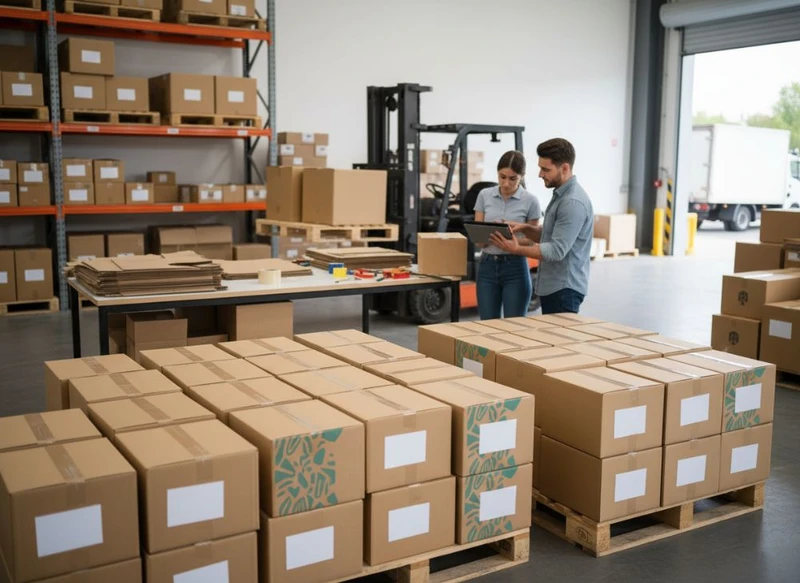
Custom packaging does not need to begin with a fully bespoke box, multiple print finishes and a large order. For many Australian small businesses, the most economical approach is to standardise the pack format, reserve custom elements for the customer-facing details, and order only where repeat demand supports it.
Maximising your budget: affordable custom packaging for small businesses is largely about making deliberate trade-offs. Spend on the details customers notice—clear branding, a secure fit and an easy unboxing experience—and simplify the elements that add cost without improving the product’s presentation or protection.
Before requesting quotes, define four basics: the product dimensions and weight, expected order quantities, required level of protection, and the role packaging plays in your brand experience. This prevents comparing prices for packaging that is not genuinely equivalent.
Smart Strategies for Ordering in Bulk
Buying in larger quantities can lower the cost per unit because set-up, materials and production preparation are spread across more boxes. However, ordering the largest possible quantity is not always the best financial decision. Packaging takes up storage space, designs can change, and a product range may evolve before every box is used.
A sensible bulk-order strategy matches your order volume to expected sales and the life of your design.
Consider dividing packaging into three groups:
- Core packaging: Plain mailers, shipping cartons or regularly used product boxes that are unlikely to change. These can often suit larger orders.
- Branded packaging: Printed boxes, sleeves or inserts featuring a logo and brand colours. Order cautiously if you are refreshing your identity or testing products.
- Campaign packaging: Seasonal messages, limited-edition artwork and event-specific gift packs. Keep quantities conservative because they have a shorter useful life.
Calculate the real unit cost
A low price per box is useful only if the whole order will be used. Include these costs in your comparison:
- Packaging unit cost
- Design, artwork or pre-press charges where applicable
- Storage and handling
- Potential waste from changed products or branding
- Cost of adding protective void fill or inserts
- Reordering costs if an initial quantity is too small
Ask suppliers to quote several quantity breaks using the same specification. For example, compare your near-term requirement with two larger quantities. The result shows whether the saving is meaningful enough to justify extra stock.
Build a repeatable packaging system
A small number of packaging formats is easier to manage than a separate box for every product. Where practical, use one or two core box footprints, then adapt the presentation with labels, sleeves, tissue or inserts. It can reduce purchasing complexity while keeping your range visually consistent.
Choosing Standard Sizes to Save on Die Costs
A custom die-cut box can deliver an exact fit and a distinctive opening experience, but it may require a new cutting tool and more design preparation. Standard-size packaging can avoid or reduce these upfront costs, particularly for a new product or short run.
Start by measuring the packed product, not just the product itself. Include any protective wrap, instruction card, accessory, cap, handle or insert. Then allow enough room for practical packing without choosing an oversized box.
Standard sizes are often a good fit for:
- Apparel and soft goods
- Books, stationery and printed products
- Candles and small homewares
- Cosmetics and gift sets with similar dimensions
- Subscription products with a consistent assortment
A stock box can still look considered when it is paired with a branded label, printed sleeve or well-designed insert. Browse custom box options when you need to compare formats and consider whether a standard structure can meet the same functional need.
When a custom size may be worth it
A custom size may make commercial sense when a standard box leaves too much empty space, requires excessive protective material or does not adequately support a fragile item. It can also be worthwhile for a premium product where the box is part of the presentation.
Before committing, confirm:
- Internal dimensions after folding, not only external dimensions.
- Board type and strength appropriate for the product and transport method.
- Whether the box requires an insert, divider or protective wrap.
- Any minimum order quantity and separate tooling charge.
- Whether the dieline can be reused for future runs of the same format.
A common mistake is choosing a box based only on a product’s length, width and height. Closure flaps, packing tolerance and protective materials can all affect whether the final pack actually works.
DIY Touches: Using Label Stickers on Stock Boxes
Label stickers are one of the most flexible ways to create branded packaging without printing every box. A plain stock carton, mailer or kraft box can become product-specific with a carefully placed label.
This approach works especially well when you have multiple product variants, frequent seasonal releases or uncertain sales volumes. Keep the base packaging neutral, then change the sticker artwork as your range changes.
Useful label applications include:
- A logo seal across a closing flap
- Product name, flavour, scent or shade identification
- Batch, handling or usage information where required
- A short thank-you message inside the box
- A tamper-evident seal, where suitable for the product and pack design
- A limited-edition or seasonal graphic
Explore custom label stickers if a label-led approach suits your packaging plan.
Choose labels for the actual surface
Not every sticker works equally well on every box. Confirm the label material and adhesive against the surface you will use, particularly for textured kraft paper, uncoated board, recycled-content stock, chilled products or surfaces exposed to moisture.
Also consider:
- Label size: A large label can wrinkle over folds or corners.
- Placement: Keep important copy away from seams, opening tabs and barcode areas.
- Print legibility: Fine text and pale colours may be difficult to read on a textured or dark box.
- Application process: A label that is slow to apply can create packing bottlenecks as order volumes grow.
For a clean result, create a placement guide so every packer applies the label in the same position.
Finding the Right Supplier: Local vs. Overseas
For Australian buyers, choosing between a local supplier and an overseas supplier is not simply a price comparison. The right decision depends on order size, lead-time tolerance, packaging complexity, communication needs and the level of risk your team can manage.
| Consideration | Local supplier | Overseas supplier |
|---|---|---|
| Communication | May be easier to discuss specifications, samples and changes in the same business hours | May require more detailed written specifications and allowance for time-zone differences |
| Small or test orders | May be more practical for sampling or smaller replenishments, depending on the supplier | Minimum quantities may be less suitable for early-stage ranges |
| Freight planning | Usually involves a simpler inbound process | Requires careful planning for freight, duties, timing and potential disruption |
| Quality checks | Samples and issue resolution may be easier to coordinate | Artwork approval and production specifications need to be especially clear |
| Unit price | Can be higher or lower depending on format, volume and finishes | Can be competitive at higher volumes, but compare the full landed cost |
Neither option automatically represents better value. A lower factory price can be offset by freight, handling, insurance, storage needs, longer planning cycles or the cost of correcting an error. Conversely, a local quote may be a strong option when flexibility, shorter replenishment cycles or close collaboration are more valuable than the lowest possible unit cost.
Questions to ask every supplier
Use a consistent brief so quotes are comparable. Ask each supplier to confirm:
- Box style, dimensions and internal usable space
- Board or paper type, thickness or weight where relevant
- Print colours, print method and finishing
- Minimum order quantity
- Tooling, setup, sample and artwork charges
- Production timing and shipping terms
- Packaging supplied flat or assembled
- Tolerance for size, colour and quantity variations
- Artwork file requirements
- How approvals, samples and production changes are handled
For food, cosmetics, children’s products, hazardous goods or regulated items, independently verify the packaging and labelling requirements that apply to your product and Australian market. Do not assume a box format or material is suitable simply because it is commonly used elsewhere.
Simplified One-Colour Printing for Cost Savings
One-colour printing is a practical way to establish a recognisable brand look while controlling packaging costs. It can be effective on both light and natural kraft stocks, particularly when the artwork uses strong typography, simple line art or a bold logo.
Reducing the number of ink colours may simplify production compared with a multi-colour design. It can also make brand consistency easier when you have a small team preparing artwork.
One-colour packaging is ideal for:
- Logo-led designs
- Monograms and repeating patterns
- Instructional icons
- Minimal product information
- Natural, handcrafted or understated brand identities
The key is to design for the limitation rather than treat it as a compromise. Use contrast, spacing and hierarchy to create impact.
Avoid these one-colour design mistakes
- Using thin lines that may disappear on textured stock
- Relying on subtle tonal differences that one ink colour cannot reproduce
- Setting small reversed-out text inside a dark printed area
- Adding large solid ink areas without confirming how they will reproduce
- Treating a digital screen colour as an exact representation of printed ink
Request a proof or sample process appropriate to the project, and review critical elements such as logo detail, small text and barcode readability before approving production.
Using Kraft Paper Boxes for a Trendy, Low-Cost Look
Kraft paper boxes can suit brands seeking a natural, simple or craft-oriented appearance. Their visible fibre texture often works well with restrained graphics, black or dark-coloured ink, and paper-based accessories.
Kraft is not automatically the lowest-cost option in every specification. Price can vary according to board grade, box structure, order quantity, printing coverage, finishing and whether the material needs additional properties for the product. Compare like-for-like quotes rather than assuming that a natural-looking board will always cost less.
Kraft packaging can be an effective choice when:
- Your identity works with a warm, uncoated appearance
- The product does not require highly accurate reproduction of bright brand colours
- You want to use a simple one-colour or two-colour design
- A slightly variable, tactile paper appearance suits the brand
Check suitability before choosing kraft
Natural paper can affect how colours appear, so expect ink to look different from the same artwork printed on white coated board. If colour accuracy is crucial, discuss suitable materials and proofing options with the supplier.
Also assess whether the box needs resistance to grease, moisture, abrasion or direct contact with the product. The correct material depends on what you pack, how it is stored and how it travels through your fulfilment process.
Design Tips for Minimalist, High-Impact Packaging
Minimalist packaging is not merely a blank box with a logo. It is a design system that makes the brand and product information easy to understand with fewer visual elements. This can support affordability because it often reduces colour count, finishing complexity and artwork revisions.
Start with the information customers genuinely need to see:
- Brand name or logo
- Product name
- Variant, size or key differentiator
- Essential instructions or warnings
- Product identifier or barcode if required for your sales channel
Then build a clear hierarchy. The customer should be able to identify the brand and product at a glance.
Use contrast, not clutter
A minimalist design often relies on a few deliberate choices:
- One dominant brand colour or ink colour
- A readable typeface with clear size contrast
- Generous clear space around the logo
- One graphic motif, illustration or icon set
- Consistent layout across product variants
- A label or sleeve for changing information rather than reprinting the full box
Avoid adding foils, embossing, spot finishes, window cut-outs and complex inserts simply because they look premium in isolation. Each feature should have a job: improve product protection, make selection easier, reinforce positioning or create a useful gifting experience.
Design for the packing line
Packaging artwork should support the way the box will be packed. If staff need to identify variants quickly, make the variant name visible on at least one practical panel. If a label is applied after packing, leave a clearly defined label area. If cartons are stored flat, avoid designs that make it difficult to distinguish similar styles in a stack.
Negotiating Better Rates on Gift Packaging Accessories
Gift packaging accessories can elevate a simple box, but costs can expand quickly when tissue paper, ribbons, cards, sleeves, tags and inserts are all customised separately. Start by deciding which single accessory makes the biggest difference for your customer.
For example, a branded tissue seal may deliver more impact than custom-printed ribbon and a foil-stamped tag used together. A well-designed thank-you card can also communicate brand personality while serving as a care guide or reorder prompt.
See gift packaging options when planning a coordinated presentation rather than selecting accessories independently.
Negotiate on simplicity and repeatability
Better commercial terms are often easier to achieve when your specification is clear and repeatable. Rather than asking only for a discount, discuss options such as:
- Using one accessory design across several product lines
- Ordering neutral tissue or ribbon in a larger quantity, then differentiating with labels
- Standardising card sizes and paper stocks
- Combining multiple accessory items into one production run where suitable
- Removing non-essential finishes
- Scheduling repeat orders around a stable forecast
- Holding artwork and specifications steady between reprints
Ask whether accessory pricing changes with quantity, print coverage, material choice or finishing. Confirm whether colours need to match the box exactly; precise colour matching may require additional controls and is not always necessary for a cohesive result.
A practical low-cost packaging plan
For a new or growing range, an affordable packaging system could look like this:
- A standard-size stock box or mailer chosen for a secure fit
- One-colour branding or a branded sticker on the outer pack
- A simple product label for variants
- One internal touch, such as tissue, an insert card or a seal
- Clear packing instructions to keep presentation consistent
This approach lets you test the customer experience before investing in a fully custom structure. As order volume, product consistency and budget grow, you can selectively upgrade the elements that create the greatest value.
Frequently asked questions
Is custom packaging affordable for very small businesses?
It can be, particularly when you customise only selected elements. Stock boxes paired with stickers, sleeves or insert cards are often more manageable than a fully custom printed box with a new structure. Compare total cost, minimum quantities and the likelihood of using all stock before ordering.
Should I choose the cheapest packaging quote?
Not without checking the full specification. Confirm materials, dimensions, printing, tooling, freight terms, assembly format and any additional charges. The cheapest quote may not include the protection, finish or quantity you actually need.
How can I make simple packaging feel more premium?
Focus on fit, consistency and restraint. A sturdy box that closes neatly, a well-positioned label, readable product information and one thoughtful internal detail can feel more considered than a pack with numerous decorative extras.
When should I move from stickers to printed boxes?
Consider printed boxes once your product dimensions, branding and sales volume are stable enough to use a larger quantity before the design changes. If you regularly apply large labels by hand, printed packaging may also simplify operations—but compare the setup and minimum-order costs first.
The best budget packaging choice is usually a modular one: standardise what stays the same, customise what customers see, and only add complexity when it has a clear purpose. When you are ready to assess a packaging supplier, review their company background and capabilities alongside a written specification and comparable quote request.
