
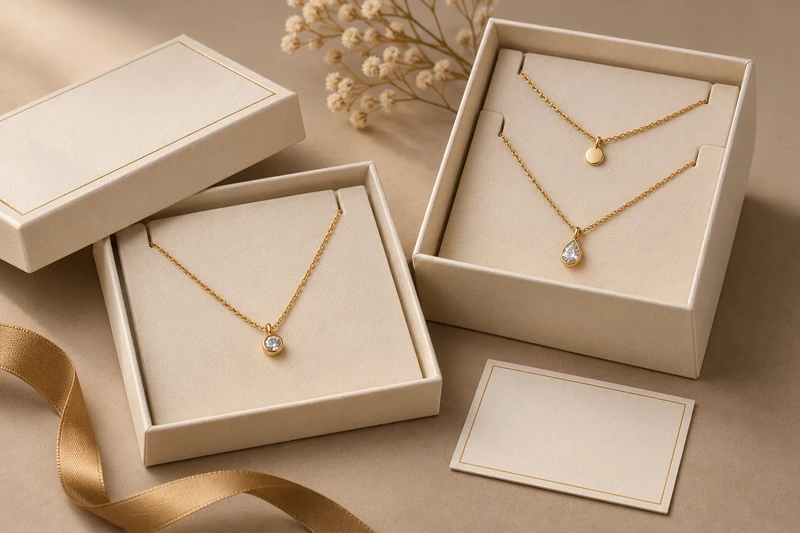
Necklace boxes should be designed around the way each necklace sits, is removed and is presented when opened. A pendant necklace usually needs a centred display point and enough depth for the pendant, while layered necklaces need separate paths and holding positions for more than one chain.
For jewellery brands, retailers and e-commerce teams in Australia, the best necklace gift box is not simply the smallest box that closes. It is a presentation system that accommodates the actual chain lengths, pendant profile, clasp position and gift-opening experience. XGolden Print designs and produces custom paper packaging, including rigid, lid-and-base, drawer and magnetic closure boxes, with structural design, inserts, artwork support, printing, finishing and sample approval available for the project.
A pendant and a layered necklace need different layouts
A single pendant necklace and a layered necklace place different demands on the insert. Treating them as the same product can leave a pendant sitting too high, a chain bunching at the edge, or multiple strands competing for the same space.
For a pendant necklace, the insert generally needs to establish three things:
- a focal position for the pendant;
- a route for the chain on either side of that position; and
- a practical place for the clasp and excess chain length.
The pendant should be visible when the box is opened without making removal unnecessarily difficult. Its thickness, width, bail or loop, and any raised stones or decorative elements all affect the clearance required between the insert and lid.
Layered necklaces need a more deliberate layout. Separate chains can be staged at different heights, routed through individual slots, or arranged in distinct channels so the set reads as intentional rather than crowded. The layout must account for whether the pieces are sold as a fixed multi-strand set, separate necklaces presented together, or a coordinated gift set with components that can be worn independently.
| Necklace use case | Layout priority | Insert considerations | Box choice to investigate |
|---|---|---|---|
| Fine pendant necklace | Centre the pendant cleanly | Pendant recess or display area, paired chain slots, clasp position | Compact lid-and-base or rigid box |
| Pendant with a larger feature | Allow for profile and visual emphasis | Internal depth, clearance to lid, stable pendant placement | Deeper rigid or lid-and-base box |
| Long-chain necklace | Manage excess chain length | Longer routing path, rear channel or controlled coil area | Rigid box with developed insert |
| Layered necklace set | Keep strands visually separated | Multiple slots, levels or individual routing paths | Wider rigid box with custom insert |
| Necklace gift set with care card | Keep jewellery and printed material orderly | Dedicated card position and accessible jewellery lift point | Lid-and-base or magnetic closure gift box |
Actual jewellery should guide every one of these decisions. A product photo alone rarely shows chain flexibility, pendant depth, clasp bulk or how a set behaves when lifted. Supplying physical samples or accurate measurements during development gives the packaging structure and insert a more reliable starting point.
Box depth and the pendant's display position
The right depth for a pendant necklace box depends on the assembled jewellery, not only the pendant diameter. A shallow pendant may still need more internal space if its bail stands proud, the chain gathers beneath the insert, or the intended presentation uses a raised platform.
Start with the display position. In most pendant necklace boxes, the pendant sits at or near the visual centre of the insert, with the chain leading outward in balanced directions. This creates a clear retail presentation and allows the recipient to recognise the product quickly when opening a gift box.
However, a centred pendant is only useful if it remains appropriately positioned after ordinary handling. Review:
- the pendant’s widest and deepest points;
- whether the pendant faces forward or can turn sideways;
- the volume created by a chain and clasp beneath or behind the display area;
- clearance between the highest point of the jewellery and the closed lid;
- whether a care card, authenticity card or gift message is placed inside the box; and
- how a team member will load the necklace during packing.
A box that is too shallow can compress the jewellery or make closing inconsistent. One that is excessively deep may reduce the impact of the presentation and allow more movement. The objective is a suitable relationship between the jewellery, fitted insert and box structure, confirmed using the actual necklace and a sample.
For shelf-facing retail, consider what a customer or sales assistant sees at the first opening. The pendant needs a defined visual position, while the logo, colour and any printed message should support rather than obscure the jewellery. For e-commerce orders, this same opening view can form part of the unboxing sequence, but a presentation box should not be treated as a complete transport-protection system. Outer shipping packaging should be planned separately around the packed necklace box and the normal handling conditions of the order.
Routing long chains behind the insert
Long-chain necklaces require a considered route for the portion of chain that is not visible on the display face. Simply adding two small slots can be unsuitable when there is substantial excess length, an extension chain, a larger clasp or multiple linked components.
A common approach is to display the pendant or front section on the insert face while directing the remaining chain behind the insert. This can create a cleaner opening view, but the route needs to be developed for the specific necklace. The available space behind the insert, the chain’s flexibility, the clasp shape and the loading method all matter.
When briefing a long-chain necklace box, provide:
- Full wearable length – Include extension-chain range where relevant.
- Chain type and thickness – Fine cable chains, bead chains and broader link styles can behave differently in an insert.
- Clasp and tag size – These components may need their own position rather than being forced through narrow slots.
- Pendant dimensions and orientation – State whether it should be upright, centred or allowed to rest naturally.
- Preferred packing sequence – Explain whether the team will route the chain from front to back, place it in a rear area, or secure the necklace in another agreed way.
- Removal expectation – Consider whether the recipient should lift the necklace from the front, release a clasp point, or remove the full insert first.
The aim is controlled presentation, not an unsupported promise that any construction will prevent tangling during all handling or transit. Necklaces vary considerably, and routing should be reviewed during sample approval under the way the product will actually be packed and presented.
For brands offering different chain lengths under one collection, it may be possible to develop related layouts, but do not assume one insert suits every SKU. A small difference in extension length or pendant profile can change how the product sits. Identify product variants early, particularly where a retailer needs a common exterior box with inserts adapted to individual necklaces.
A lid-and-base style and a layered-necklace rigid style
Box structure influences both the recipient’s opening experience and the practical space available for the insert. A lid-and-base box offers a familiar gift presentation: the lid lifts away to reveal the necklace in its prepared display position. A rigid box can also provide the wider footprint or internal arrangement needed for a layered set.
The LB-311 necklace lid-and-base box is a relevant style reference for brands considering a necklace-specific lid-and-base presentation. Its suitability should still be confirmed against your necklace dimensions, insert concept, artwork and intended packing process. A catalogue style is a starting point for the brief, not proof that it fits every pendant or chain construction.
For a set with several strands, the RB-311 layered-necklace rigid box provides a useful rigid-box style reference. Layered products may need extra width, separate visual zones or a more developed insert face than a single pendant necklace. Confirm the layout with physical jewellery, especially if the set includes chains with different drop lengths or removable pieces.
The structural choice should follow the product application:
Lid-and-base boxes for a considered reveal
A lid-and-base necklace box can suit a pendant launch, boutique retail sale, bridal-party gift or branded jewellery gift set. The separate lid creates a pause before the jewellery is seen and gives the insert a clear stage.
This format is worth considering when the visual reveal matters and the product can be loaded consistently into a fitted insert. It can also accommodate coordinated branding across a collection, provided logo placement and printed artwork are planned around the visible opening surfaces.
Rigid boxes for layered arrangements
A rigid style may be preferable where the necklace layout needs more internal organisation. For example, a layered set may need individual chain routes, distinct anchoring points and enough visible space to show the relationship between strands.
The box should not make the jewellery feel over-secured or difficult to remove. During the design stage, balance display stability with a straightforward recipient experience. An insert that holds every component tightly may look orderly in a product image yet become frustrating at gifting or retail counter handover.
XGolden Print can support structural design, material selection, artwork, printing, finishing and fitted insert development for custom necklace boxes. Material and finishing choices should be made against the required construction, intended presentation and project brief. Confirm suitability, final specifications and commercial terms for the individual project rather than assuming a particular material or finish is appropriate.
Care cards and removal access for gifts
Care cards can add useful product information to necklace gift boxes, particularly for premium retail presentation, online gifting and event packs. They may explain how to wear a layered set, identify individual pieces, communicate a brand message or carry a personalised gift note.
The card should have an assigned place rather than being inserted loosely over the jewellery. Possible approaches include a position beneath the insert, a dedicated area inside the lid, or a separate compartment within a wider gift presentation. The best choice depends on whether the recipient needs to see the card before removing the necklace and whether it would conceal the pendant on opening.
Removal access deserves equal attention. Ask how the recipient will take the necklace out without pulling awkwardly on a fine chain or lifting the pendant by its most delicate-looking part. Depending on the actual layout, the insert may need:
- an accessible edge or lift point;
- a finger space beside the jewellery;
- a card or tab that assists with lifting the insert;
- a clear sequence for releasing chain positions; or
- enough open space for a sales assistant to present the item at a retail counter.
For gift sets, coordinate the necklace box with the broader packaging system. A necklace can sit within a multi-product presentation alongside a watch, candle, fragrance item or other customer product, but each component needs its own space and access plan. XGolden Print can plan gift packaging around multiple products, coordinated branding and the intended opening experience.
When event planners or corporate gifting teams are specifying necklace boxes, include the event message, individual names if applicable, card content, quantity breakdown and packing workflow in the brief. Local-language artwork should be supplied or reviewed carefully so product names, care instructions and gift messaging are correct for the intended Australian audience.
Checking presentation after normal handling
A necklace box should be checked as a packed product, not just as an empty sample or flat artwork file. Before production, review how the necklace looks after the ordinary handling expected during packing, retail preparation, gift assembly and receipt by the customer.
A practical presentation review can include these checks:
- Is the pendant still in its intended display position when the lid is opened?
- Are chains routed as expected, without visibly obscuring the pendant or each other?
- Does the insert allow the box to close without forcing the jewellery?
- Can a recipient remove the necklace without confusing steps or excessive pulling?
- Does the care card remain in its planned position?
- Does the exterior artwork align with the collection, product variant and gift occasion?
- If used for online orders, has outer packaging been considered separately from the retail necklace box?
- Can the packing team repeat the agreed layout across the required quantity?
Normal handling checks help identify issues that are easy to miss in an initial layout: a chain that shifts, a clasp that occupies more space than expected, a pendant that sits differently once the lid is closed, or a card that covers the jewellery. They do not establish a universal transport or jewellery-care claim. Transport conditions, outer packaging and product-specific requirements must be evaluated separately.
Sample approval before production is available through XGolden Print’s process. This gives packaging buyers a point at which to assess the developed structure, insert layout and artwork in relation to the actual necklace application. For brands planning a new box rather than selecting a starting style, our custom box service can support the development of a structure around the product and presentation brief.
Prepare a necklace box brief before requesting a quote
A specific brief makes it easier to compare layouts and develop a box that suits the necklace rather than a generic jewellery category. Include the following details:
- necklace type: pendant, long chain, layered set or gift set;
- full chain length, extension range and clasp dimensions;
- pendant width, height, depth and preferred display orientation;
- number of pieces in the box and whether they are sold together;
- retail, gifting, event or e-commerce use;
- preferred box structure, including any LB-311 or RB-311 style reference;
- required exterior and interior artwork, including care cards;
- expected packing workflow and whether jewellery will be pre-loaded;
- required quantity, artwork files, delivery date and delivery destination.
Discuss your necklace gift box project with XGolden Print by sharing the jewellery dimensions, quantity, artwork, required delivery date and destination. We can help develop a custom packaging brief covering the box structure, fitted insert, presentation and sample approval requirements.
