
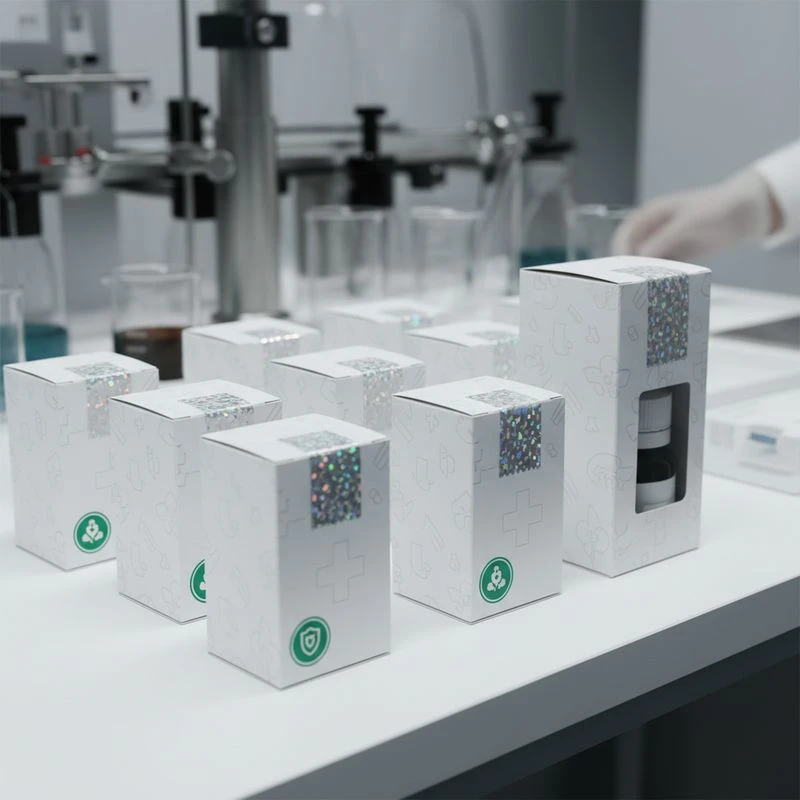
Pharmaceutical custom packaging with safety compliance is not simply a matter of printing a carton and choosing a bottle. It is a controlled design process that must protect the medicine, communicate essential information clearly, deter inappropriate access where required, and work reliably through filling, storage and dispensing.
For products supplied in Australia, the packaging specification should be reviewed against the current requirements that apply to the medicine, its classification, its route to market and the jurisdictions involved. A packaging supplier can manufacture to an approved brief, but the product sponsor, manufacturer and relevant compliance specialists should confirm that the finished pack is suitable before commercial release.
Pharma Packaging
Effective pharmaceutical packaging combines four functions: containment, protection, communication and usability. A pack may look polished yet still be unsuitable if it allows product damage, obscures important label information or creates difficulties for the people expected to open and use it.
The first decision is to define the packaging system rather than specifying an outer box in isolation. In most cases, the system includes:
- The primary container that directly holds the medicine, such as a bottle, blister, sachet, tube or vial.
- A closure or seal, which may provide reclosure, tamper evidence or dispensing control.
- The secondary pack, often a printed carton that protects the primary pack and carries additional information.
- Any leaflet, dosing device, insert, tray, divider or label needed for use, identification or presentation.
- The tertiary packaging used to protect grouped units during warehousing and distribution.
Start with the product’s real risks
The appropriate custom pharmaceutical packaging depends on the medicine and how it will be handled. Before choosing board grade, closure type or print finishes, identify the conditions the pack needs to manage.
Consider:
- Sensitivity to light, moisture, oxygen or odours
- Risk of crushing, puncture or leakage
- Dose format, including tablets, capsules, liquids, powders, creams or devices
- Storage conditions and any temperature-related handling needs
- Frequency of opening and whether the pack must be reclosed
- User capability, including dexterity, vision and reading needs
- Risk of accidental access by children
- Potential for tampering, substitution or counterfeiting
- Whether the product is sold in a pharmacy, supplied through a clinical setting, or distributed in bulk
For example, a folding carton may provide display space and product grouping, but it does not necessarily provide the moisture barrier required for a hygroscopic tablet. Likewise, a sturdy bottle can contain a liquid medicine, but its closure and induction seal need to be assessed separately for leakage and tamper evidence.
Material choices should support the approved pack design
Paperboard cartons remain a practical secondary packaging choice for many pharmaceutical products because they can carry clear printed information, accommodate inserts and be made in formats suited to automated or manual packing. Their limitations matter, however: carton board is not a substitute for a barrier container, and its performance can be affected by moisture, compression and rough handling.
Common secondary-pack formats include:
| Pack format | Often suited to | Key checks before approval |
|---|---|---|
| Folding carton | Bottles, blister cards, tubes and small devices | Fit, panel layout, barcode scannability, insert space and opening integrity |
| Sleeve | Multipacks or products with a robust primary pack | Retention, tamper strategy and label visibility |
| Rigid box | Premium presentation packs or sensitive components | Cost, assembly method, transport protection and opening experience |
| Display carton | Pharmacy or retail shelf presentation | Product security, stock rotation and easy identification |
| Partitioned carton | Multiple components, vials or devices | Separation, movement control and packing sequence |
A custom box solution should be designed around the approved primary pack dimensions and packing workflow. Requesting a carton before finalising the bottle, blister, closure or insert can lead to avoidable redesign work.
Keep product identity unambiguous
Pharmaceutical packs should make it easy to distinguish one product, strength, pack size and presentation from another. Confusion risks increase where products have similar names, colour palettes, dosage forms or strengths.
Build distinction into the layout through more than colour alone. Use clear product naming, strength hierarchy, dosage-form wording, pack-size information and a consistent location for key identifiers. Colour can assist recognition, but it should not be the only differentiator, particularly where users may have low vision or where printing variation is possible.
Avoid decorative choices that compete with critical content. Metallic foils, gloss finishes, fine type and busy artwork may be attractive, but they can reduce legibility or make variable information harder to inspect.
Regulatory Design
Regulatory design means building the packaging artwork and physical format around approved content, required information and controlled production processes. It does not mean assuming that a template used for one medicine, product category or market will be correct for another.
In Australia, pharmaceutical packaging and labelling requirements can depend on the medicine’s status and supply arrangements. Current expectations should be confirmed with the appropriate regulatory, quality and legal advisers before artwork is locked. State and territory requirements may also be relevant for particular scheduled medicines and supply channels.
Design from an approved content hierarchy
A well-controlled pharmaceutical carton provides enough space for mandatory and operational information without shrinking important text to an impractical size. Start with content, then fit the structural design around it—not the reverse.
An artwork brief commonly needs to account for:
- Product name and medicine name conventions
- Active ingredient and strength information
- Dosage form and route of administration where applicable
- Pack quantity or volume
- Batch, lot, expiry and serialisation fields where relevant
- Storage, warning and handling statements
- Sponsor or responsible-party details where required
- Barcode and machine-readable code placement
- Space for variable data, overprinting or labels
- Directions to consumer information or enclosed literature
- Version-control references for internal quality processes
The exact information, wording, placement and legibility expectations must be verified for the particular product. Do not rely on a generic packaging printer’s artwork template as evidence of regulatory compliance.
Protect legibility through print-ready artwork
Small errors can have serious consequences on a medicine pack. Artwork files should therefore be checked for content accuracy as well as visual appearance.
Before production, confirm:
- Text is editable and proofread against the approved source content.
- Minimum text sizes, contrast and line spacing remain readable on the chosen substrate.
- Barcodes and codes have sufficient quiet space and are placed away from folds, glue areas and heavy graphic elements.
- Variable-data fields are clearly defined, including their dimensions, location and intended printing method.
- Dielines, folds and glue flaps do not cover key information.
- Colour use does not create confusion between strengths or presentations.
- Proof approval is documented with the correct artwork version.
A digital proof is useful for reviewing copy and layout, but it may not fully represent the final substrate, ink coverage, embellishment or fold behaviour. A physical sample or production-representative proof can help assess carton construction, readability and placement in real conditions. The appropriate approval method should be determined within the product’s quality system.
Tamper evidence is different from child resistance
These two concepts are often grouped together, but they solve different problems.
- Tamper-evident packaging helps show whether a pack may have been opened or interfered with before the intended user receives it.
- Child-resistant packaging is designed to make opening more difficult for young children, while remaining practicable for intended adult users.
A carton seal, perforation or shrink band may provide a visual indication of opening, but it does not automatically make the pack child resistant. Conversely, a child-resistant closure may not provide an adequate tamper-evident feature on its own. Assess both functions independently.
Child Resistant
Child-resistant packaging should be selected when the product risk assessment, applicable requirements or supply conditions call for it. The goal is risk reduction, not a claim that a package is impossible for a child to open.
This packaging must be considered as a complete system. A child-resistant cap on a bottle may be undermined by a loose outer carton, an easily removed closure, a secondary pack that exposes several units, or instructions that make the opening mechanism unclear for adults.
Common child-resistant formats
Several formats may be used depending on the medicine and container type:
- Push-and-turn closures for suitable bottles
- Squeeze-and-turn closures for selected containers
- Blister designs with controlled access features
- Unit-dose formats designed to limit immediate access
- Carton structures with opening features intended to deter child access
Each option brings trade-offs. Push-and-turn closures can be familiar but may be difficult for people with limited grip strength. Blister packs can support dose control but may be challenging for some users to press through. Carton-based approaches may preserve presentation but need careful assessment of opening consistency and the protection offered by the primary pack.
Balance resistance with adult accessibility
A child-resistant package can create a new safety issue if the intended user cannot open it, transfers medicine to an unlabelled container or leaves it unsecured after repeated attempts. Consider likely users, including older adults, people with reduced dexterity and carers.
Practical questions include:
- Can the opening instruction be seen and understood?
- Is the instruction placed where the user needs it?
- Is the closure orientation obvious?
- Can the pack be opened and reclosed consistently?
- Does reclosure restore the intended safety function?
- Are there alternative presentations needed for legitimate accessibility requirements?
Any child-resistance performance claims, testing requirements or standards must be confirmed for the particular product and market. Do not represent a format as child resistant based solely on its appearance or supplier description.
Common mistake: treating the carton as the safety feature
An outer carton can add protection and hold information, but it is not automatically the critical safety barrier. If a bottle has a child-resistant closure, the carton should fit it securely without damaging the closure or making its instructions inaccessible. If the outer carton itself forms part of the access-control design, its opening performance, repeat use and manufacturing tolerances deserve formal review.
Secure Containers
Secure pharmaceutical containers protect product integrity, preserve identification and provide confidence that the pack reaches the user in its intended condition. Security is broader than a seal: it includes the physical interface between container, closure, label, carton and any serialised or traceability process.
Specify the container–closure–carton relationship
A secure pack begins with compatibility. The bottle or blister, closure, label and carton should be evaluated as one assembly.
Confirm the following with the relevant technical and quality teams:
- The primary container fits the carton without excessive movement.
- The carton does not abrade labels, scratch containers or damage closure features.
- Inserts, measuring devices and accessories remain in their intended position.
- The opening direction is clear and does not stress the primary container.
- The selected board and structure withstand expected handling conditions.
- Glue placement does not obstruct product access or contaminate contents.
- Seals, labels and security features remain visible after packing.
- Variable data can be applied and inspected without covering important text.
Where liquids, glass containers, sharp components or multiple items are involved, internal supports may be needed. Inserts, partitions and trays can minimise movement, but they must be matched to the actual product tolerances rather than based on nominal dimensions alone.
Use tamper-evident features thoughtfully
Tamper evidence can take many forms, including glued carton closures, seals, tear strips, shrink bands, breakable rings and security labels. The best option is the one that clearly indicates interference without making legitimate opening unnecessarily difficult.
When evaluating a feature, ask:
- What visible change will indicate opening?
- Can the user recognise that change without specialist knowledge?
- Is the feature compatible with the packing process?
- Does it affect recycling or disposal expectations?
- Can it be applied consistently without obscuring required information?
- Does it remain effective after normal storage and handling?
Security features should never replace good inventory control, approved artwork management or traceability procedures. If counterfeit deterrence, serialisation or authentication is relevant, define the required process early because it can affect print method, data handling, inspection and carton layout.
B2B Production
For procurement teams, compliant pharmaceutical packaging depends on disciplined specification and change control as much as the finished carton. The most useful supplier conversation starts with an unambiguous brief, approved artwork and clear acceptance criteria.
XGolden Print provides custom packaging boxes and printing solutions, with 27 years of experience in packaging production. For pharmaceutical work, buyers should still confirm the supplier’s specific capabilities, quality documentation, material options, proofing process and suitability for the intended pack before placing an order.
Build a production-ready brief
A practical brief for custom pharmaceutical cartons should include:
- Product and SKU names, including all strengths and pack sizes
- Final dieline and carton dimensions
- Primary-pack dimensions, weights and tolerances
- Board, finish and print requirements
- Artwork files and approved copy source
- Barcode specification and code placement
- Variable-data areas and overprinting requirements
- Tamper-evident or security features
- Insert, leaflet, divider or tray requirements
- Packing orientation and assembly instructions
- Version number, approval status and change-control contacts
- Required samples, proofs or inspection expectations
- Storage and delivery packaging requirements for flat-packed cartons
Do not send only a visual mock-up. A mock-up may not show glue zones, fold direction, internal clearance, barcode quiet areas or the dimensions needed for reliable packing.
Ask production questions before committing
The right questions reduce late changes and help compare suppliers fairly:
| Buyer question | Why it matters |
|---|---|
| Can the supplier work from our approved dieline and artwork version? | Prevents unintended layout or structural changes |
| What proofing options are available? | Helps define how copy, colour and construction will be reviewed |
| How will batch-specific or variable information be handled? | Avoids errors in placement and production workflow |
| What material and finishing options suit the carton’s use? | Supports fit-for-purpose durability and presentation |
| Can samples be supplied for packing-line or assembly checks? | Identifies fit and handling issues before full production |
| How are revisions identified and controlled? | Reduces the risk of obsolete artwork being used |
| What tolerances or inspection criteria need agreement? | Establishes measurable acceptance expectations |
A supplier should not be asked to make compliance decisions that belong to the product sponsor, manufacturer or quality team. Instead, provide the approved requirements and ask whether the proposed structure and print process can meet them.
Plan for artwork changes
Medicine packs often need updates due to revised approved information, supplier changes, barcode adjustments, new pack sizes or language changes. Treat every revision as a controlled change, even where the visual amendment appears minor.
A robust process typically includes:
- Revising the approved artwork source.
- Assigning a clear version identifier.
- Checking all affected pack components, not only the carton front.
- Confirming barcode and variable-data impacts.
- Obtaining required internal approvals.
- Separating obsolete files and stock from current versions.
- Checking the first production output against the final approved version.
Mixing old and new cartons, inserts or labels can create confusion even if the product itself is unchanged. Plan stock transitions before an artwork update goes into production.
A practical selection checklist
Before approving pharmaceutical custom packaging, confirm that you can answer “yes” to these questions:
- Is the product’s regulatory and safety requirement defined for Australia?
- Has the primary container been assessed separately from the outer carton?
- Does the pack protect the product under expected conditions?
- Is critical information readable, unambiguous and correctly positioned?
- Are tamper evidence and child resistance assessed as separate requirements?
- Does the complete pack work for intended users, including opening and reclosure?
- Are carton fit, inserts and internal supports based on real product dimensions?
- Have barcode, batch and expiry areas been planned before artwork approval?
- Is there a documented artwork version and change-control process?
- Have samples or proofs been reviewed at the right stage for the product risk?
Frequently asked questions
Is a printed pharmaceutical carton enough to make a product compliant?
No. A printed carton is only one component of the packaging system. Compliance depends on the medicine, the primary container, label content, safety features, manufacturing controls and the requirements that apply to its supply in Australia. Confirm the complete system with the responsible regulatory and quality specialists.
Does tamper-evident packaging make a container child resistant?
No. Tamper evidence indicates possible prior opening or interference. Child resistance concerns reducing access by young children. A pack may require one feature, both features or neither, depending on the product assessment and applicable requirements.
Can pharmaceutical packaging use premium finishes?
It can, provided finishes do not compromise legibility, barcode performance, required information, packing processes or inspection. Consider whether gloss, foil, embossing or dark backgrounds could reduce contrast or make variable data harder to read.
What should be supplied to a packaging manufacturer?
Provide approved artwork, dielines, primary-pack dimensions, material requirements, intended packing method, quantity, variable-data needs, safety features and acceptance criteria. Also identify the artwork version and the person authorised to approve changes.
The most reliable next step is to turn your product and compliance requirements into a controlled packaging brief, then assess proposed samples against the complete primary-container and carton system before full production.
