
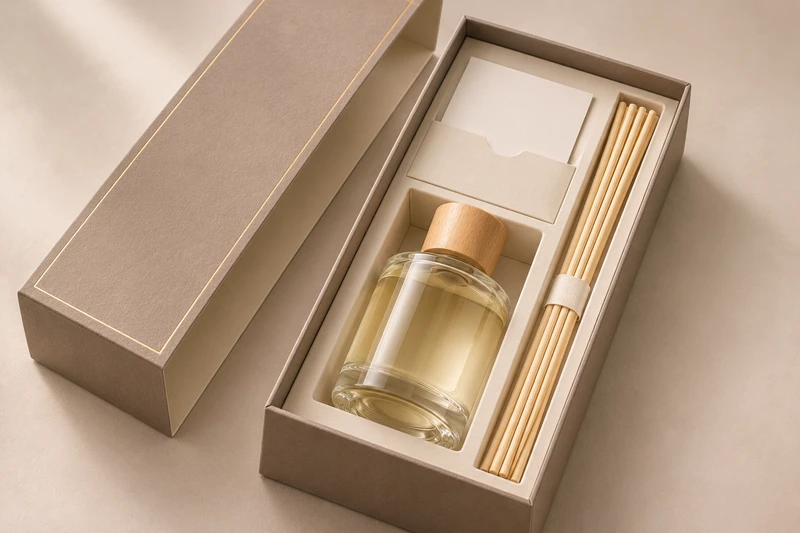
Reed diffuser boxes need to accommodate two very different components: a closed glass fragrance bottle and a long, lightweight reed bundle. The strongest layout gives each component its own defined position, makes removal intuitive and presents the set as a coordinated home-fragrance product rather than a collection of loose parts.
For brand owners and packaging buyers in Australia, this means confirming the actual bottle, closure, reed bundle and any accessory dimensions before choosing a box size or insert style. XGolden Print designs and produces custom paper packaging boxes, gift packaging, labels and stickers, with structural design, material selection, artwork support, fitted inserts and sample approval available for a project-specific brief.
What belongs in a reed diffuser gift box
A reed diffuser gift box commonly holds a filled and closed diffuser bottle, a bundle of reeds and, depending on the product offer, a cap, collar, decorative accessory, instruction card or gift message. The box is secondary packaging: it presents and groups the customer’s product components. The bottle itself remains the primary container for the fragrance liquid.
The most useful starting point is to list every item that must appear when the box is opened. This prevents a layout from being developed around the bottle alone, only to discover that the reeds bend, rattle or require an awkward separate sleeve.
Typical reed diffuser gift set components include:
- A closed glass diffuser bottle, with its final cap or stopper fitted
- A reed bundle in its final wrap, sleeve or tie
- A product information, care or use card
- A gift card, promotional insert or brand story card
- Optional accessories, such as a decorative collar or display element
- A bottle label or sticker, where the customer’s product requires one
- An outer gift box for a single diffuser or a coordinated multi-product set
For a retail reed diffuser, the outer box can carry the visual identity, fragrance name, scent variant, product volume and customer-facing instructions supplied by the brand. For a gift set, the opening sequence becomes more important: the recipient should see the fragrance product and reed bundle in a deliberate order, without having to pull through loose filler or search underneath an insert.
A reed diffuser box should not be treated as a complete transport-protection system by default. Retail and gift packaging may need additional outer shipping packaging and handling measures for online orders or distribution. Likewise, paper packaging should not be relied upon to contain liquid if a bottle leaks. Liquid containment, closure suitability and any separate protective shipping arrangement need to be considered independently of the presentation box.
| Reed diffuser use case | Main packaging requirement | Layout option to explore |
|---|---|---|
| Single diffuser for retail | Bottle stability, clear variant identification and shelf presentation | Fitted bottle recess with a separate reed channel |
| Premium gifting | A considered opening experience and coordinated components | Rigid-style presentation box with insert and card space |
| Multi-product home-fragrance set | Clear separation between products and easy product removal | Compartments sized for each bottle, candle or accessory |
| E-commerce order | Presentation packaging separated from transport protection planning | Retail box within a separately specified transit pack |
| Event or corporate gifting | Consistent branding and room for a message or event detail | Gift box with a branded insert card or internal print area |
Bottle dimensions and reed length define the layout
The bottle and reed bundle set the fundamental dimensions of reed diffuser boxes. Do not use a nominal bottle capacity as a substitute for measurements. Bottles of the same fill volume can have very different heights, widths, shoulder shapes, base profiles and closure heights.
Measure the final packed bottle, including:
- Overall height from base to the top of the final closure
- Maximum width or diameter
- Base diameter or footprint
- Shoulder profile, especially if the insert will support the bottle around the neck or body
- Weight when filled
- Any fragile decoration, label edge, foil detail or raised feature that should not rub against the insert
For reeds, measure the complete bundle as it will be packed, rather than one loose reed. Record the bundle length, diameter, wrap thickness and whether the ends are even or deliberately tapered. Long reeds often determine the internal box length or height, while the bottle determines the depth and the structural support required.
Choose a layout based on the real packed components
There are two common orientation approaches for reed diffuser packaging:
Flat or horizontal presentation places the bottle and reeds side by side or in stacked channels. This can create a gift-set feel and lets the customer see both components together as the box opens. It may suit a wider presentation box where the reed bundle can remain straight.
Upright or vertical presentation positions the bottle standing in an insert while reeds sit alongside it or in a separate long compartment. This can support a more compact shelf-facing footprint, but the relationship between bottle height and reed length must be planned carefully.
Neither orientation is automatically better. A short, broad bottle with long reeds may need a different proportion from a tall bottle with a compact bundle. Artwork panels, retailer shelf constraints, gift wrapping expectations and the intended opening motion should also be assessed before a structure is selected.
Allow practical clearance around components, but do not assume a generous void improves the result. Too little allowance can make packing difficult or create scuffing; too much can make the product feel loose and reduce the sense of care when opened. The appropriate tolerance depends on the bottle, reed wrap, insert material and assembly process, so it should be confirmed through a sample.
Consider packing workflow, not only the unboxing image
A visually appealing reed diffuser box also needs a sensible packing sequence. For example, the packer may need to place the bottle into its recess before sliding in the reed bundle and adding a card. If reeds need to be inserted through a narrow opening after the box is formed, the process could be unnecessarily difficult.
When preparing a brief, state:
- Which component goes into the box first.
- Whether the bottle is packed filled and closed.
- Whether reeds arrive pre-bundled or require a separate sleeve.
- Whether a card sits above, below or beside the products.
- Whether the box will be assembled manually or through a defined packing workflow.
- Whether retailers or event teams will need to add another component before distribution.
These details help ensure the reed diffuser box works for both packing and presentation.
Separate positions for the bottle and reed bundle
Separate positions are usually the clearest solution for a reed diffuser bottle and reeds. A fitted bottle area can help keep the closed bottle in its intended place, while a dedicated channel, tray or compartment prevents the reeds from crossing over the bottle or catching when the box is opened.
The insert does more than fill empty space. It establishes the opening hierarchy, supports a neat retail appearance and provides a repeatable location for every component. For a fragrance gift set, the customer should be able to identify what each compartment contains at a glance.
Plan the product removal sequence
A good reed diffuser gift layout considers what the recipient removes first and what remains visible afterwards. There are several practical sequences:
- Bottle first: The bottle is the central product, with reeds revealed beside or beneath it.
- Reeds first: The reed bundle is positioned in a top channel, then the bottle is lifted from its recess.
- Card first: A branded message or scent story creates a gifting moment before the products are removed.
- All components visible: Bottle, reeds and card are presented together in separate positions on opening.
The right sequence depends on the brand’s intended experience. A straightforward retail diffuser may benefit from immediate product visibility. A premium gift presentation may use an internal cover, card or layered insert to create a more considered reveal.
Avoid layouts where the customer must grip the bottle by a delicate closure, pull hard on reeds, or turn the box upside down to access a component. Include practical access points in the discussion, such as finger notches, ribbon pulls or a shaped opening around the bottle. Their suitability depends on the final structure and components.
Keep liquid containment separate from the insert brief
A fitted insert can organise a closed bottle, but it is not a substitute for a leak-management solution. If the diffuser liquid escapes from the primary container, paperboard packaging, printing and decorative finishes may be affected. The bottle closure, any seal, the filling condition and the way the product is handled in shipping should be reviewed separately by the product owner.
For online orders, specify the retail reed diffuser box first, then consider the separate outer packaging needed for the delivery journey. This distinction helps teams avoid assuming that a premium presentation box alone addresses all handling conditions.
Home-fragrance box styles that can inform a brief
The structural format should serve the diffuser’s dimensions, component count and intended presentation. XGolden Print offers formats including rigid boxes, magnetic closure boxes, drawer boxes and lid-and-base boxes. Each can be explored for a reed diffuser brief once the real bottle and reeds are available for review.
A home-fragrance set box structure, LB-330 may be a useful reference point when developing a multi-component home-fragrance presentation. It is an example of a home-fragrance box structure, not evidence of a dedicated reed diffuser design or suitability for a particular reed length. Bottle fit, insert layout and opening sequence should be developed around the actual components.
Likewise, the RB-330 home-fragrance rigid box can help inform a premium presentation brief where a rigid box format is being considered. The product page does not establish a reed diffuser-specific configuration, dimensions or component capacity, so these details need confirmation during structural development.
Match the format to the buying occasion
Retail shelf presentation may call for a format with clear front, side and back panels for fragrance identification, brand artwork and product information. Consider how the box will face on shelf and whether multiple scent variants need a consistent visual system.
Gift-ready presentation may place more emphasis on the opening moment, internal print, coordinated components and a fitted insert. This can suit seasonal gifting, housewarming offers, corporate gifts and special-event presentations.
A set with multiple fragrance products needs visible separation between items. A diffuser bottle, reed bundle and another home-fragrance item should each have a defined space rather than being packed loosely together.
Event gifting may need room for a personalised card, event message or co-branded artwork. Confirm who supplies the artwork and whether every set uses the same message or requires variable information before production planning begins.
Material selection and finishes should be chosen for the intended presentation and handling of the reed diffuser box. XGolden Print can support material selection, printing and finishing, but the final choice should be confirmed against the project’s bottle weight, insert design, artwork, use conditions and production requirements.
Fragrance identification and shelf presentation
Reed diffuser packaging often carries the information that helps shoppers distinguish scent variants before opening the box. The visual system should make the fragrance name, collection or intended ambience easy to find while retaining a coherent brand appearance across the range.
For Australian retail and online listings, prepare final artwork in the language and content format required for the customer’s product and sales channels. Identify the panels that need to carry the fragrance name, product details, use instructions or any brand-supplied information. A pack that looks balanced from the front may still need enough space on other panels for essential copy, barcodes or retailer-specific requirements.
Useful artwork questions include:
- Which panel is the shelf-facing front?
- How will scent variants be recognised at a glance?
- Does the bottle label visually match the outer box?
- Will the pack be photographed for online product pages?
- Is there a gift message, seasonal sleeve or event-specific element?
- Does the product range require consistent colour, naming and layout across several fragrances?
Labels and stickers can also be specified for the diffuser bottle, outer box or gift bag. Dimensions, shape, application surface and required roll or sheet format should be agreed for the individual project. A label applied to curved glass has different placement considerations from a sticker applied to a flat carton panel, so provide the actual container dimensions and identify whether labels will be applied by hand or through a defined application process.
Keep any fragrance liquid contact away from packaging elements not designed as a primary contact layer. The bottle and closure system remain responsible for holding the customer’s diffuser product; the label and outer reed diffuser box support identification and presentation.
Reviewing the complete sample before production
A complete sample is the most valuable stage for confirming a reed diffuser box because it brings bottle dimensions, reed length, insert fit, artwork and opening sequence together. Reviewing a flat artwork file alone cannot show whether the reed bundle catches on an edge or whether the filled bottle is easy to remove.
XGolden Print can provide sample approval before production as part of the packaging development process. The exact sample approach, materials, finishes, terms and schedule should be confirmed for the project.
When reviewing a complete reed diffuser packaging sample, check the final packed set rather than substitute components wherever possible.
Reed diffuser sample checklist
- Is the actual filled and closed bottle seated correctly?
- Does the insert support the bottle without obscuring important label areas?
- Is the reed bundle straight, protected and easy to remove?
- Are the bottle and reeds separated throughout normal opening?
- Can the packer assemble the set in the intended order?
- Can the customer remove each product without excessive force?
- Does the outer box close properly with every component inside?
- Are fragrance name, variant details and brand artwork visible on the intended panels?
- Is there sufficient space for all customer-supplied information and any gift card?
- Have retail presentation and separate transport packaging needs been considered independently?
- Does the final sample reflect the correct bottle, reeds, closure, labels and accessories?
This review is also the time to check consistency across fragrance variants. If one bottle shape, reed length or accessory changes between SKUs, it may affect the shared box dimensions or insert design. Flag those variations early rather than assuming one layout will suit every product in a range.
XGolden Print has 27 years of experience and provides structural design, artwork support, printing, finishing, fitted inserts and production for custom packaging projects. For a reed diffuser range, these services can be brought together around the product’s actual components and intended retail or gift presentation.
To discuss custom reed diffuser boxes, send XGolden Print your bottle dimensions and filled weight, reed bundle length and diameter, component list, quantity, artwork, required delivery date and destination. For a multi-product offer, a custom gift packaging brief should also identify the desired opening sequence and insert layout.
