
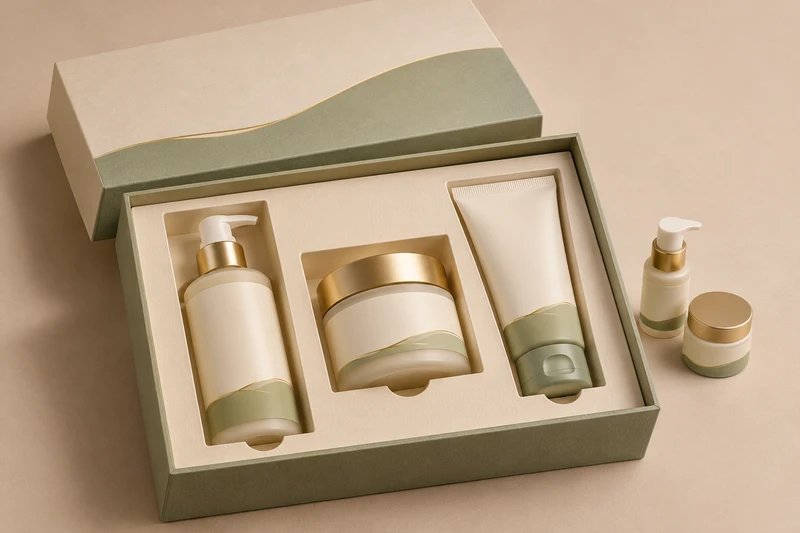
Skincare gift boxes bring a complete routine or miniature collection into one clear retail and gifting presentation. For a set to work well, the box needs to accommodate the real bottles, jars and tubes, guide the customer through the intended routine, and keep each product easy to identify and remove.
For beauty brands, retailers and e-commerce teams in Australia, the most useful brief starts with the products rather than a standard box size. Record each container’s filled dimensions, weight, closure shape and preferred position. XGolden Print can support skincare gift box projects through structural design, material selection, artwork support, printing, finishing, fitted inserts and sample approval before production.
Skincare gift packaging is an outer presentation format. It does not replace the primary bottle, jar or tube, nor should it be treated as a complete transport-protection system for online orders. If sets will be sent to customers, specify the separate outer shipping arrangement and handling requirements as part of the wider packing plan.
Skincare routines and mini sets that need a shared box
A shared skincare gift box suits products designed to be used together: a daily cleanse-and-moisturise pairing, a three-step facial routine, a seasonal gift edit, a travel-oriented miniature assortment or a product introduction set for retail display. Bringing the products together helps the brand communicate the routine as one purchase rather than a collection of unrelated individual SKUs.
The box should match the set’s purpose.
| Skincare set use | Typical contents | Key packaging requirements | Suitable packaging direction |
|---|---|---|---|
| Daily routine set | Cleanser, serum and moisturiser | Clear product order, stable layout and room for mixed container heights | Rigid box or lid-and-base box with fitted insert |
| Mini discovery set | Small bottles, jars or tubes | Accurate cavity sizing, easy product removal and visible variant names | Compact gift box with removable insert |
| Premium gifting set | Full-size skincare items plus a gift message or accessory | Strong presentation, coordinated artwork and considered opening experience | Rigid box or magnetic closure box |
| Retail launch kit | Hero product with supporting products | Shelf-facing product identification and adaptable artwork for variants | Custom box with an insert designed around the SKU mix |
| E-commerce gift bundle | Mixed skincare products packed for dispatch | Presentation box plus a separate plan for outer transit packaging | Gift box with fitted insert and separate dispatch packaging |
A skincare routine box can also accommodate different pack formats in one set. For example, a tall pump bottle may sit beside a low cream jar and a flexible tube. The benefit is a more complete routine presentation; the complication is that each item has different footprint, height and removal needs. A stock-sized carton may not manage those differences neatly, so a set-specific structural layout is often the better starting point.
Mini sets need the same discipline as full-size collections. A miniature bottle is not automatically suitable for a particular cavity just because it appears similar to another mini product. Diameter, cap width, shoulder profile and filled weight all affect the layout. Confirm the actual containers before setting mini-set dimensions or approving an insert.
For gift-ready ranges, consider what the recipient sees first. The first visible panel may carry the range name, the routine name or a concise description of the collection. Inside, the products can be arranged in routine order, supported by a printed card or clearly labelled primary packs.
Matching bottles, jars and tubes to one layout
Start a skincare gift box layout with a container schedule. This avoids designing a visually appealing box around assumed measurements that do not match the finished products.
For every bottle, jar and tube, provide:
- overall height, width and depth;
- diameter for round jars and bottles;
- cap, pump, dropper or applicator dimensions;
- filled product weight;
- whether the item must stand upright;
- labels already applied to the primary container;
- any carton, leaflet, spatula, pouch or gift card included in the set;
- the preferred order in which the customer sees and removes the products.
Measure the finished primary containers, including closures. A bottle’s body diameter alone is not enough if a pump or cap creates the widest point. For tubes, identify whether the cap or sealed end changes the required cavity shape. For jars, account for the lid profile and any label seam that should face forward.
Choose the box around the set, not the other way around
A skincare gift box needs enough internal space for the product arrangement and insert, but unused space can make products look disconnected or allow movement within the presentation pack. At the same time, cavities that are too tight can slow packing and make removal difficult for the recipient.
Useful layout questions include:
- Should all products sit upright, or can they lie flat?
- Is the hero serum or moisturiser intended to be centred?
- Will the customer remove products one at a time or lift out the full insert?
- Does one product need a larger cavity because it is heavier or taller?
- Is a printed routine card placed above, below or beside the products?
- Are there product variants that require the same outer box with a revised insert?
The outer dimensions should be confirmed only after the container arrangement and insert concept have been reviewed. This is particularly important where one range combines a jar, a bottle and a tube, as their different shapes can create awkward unused areas if the layout is not planned from actual samples.
Material and finish decisions should serve the intended presentation and handling of the skincare set. A buyer may want a clean clinical appearance, a gift-oriented premium feel or a softer natural visual direction. Rather than selecting a finish from appearance alone, confirm how the box will be opened, displayed, packed and handled, then assess material and finishing options against the specific project.
Routine order and product identification
Skincare gift boxes should make the routine understandable even when the set is opened for the first time. Product order can be communicated through left-to-right placement, numbered cavities, printed insert headings, a routine card or labels on the primary containers. The clearest approach depends on how much information is already visible on each bottle, jar or tube.
For a three-step collection, the layout might present cleanser first, serum second and moisturiser third. A different range may group products by morning and evening use rather than a strict sequence. The packaging should reflect the brand’s own approved routine information rather than suggesting usage instructions through box design alone.
Australian retail and e-commerce teams can also plan artwork for the way customers encounter the set:
- Put the collection name and product count where it can be read when displayed or photographed.
- Keep product variant names clear when several routine combinations use a similar box structure.
- Allow sufficient space for approved English-language product information, directions or other copy supplied by the brand.
- Check that barcodes, batch-related details or retail identifiers are allocated to the intended panel rather than competing with the gift presentation.
- Consider whether the outer box needs to identify every included item or whether the primary container labels and an enclosed card carry that detail.
Labels and stickers remain part of the system
The gift box identifies the collection, but labels and stickers may be needed for individual bottles, jars, tubes, inner cartons or bags. XGolden Print produces custom labels and stickers that can be specified for these surfaces, with agreed dimensions, shapes and roll or sheet formats.
A useful label brief identifies the container material and shape, the label position, the available application area and whether labels will be applied by hand or through a planned application process. A curved jar, tapered bottle and flexible tube do not present the same label area. Confirm the actual surface and intended use conditions before selecting label materials or finishes.
Avoid relying only on a lid label for product identification when jars may be separated from the gift set. Each primary container should retain the identification the brand requires once it leaves the outer box.
Lid-and-base and rigid-box examples from XGolden
Lid-and-base and rigid-box structures can suit skincare gift boxes where the opening experience, presentation and organised product layout are important. The appropriate choice depends on the product mix, desired reveal and how the set will be packed.
The LB-302 skincare-trio lid-and-base box is a relevant structural example for brands considering a separate lid and base for a three-product skincare presentation. A lid-and-base structure can create a straightforward full-set reveal when the lid is lifted, with products arranged in an insert beneath. Its actual fit, dimensions and mini-set suitability must still be agreed against the finished containers; the model does not establish a fixed miniature size.
For a more substantial presentation format, the RB-302 skincare-routine rigid box shows a rigid-box direction for skincare routine packaging. A rigid box may be considered when the brand wants a more defined gift presentation and a stable base for a custom insert. It is a structural reference, not evidence that every routine, bottle or jar combination will fit. Confirm the layout against the actual SKU range, weights and opening requirements.
The structural decision should follow the experience you want to create:
- Lid-and-base boxes can suit a complete reveal, especially where products are arranged in a single visible layer.
- Rigid boxes can suit elevated retail or gifting presentation where the box itself is part of the perceived value of the set.
- Drawer boxes may suit a staged reveal and can keep the product tray contained as it is opened.
- Magnetic closure boxes may suit sets designed to be opened and retained, subject to the individual construction and project requirements.
For broader formats beyond skincare-specific structures, explore XGolden Print’s gift packaging options. The right style should be selected after the contents, dimensions, opening sequence and intended presentation have been defined.
Inserts that support packing and product removal
A fitted insert gives skincare gift boxes their internal order. It can separate bottles from jars, retain products in the intended routine sequence and help the packing team place each SKU consistently. However, the insert needs to support both packing access and customer removal.
An insert should be reviewed for:
- cavity dimensions around the finished product, not an early container drawing;
- enough clearance for packers to place products without forcing them;
- finger access, cut-outs or another agreed removal method;
- the orientation of labels, logos and pumps;
- whether heavy products need a different position within the set;
- space for cards, sachets, accessories or a protective top layer if included;
- whether the insert can accommodate more than one approved product variant.
Removable inserts are especially useful for skincare routine sets because they can present a clean arrangement while allowing the customer to take out products individually. They can also support a seasonal or limited-edition refresh when an existing outer format is retained and the product mix changes, provided the revised insert and box fit are checked.
Do not assume an insert alone provides complete protection for a parcel in transit. The presentation box and insert manage the products within the set; outer dispatch packaging should be planned separately according to the actual shipping method, destination and handling expectations.
A common mistake is to make the insert so close-fitting that the customer cannot remove a short jar without tipping the box. Another is to leave too much clearance around a tall bottle, which can undermine the intended display. Physical sample review is the practical way to assess these points.
Approving artwork and a complete set sample
Artwork approval should happen alongside structural approval, not after the box layout has been treated as final. The dimensions, opening direction and insert configuration affect where brand elements, product names, routine steps and retail information can be placed.
Prepare artwork with the full skincare set in mind:
- Identify the front, back, side, lid, base and internal panels.
- Confirm how the box opens and which message appears first.
- Map the product names and routine order to the final insert layout.
- Check whether each SKU needs a distinct outer-box identifier.
- Supply approved logos, colours, copy, barcodes and any required product information.
- Review the relationship between outer-box artwork, primary-container labels and enclosed cards.
XGolden Print provides structural design, material selection, artwork support, printing, finishing, fitted inserts and sample approval before production. With 27 years of experience in custom paper packaging, the team can help translate a product schedule into a packaging brief that considers the full set rather than only the external box.
A complete sample review is valuable because it brings together the outer box, insert and actual containers. Check that bottles, jars and tubes sit in the correct positions, labels face as intended, products can be removed comfortably and the opening sequence communicates the routine clearly. Any changes to container dimensions, caps, labels or included components should be raised before production approval.
For skincare brands developing a new format rather than adapting an existing structure, custom box packaging can provide a starting point for discussing the required dimensions, presentation and internal layout.
A practical brief for skincare gift boxes
Before contacting a packaging supplier, assemble a brief that includes:
- product names and the number of SKUs in the set;
- physical samples or confirmed finished dimensions for every container;
- filled weights and closure details;
- photographs of bottles, jars and tubes from multiple angles;
- the intended routine order and unboxing sequence;
- preferred box style, if known;
- retail, gifting, e-commerce or event use;
- insert requirements and any additional cards or accessories;
- artwork files or an outline of the required copy;
- estimated quantity, required delivery date and delivery destination.
A clear brief reduces the risk of treating skincare gift boxes as generic cartons. It gives the packaging design process the information needed to create a coordinated presentation for the customer products, whether the set is a three-step routine, a miniature discovery collection or a premium gifting edit.
Discuss your skincare gift box project with XGolden Print by sharing your container dimensions, product quantity, artwork, preferred presentation, required delivery date and delivery destination.
