
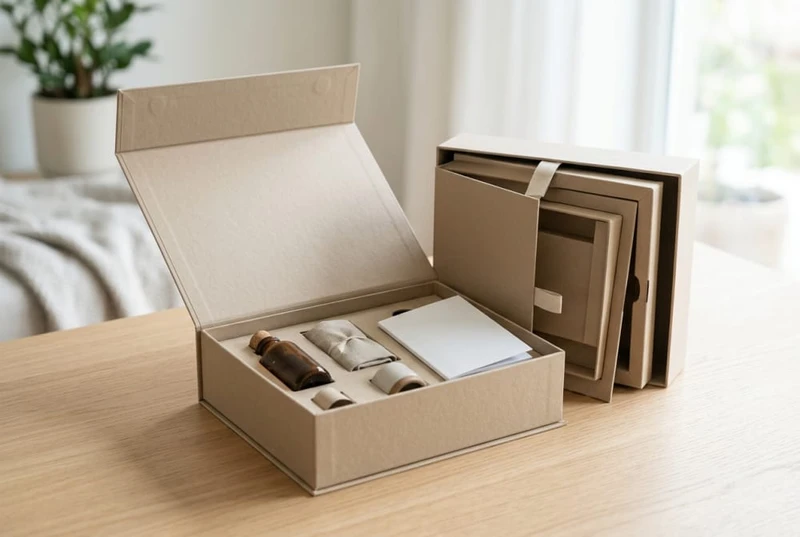
Subscription packaging earns its place when it does two jobs at once: it makes repeated fulfilment easier for the packing team and gives customers a reason to look forward to the next delivery. The most effective formats use a dependable outer box, adaptable internal organisation and a campaign layer that can change without redesigning the entire pack each month.
For Australian brands, the best subscription packaging concepts built for repeat shipments and stronger brand memory balance protection, pack-out speed, material use and presentation. Start with product range and packing workflow, then add the visual details that make each edition feel considered rather than routine.
Subscription packaging at a glance
A subscription box is not simply a branded shipping carton. It is a repeatable packaging system designed for a predictable cadence, varied assortments and a customer who may compare this month’s delivery with the previous one.
The system normally has four layers:
- Outer transit box — protects the order through handling and provides a consistent recognisable shape.
- Inner presentation layer — includes a mailer, tray, tissue, sleeve or lift-out panel that creates a more deliberate reveal.
- Product-control components — inserts, dividers, wraps or cushioning that prevent items moving and separate incompatible products.
- Campaign layer — printed cards, labels, stickers and themed artwork that can change by edition.
A fixed outer format is usually more practical than a completely new box design for every campaign. It gives purchasing and fulfilment teams a stable pack-out process while retaining room for seasonal themes, product launches and personalised touches.
| Packaging approach | Best suited to | Main benefit | Main limitation |
|---|---|---|---|
| Branded corrugated mailer | Mixed products and regular parcel shipping | Protective, simple, and recognisable | May need inserts to prevent movement |
| Rigid presentation box inside a shipper | Gifts, premium beauty, collectables | Strong reveal and perceived occasion | Adds components and packing steps |
| Folding carton with an outer mailer | Smaller, lightweight curated sets | Efficient presentation for uniform products | Less forgiving of product-size changes |
| One-size mailer with modular inserts | Rotating assortments | Adaptable month to month | Insert design needs careful planning |
| Box with a printed sleeve or label | Campaign-led editions | Refreshes the look without changing the box | Sleeve or label must suit the packing workflow |
The right option depends less on what looks impressive in a flat artwork proof and more on how reliably it works across a year of changing product combinations.
Planning a repeatable box format for rotating products and monthly campaigns
Choose the box around the product range, not only the ideal current assortment. Subscription businesses frequently add limited editions, swap product suppliers or introduce an item with a different shape. A pack that fits one launch perfectly but cannot accommodate a later variation can create costly rework.
Define the pack-out envelope
List the smallest and largest likely combinations, including:
- product dimensions and weight;
- fragile, leak-prone or crush-sensitive items;
- products that need to remain upright;
- items with their own retail cartons;
- printed cards, samples and redemption materials;
- cushioning or separation required between products.
Use this list to establish the internal dimensions that must be available. Allow sufficient tolerance for practical packing, but avoid large empty spaces. Excess room encourages movement, makes the box feel underfilled and may require unnecessary void fill.
Standardise the structural base
For many programmes, a standard outer carton or mailer works well across several editions. The internal arrangement can then adapt through paper wrap, a tray, adjustable dividers or a small range of interchangeable inserts.
When selecting a structure, ask:
- Can the box be erected quickly and consistently?
- Does the closure remain secure without extra tape, or is tape part of the intended process?
- Can a packer identify the correct orientation immediately?
- Does the structure work if one product is removed or substituted?
- Can the pack be opened without customers needing to tear through the branded presentation layer?
- Is the box practical to store flat before use?
A structural sample is particularly valuable where the box has an unusual opening, a self-locking closure or an insert that must fold in a specific sequence. Check the physical pack with the broadest product mix before approving print artwork.
Separate permanent and changeable design elements
Treat the recurring box as the long-life asset. Keep permanent brand elements—logo placement, core colours, opening message and key contact details—on the structural box where appropriate. Put edition-specific elements on cards, sleeves, stickers or removable labels.
This approach can help a brand maintain recognition while allowing each delivery to have its own personality. It also means a theme can be updated without leaving unused seasonal stock behind.
For a broader view of structural formats, compare custom packaging boxes according to product shape, closure style and intended presentation.
Insert strategies that keep mixed assortments organised and visually appealing
An insert should solve a real packing or protection problem. It is useful when it holds items in place, sets the opening order, separates products or presents a collection more clearly. It becomes a liability when it only adds cost and assembly time without improving the customer’s experience.
Match the insert to product variation
Die-cut trays suit a stable assortment where products have reliable dimensions. They create a neat, controlled layout and can make a collection appear curated. However, a tray cut for exact product shapes is less flexible if items change size.
Adjustable dividers work well for different combinations of jars, bottles, packets or boxed goods. They create compartments without requiring an exact cut-out for every SKU.
Paper wraps and tissue are flexible choices for soft goods, irregular shapes and small product changes. They can support a layered reveal, though they need a clear packing method so presentation is consistent.
Lift-out cards or false bottoms can separate welcome materials from products beneath. Use them carefully: customers should be able to see how to open or lift the panel without damaging the pack.
Product bands and small sleeves can bundle related items, such as a themed pair or a starter set. They are especially helpful when the same outer box carries a different product story each month.
Design for visibility, not just containment
When the box opens, customers should quickly understand what they received and where to start. Arrange the pack so the most recognisable item, welcome card or theme message appears first. Avoid placing a loose small item where it can disappear beneath filler.
A useful opening sequence often looks like this:
- A short branded message or edition card.
- A visible hero product or the main themed item.
- Clearly separated supporting products.
- Instructions, ingredients, usage information or care guidance where applicable.
- A simple cue for reuse, recycling or disposal where it is relevant and accurate for the materials used.
For food, cosmetics, wellness products and other regulated categories, packaging decoration must not obscure mandatory product labelling or create confusion about the product itself. Confirm applicable Australian requirements and product-specific labelling obligations before finalising the design.
How storytelling, print, and presentation shape the unboxing experience
The unboxing experience should clarify the purpose of the box, not delay access to the products. Strong storytelling is usually concise: a campaign name, a brief explanation of the selection and clear guidance on how to enjoy the contents.
Print and presentation can create distinction at several moments:
- Before opening: a recognisable exterior, restrained brand mark or edition identifier.
- At the reveal: an inside-lid message, printed tissue or top card that introduces the theme.
- During discovery: product cards that explain why an item was selected, how to use it or what makes it part of the collection.
- After unpacking: a box structure attractive enough to retain for storage, gifting or organisation—provided reuse is genuinely practical.
Choose finishes according to the handling environment. A highly tactile or delicate surface may not suit a box that experiences frequent scuffing during transit. Likewise, dense dark artwork can show rubbing more readily than a lighter, more forgiving design. Ask the printer which board, coating and decoration combinations are compatible with the structure, artwork and expected handling.
Colour should be managed carefully where branded products, product labels and campaign cards need to feel consistent. Supply approved artwork files, define critical brand colours and review a production-appropriate proofing process with the supplier. Digital screen colours are a guide, not a substitute for agreeing how colour will be assessed in print.
For premium editions, gift packaging can offer useful inspiration for presentation features such as wraps, reveal panels and coordinated finishing details. The key is to retain the speed and protection needed for recurring fulfilment.
Sticker applications for themes, personalisation, and flexible monthly editions
Stickers are one of the most flexible tools in a subscription packaging system. They can convert a neutral stock box into a themed release, distinguish different customer plans or add a small personalised detail without altering the permanent carton artwork.
Useful applications include:
- edition names or seasonal campaign seals;
- plan, flavour, shade or product-variant identification;
- “pack me first” markers for fulfilment teams;
- tamper-evident seals where suitable for the product and pack design;
- name fields or batch-specific labels;
- return, care or sorting instructions;
- QR codes that lead to digital content, provided the code is tested at its final printed size.
A label must be selected for its surface, application method and storage conditions. Adhesion can vary across uncoated board, coated board, textured paper and plastic film. Small labels with intricate type can also be difficult to apply consistently at speed.
If a sticker is part of the customer-facing design, define its placement with a clear visual guide. A seal placed slightly crooked may feel casual and handmade for some brands, but careless for others. For campaign labels and operational identifiers, explore custom stickers with the intended surface, size and application process in mind.
Packaging differences across beauty, snack, hobby, and wellness subscription models
The category influences what customers expect, how products need to be arranged and what information must stay visible.
| Model | Packaging priority | Suitable structural approach | Important check |
|---|---|---|---|
| Beauty subscription | Presentation, product protection and discovery | Mailer with tray, dividers or paper-wrapped sections | Keep product labels accessible; account for bottles, tubes and glass |
| Snack subscription | Product separation and efficient assortment changes | Corrugated mailer with dividers, bands or flexible paper wrap | Confirm food-contact and labelling considerations where relevant |
| Hobby or craft subscription | Organisation and component security | Compartmented box, resealable inner packs and instruction card | Prevent small parts mixing; make instructions easy to find |
| Wellness subscription | Calm presentation and clear product information | Neat mailer with layered card, dividers and protected items | Avoid unsubstantiated claims; verify labelling and product requirements |
Beauty boxes often benefit from a controlled visual layout because customers may expect an elevated reveal. Yet a precise tray can become restrictive if product sizes rotate often. A combination of dividers and tissue may offer more flexibility.
Snack subscriptions need to cope with packs of varying dimensions and occasional crushed corners. Design compartments around the broadest likely product sizes, and make sure products that could transfer scent or crumbs are appropriately separated.
Hobby boxes should prioritise findability. Small components, tools and instruction sheets are best placed in a clear, repeatable order. If customers must use items in sequence, number the compartments or use a top card to explain the order.
Wellness boxes require special care around messaging. Packaging can make the collection feel reassuring and refined, but it should not make product claims that are unsupported or inconsistent with the items inside. Confirm the relevant requirements before printing any health-related statements.
Design choices that support faster fulfilment with fewer packing mistakes
A visually impressive pack can fail commercially if it is slow to assemble or difficult to check. Good subscription box design makes the correct pack-out the easy pack-out.
Build visual controls into the box
Use practical cues that help the team pack accurately:
- printed product zones or simple internal position markers;
- a clearly marked front, back, top and opening edge;
- an insert that can only fit one way;
- colour or icon coding for different plans;
- a card that lists the contents or packing order;
- a designated space for variable material, such as a personal note or campaign card.
Keep these aids subtle if they are customer-facing. A small internal icon or short cue can guide the packing team without making the finished box look technical.
Reduce component count where possible
Every separate component introduces another item to pick, count and place. This does not mean minimal packaging is always best; it means each component should earn its place.
Before adding a ribbon, sleeve, card, insert or seal, ask:
- Does it protect the product?
- Does it materially improve the reveal?
- Does it help customers understand the edition?
- Does it prevent a packing error?
- Can it be applied reliably in the intended workflow?
If the answer is no to all five, remove it or combine its function with another component.
Test real-world variations
Test the box with the heaviest, smallest, tallest and most fragile expected product combinations. Also test an order missing a product, a late product substitution and a packer following written instructions for the first time. These checks often reveal gaps that are not obvious when viewing a complete, ideal arrangement.
Confirm the final packed dimensions, storage needs, closure method and any outer shipping requirements with the relevant teams before committing to a production run. A packaging supplier can produce the components, but the brand still needs to validate that the complete system suits its own fulfilment process.
What makes subscription packaging feel disposable instead of memorable
Memorable packaging is not necessarily elaborate. It feels intentional, easy to use and connected to the brand. Disposable packaging often feels generic because it adds no clear value beyond containing products.
Common issues include:
- a box that is far larger than its contents;
- products loose inside with no visual order;
- excessive filler that obscures the items;
- a complicated opening sequence with no instructions;
- generic campaign artwork that could belong to any brand;
- too many disconnected messages, fonts or colours;
- an insert designed for one product mix but forced onto another;
- labels that are hard to scan, peel or apply evenly;
- premium-looking finishes used on a structure that arrives scuffed or difficult to close;
- no visible difference between monthly editions, leaving subscribers with little sense of progression.
The opposite is not “more packaging”. It is a coherent system: a dependable box, a logical product layout, one clear campaign idea and a few carefully chosen details.
A useful final review is to place the unopened box, opened box and fully unpacked contents side by side. At each stage, ask whether the customer can immediately tell what the brand is, what this edition represents and what to do next.
A practical selection checklist
Before ordering subscription packaging, document the following:
- The full product-size range and maximum packed weight.
- Which items need protection, separation or upright placement.
- The expected number of changing editions each year.
- Which elements are permanent versus campaign-specific.
- The desired opening sequence and visible hero item.
- Required product information and any labelling that must remain unobstructed.
- The number of components a packer must handle per order.
- Storage space for flat boxes, inserts and variable campaign materials.
- Artwork, colour and finish expectations.
- How the complete pack will be checked with real product combinations.
XGolden Print provides custom packaging boxes and printing solutions, with 27 years of experience in packaging production. When discussing a project, provide the product list, pack-out sequence and desired campaign flexibility alongside the artwork brief. That information makes it easier to assess whether a fixed box, modular insert system or themed label approach best fits the subscription programme.
