
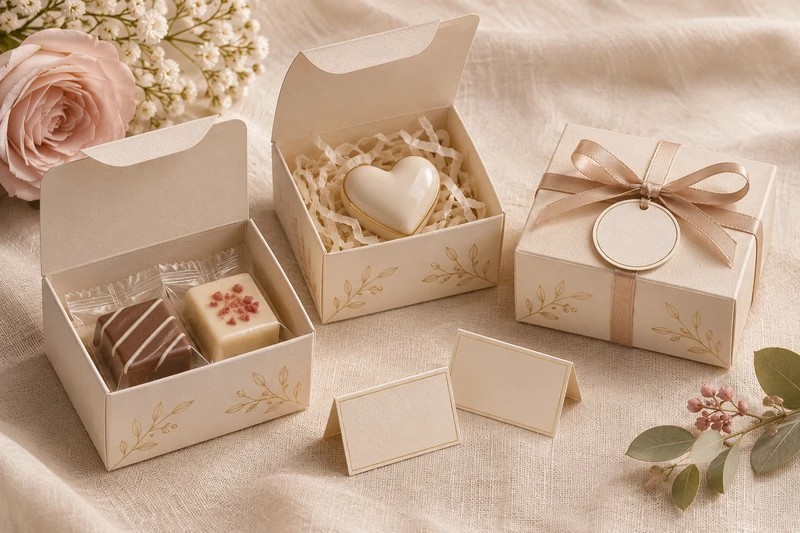
Wedding favour boxes should be designed around the actual item each guest receives, not simply around a preferred box shape. A small wrapped confection, scented keepsake, place-card gift or jewellery-style token each needs different internal space, closure security and presentation.
For couples, event planners and gifting buyers in Australia, the most effective wedding favour packaging also fits the table-setting plan and the venue handover process. It needs to look considered when placed at each setting, be straightforward to assemble in quantity and protect the favour during packing and transport to the event.
XGolden Print designs and produces custom paper packaging boxes, gift packaging, labels and stickers. We can support a wedding favour brief with structural design, material selection, artwork support, printing, finishing, fitted inserts and sample approval before production. As no confirmed miniature wedding-favour box SKU is available in the selected catalogue, a favour box should be developed through a custom packaging brief rather than adapting an unrelated box format.
Match each favour box to the actual guest gift
The right wedding favour box starts with the gift’s form, weight and presentation goal. A box for two wrapped truffles does not have the same requirements as one holding a small candle, tea tin, engraved keyring or delicate ornament.
Table favours are generally individual guest gifts placed at a table setting, grouped on a welcome table or handed out at the end of a celebration. They are different from wedding-dress storage boxes, which are intended for a garment, and from larger bridal-party gift boxes containing multiple items. Keeping these uses separate helps prevent an oversized, impractical or visually inconsistent packaging choice.
Consider the intended role of the favour box:
| Wedding favour use | Packaging requirement | Useful box or label approach |
|---|---|---|
| Individually wrapped sweets | Space for the quantity and wrapping without crushing | A close-fitting custom box with enough clearance for easy filling |
| Small keepsake or token | Protection from movement, rubbing or rattling | A tailored box with a fitted insert where appropriate |
| Tea, confectionery or mini gift set | Clear arrangement for several separate products | A box layout planned around each item and its opening sequence |
| Place-setting favour | Compact footprint and a visible guest name or event detail | Coordinated box artwork plus a personalised seal or sticker |
| Take-home favour for a larger event | Efficient packing and simple distribution | A format considered alongside assembly, packing and venue handover |
Before selecting a style, measure the finished favour exactly as it will be packed. Include its wrapping, lid, tag, ribbon, protective tissue or other presentation components. If the contents are supplied in different variants, such as assorted sweets or several keepsake designs, establish whether each version has the same outer dimensions.
Weight matters as well. A lightweight paper token may stay in position without internal support, while a denser item may shift during handling. An insert can create a defined location for a keepsake and improve the reveal when a guest opens the box. The need for an insert, and its suitable material and structure, should be confirmed against the individual project.
Wedding favour packaging is presentation packaging, not automatically a complete transport-protection solution. Outer cartons and packing methods should be planned separately for moving completed favours to the venue. Likewise, the favour box is not necessarily the primary container for food. Where confectionery is included, decide whether it will be sealed or wrapped before it enters the box. Food-contact suitability should never be assumed and must be confirmed for the chosen materials and construction.
Wrapped sweets and small keepsakes need different space
A well-sized wedding favour box presents a gift deliberately. Too much empty room can make one small item appear lost, while a tight fit can damage wrapping, mark a delicate item or slow down assembly.
For wrapped sweets
Start with the count of sweets per guest and the real dimensions of each wrapped piece. Consider whether the items will lie flat, stack, sit in rows or be placed inside a separate bag. The finished pack should be tested for practical filling: a design that looks neat in a mock-up may be awkward when a team is packing hundreds of favours.
Useful questions include:
- Will the sweets be individually wrapped before packing?
- Is a bag, tissue or divider needed to keep the contents tidy?
- Must guests be able to see the confectionery when they open the box?
- Will assorted items vary in thickness or shape?
- Does the box need a closure that remains secure until the event?
Avoid describing a paper favour box as suitable for direct food contact unless the relevant material and project requirements have been checked. Wrapped confectionery can simplify the packaging plan, but it does not remove the need to confirm all relevant requirements with the contents supplier and packaging provider.
For small keepsakes
Keepsakes often benefit from a more controlled presentation. A small charm, candle, miniature fragrance item, jewellery-style token or other memento may need a recess, platform or fitted insert to stop movement. The insert can also create a more polished opening experience by placing the item at the centre of the box.
The intended guest interaction should guide the structure. A lid-and-base box can make the reveal feel ceremonial, while a drawer format can suit a compact item that is pulled out from the table favour. A magnetic closure box may be appropriate for a more substantial gift, subject to the required dimensions, weight and project specification. Rigid boxes can also suit elevated gifting concepts, although they may not be necessary for every small favour.
For multi-item gifts, map the layout before artwork is finalised. A tea sachet paired with a small sweet, for example, needs each item to remain identifiable and easy to remove. It is better to define the arrangement at the start than to rely on loose contents falling into a workable display later.
Personal names, dates and finishing details
Personalisation turns wedding favour boxes into part of the event’s visual story. Names, a wedding date, a short message or a monogram can be printed on the box, applied as a separate label or used as a seal that closes the packaging.
The best method depends on whether every favour is identical or whether each guest receives an individual name. If the artwork is common across all boxes, printing the shared event details directly on the box may create a clean, integrated appearance. If guest names differ, a separate label, sticker or tag can make sorting and placement easier.
When preparing personalised artwork, decide early:
- Which information appears on every box?
- Which details change by guest, table or gift variant?
- Is the guest name intended as a place-card function?
- Where will variable details be checked before packing?
- Is the text readable at the box’s actual finished size?
- Does the design still work when viewed under venue lighting?
Finishes should support the intended mood rather than compete with a small format. An embossed detail, coloured print area or subtle seal can give a favour more presence without requiring excessive text. Fine decorative elements and very small type should be assessed on a sample, especially where names or dates must remain easy to read.
For an added closure detail, LS-330 embossed gift-seal labels provide an existing example of a gift-seal label style. They can be relevant when the aim is to secure tissue, close a favour box or add a decorative finishing point. Confirm the label dimensions, surface compatibility, application method and final project suitability before specifying them for a wedding favour.
Labels and stickers need a defined application surface. Specify whether the seal will sit on coated paper, uncoated paper, ribbon, a bag or another component. Also explain whether the label is applied by hand before the event, by a packing team or as part of another workflow. The requested roll or sheet format should be agreed in line with how the labels will be handled.
Choosing a box around the size of the favour
A custom wedding favour box should be built from the inside out. Record the contents first, then allow only the clearance needed for packing, presentation and removal. This approach avoids selecting a generic small box and trying to make an unsuitable gift fit.
Provide three dimensions for the packed item: length, width and height. If it is irregularly shaped, give its widest points and note any fragile or protruding parts. Include photographs or a physical reference where available, particularly for items with unusual shapes.
Also determine whether the box needs:
- A snug cavity or open internal space
- An insert, divider or platform
- Tissue, ribbon, a sleeve or a separate tag
- A visible opening direction or reveal sequence
- A closure tab, lid, drawer or seal
- Space for one favour only or multiple gift components
For a single sweet or small token, a compact folding carton may be appropriate depending on the contents and desired presentation. For a premium keepsake, a rigid, drawer or lid-and-base construction may better suit the opening experience. The appropriate choice is a structural and visual decision, not simply a matter of making the box look more expensive.
Explore custom box packaging when the favour requires new dimensions, a specific insert layout or a structure designed around the actual guest gift. XGolden Print can support structural design, material selection, artwork and finishing as part of this process. Material suitability, selected finishes, insert construction, order quantities, sampling terms, pricing and production schedules all need to be confirmed for the individual brief.
Gift seals and a consistent table presentation
Wedding favour boxes often do more than hold a small gift. Across a dining table, they contribute to the overall place setting. Consistent colours, typographic choices and closure details can link favours with menus, name cards, welcome gifts or other event packaging.
A coordinated presentation does not mean every item needs identical decoration. For instance, the box may carry a shared wedding mark while a seal identifies each guest, table or favour variation. This can be practical for events with dietary distinctions, assorted contents or seating changes, provided the identification system is simple enough for the packing team to manage.
When using labels or stickers, set rules for placement:
- Choose one repeatable position, such as the front panel, closure edge or top centre.
- Allow enough clear surface around the label for it to sit neatly.
- Confirm that names, dates or icons remain visible once the box is closed.
- Establish an application order: fill box, close box, apply seal, then sort by table.
- Keep different label variants clearly separated during assembly.
For event planners preparing a broader gifting programme, gift packaging options can help frame how box formats, coordinated branding and the intended opening experience work together. A wedding favour is small, but it should still feel connected to the event rather than like an afterthought.
Retail presentation may also be relevant where favours are sold as part of a wedding, celebration or confectionery collection before the event. In that case, the packaging may need space for product identification and other information determined by the seller. This is a separate consideration from an individual table favour, where the guest name and visual impact may take priority.
Trial assembly and packing for the event
A sample approval stage is valuable for wedding favour boxes because the practical work happens at scale and often close to an event date. A single assembled box can confirm the fit, look and opening feel, but the assembly workflow should also be reviewed before full production.
Trial the complete sequence using finished or representative contents:
- Fill the box with the exact wrapped sweet or keepsake.
- Add inserts, tissue, tags or ribbons in the intended order.
- Close the box and apply any seal or personalised label.
- Check that the box remains neat when lifted, stacked and moved.
- Confirm that the guest name or event message is visible at the intended table position.
- Pack several completed favours into the planned outer carton or event container.
- Record how they will be sorted, counted and handed over at the venue.
This trial can uncover common issues: a ribbon that slows packing, a label that is difficult to align, a box that is hard to close once filled, or different gift variants that need slightly different dimensions. It also helps determine whether the venue needs boxes grouped by table, alphabetically by guest name or by another distribution method.
Keep venue handover separate from the favour-box design itself. The guest-facing box creates the gift experience; outer packing is responsible for organising completed favours for transport and delivery to the event location. Tell the packaging team how many favours go to each table, whether they will be assembled centrally or on site, and who will unpack them. This gives the project a more realistic packing plan without treating the favour box as a transport carton.
A clear brief reduces late changes. For a custom wedding favour box project, prepare:
- A description and dimensions of each favour item
- The number of guests and any product or name variations
- Whether contents are wrapped, bagged or require an insert
- Preferred box structure and opening experience, if known
- Artwork files, copy, names and date details
- Proposed labels, seals, ribbons or other finishing components
- Assembly responsibility and venue handover method
- Required delivery date and destination
XGolden Print has 27 years of experience and can support the design-to-production process for custom paper packaging, including samples before production. To discuss wedding favour boxes, share the favour dimensions, quantity, artwork, required delivery date and destination with XGolden Print, along with details of any personalised labels, inserts or packing requirements.
